Key takeaways
- Check the flooring warranty and the steam-mop manual first.
- Test in a hidden area for several minutes.
- Use the lowest effective steam setting.
- Keep the mop moving instead of leaving it parked on one spot.
- Do not steam damaged seams, loose planks, or exposed wood.
- Allow the floor to dry before replacing rugs or furniture.
The best steam mops for most homes are the Bissell PowerFresh 1940 for balanced everyday cleaning, the Shark Steam Pocket Mop for a light, maneuverable option, and the Kärcher SC 3 EasyFix when a larger tank and faster refilling matter more than a slim mop design.
Our top picks


As an Amazon Associate we earn from qualifying purchases at no extra cost to you. Ratings are shown as listed on Amazon.
Best steam mops at a glance
| Model | Heat-up time | Water capacity | Cord length | Approx. weight | Best for |
|---|---|---|---|---|---|
| Bissell PowerFresh 1940 | About 30 seconds | 12.5 fl oz / 370 ml | 23 ft / 7 m | 6.2 lb / 2.8 kg | Most homes and regular hard-floor cleaning |
| Shark Steam Pocket Mop S3501 | About 30 seconds | 15 fl oz / 450 ml | 25 ft / 7.6 m | About 4.9 lb / 2.2 kg | Low-cost, lightweight cleaning |
| Kärcher SC 3 EasyFix | About 30 seconds | 1 L / 33.8 fl oz | 13 ft / 4 m | About 5.7 lb / 2.6 kg before accessories | Large areas and fewer interruptions |
| PurSteam 10-in-1 Steam Mop | About 30 seconds | 11.5 fl oz / 340 ml | About 16 ft / 4.9 m | About 5 lb / 2.3 kg | Small spaces and occasional use |
Specifications can vary by regional version, production revision, and included accessories, so check the label or manufacturer’s current manual before buying. The comparison shows the practical trade-off: conventional steam mops are lighter and easier to store, while a canister-style machine such as the SC 3 EasyFix carries substantially more water and usually includes more attachments.
Our picks by cleaning situation
Best overall: Bissell PowerFresh 1940
The PowerFresh 1940 is the most balanced choice for sealed tile, ceramic, stone, and suitable sealed wood floors. Its roughly 30-second warm-up keeps preparation short, while the 23-foot cord reduces outlet changes in a typical kitchen or hallway. The tank is not large, but 370 ml is enough for many routine cleaning sessions if you vacuum first and use controlled passes.
Its washable microfiber pads are a useful ownership advantage. The included pad types are designed for different levels of soil, and the mop commonly includes a carpet glider for refreshing rugs rather than deep-cleaning them. The swivel head is adequate around chair legs and cabinets, although it is not as agile as a very lightweight pocket mop.
Best lightweight option: Shark Steam Pocket Mop S3501
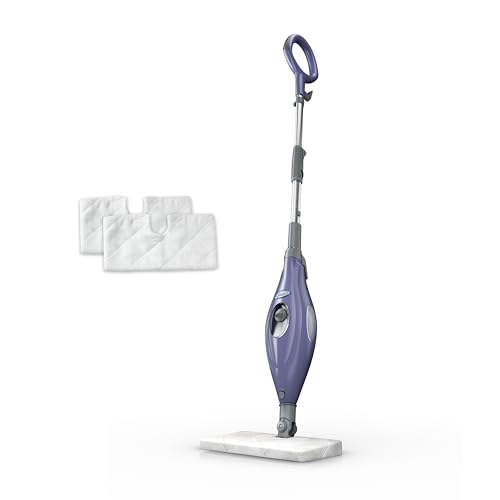
The Shark S3501 suits apartments, quick kitchen cleanups, and anyone who dislikes pushing a heavy appliance. Its light body and approximately 25-foot cord make it easy to move between rooms. The tank is slightly larger than the PowerFresh’s, but the mop still favors short or medium cleaning sessions rather than whole-house deep cleaning.
The washable pocket pads attach around the mop head and can be flipped during a session. That gives you a cleaner contact surface without stopping to replace the pad. The trade-off is that pocket pads must be removed and washed after use; leaving a damp pad attached can create odors and shorten its useful life.
Best for large floors: Kärcher SC 3 EasyFix
The SC 3 EasyFix is a canister steam cleaner with a floor head, not a simple upright steam mop. Its approximately one-liter tank is the key advantage: it can cover substantially more floor before refilling. Kärcher also uses a continuous-fill design, allowing water to be added while the machine is in use after following the safety instructions.
This model is more versatile for grout lines, shower areas, and other hard surfaces because it accepts detail tools. However, the separate canister and shorter cord require more planning. It is a better fit for a larger home or frequent deep cleaning than for someone who wants a mop that stores beside a broom.
Best for occasional use: PurSteam 10-in-1 Steam Mop
The PurSteam 10-in-1 is aimed at buyers who want a compact steam mop with handheld accessories without moving up to a larger canister machine. Its roughly 340 ml tank and short warm-up are suitable for small areas, but its cord and capacity are less convenient for cleaning several large rooms in one session.
It can be attractive when storage space and purchase cost are the main concerns. Before choosing it, confirm that replacement pads and accessory parts are readily available in your region. A low initial price is less useful if a worn pad or missing attachment requires replacing the whole unit.
What matters more than the headline steam temperature
Heat-up time and steam control
A 30-second heat-up is now common among household steam mops, but the useful question is how quickly the mop recovers after a refill or pause. A variable steam setting is valuable on sealed wood and laminate because maximum steam is not automatically better. More moisture can seep into joints, damage finishes, or leave the floor wet.
Water-tank capacity
Capacity affects interruptions rather than cleaning power. As a planning estimate, a compact upright may use roughly 200–350 ml during a moderate 20–30 minute session, depending on steam intensity and how often you pause. A 370 ml tank may therefore be enough for one floor-cleaning pass, while a one-liter canister is more suitable for multiple rooms.
Do not fill beyond the marked line. If your tap water is hard, mineral scale can clog the heating system. Use only the water type specified by the manufacturer; adding detergent, fragrance, vinegar, or essential oils can damage seals and create residue.
Cord length and maneuverability
A long cord is particularly useful because steam mops should not normally be used with an extension cord unless the manual specifically permits it. A 23–25-foot cord can cover a kitchen and adjacent hallway from one outlet. A canister’s shorter cord may be offset by a longer hose, but it takes more effort to pull the body around furniture.
Look for a swivel joint, a low-profile head, an easy-to-press handle, and a parking position that keeps the hot pad away from flooring and skin. A wide head covers rooms faster but can become awkward around toilet bases, table legs, and narrow gaps.
Safe flooring compatibility
Steam mops are generally intended for heat-resistant, sealed hard flooring. They are usually appropriate for ceramic and porcelain tile, sealed stone, and some sealed vinyl or linoleum when the flooring manufacturer permits steam. Grout may tolerate steam, but repeated high heat can weaken deteriorated grout or drive moisture into cracks.
Use extra caution with laminate, engineered wood, solid hardwood, bamboo, cork, unsealed stone, waxed floors, and floors with lifting seams. Some manufacturers prohibit steam on these surfaces even when the floor appears waterproof. Steam can enter joints and edges, soften adhesives, cloud finishes, or cause swelling.
- Check the flooring warranty and the steam-mop manual first.
- Test in a hidden area for several minutes.
- Use the lowest effective steam setting.
- Keep the mop moving instead of leaving it parked on one spot.
- Do not steam damaged seams, loose planks, or exposed wood.
- Allow the floor to dry before replacing rugs or furniture.
A practical buying decision matrix
| Your situation | Choose | Why |
|---|---|---|
| First steam mop, regular kitchen cleaning | Bissell PowerFresh 1940 | Balanced weight, cord reach, pad system, and simple controls |
| Small apartment or limited storage | Shark S3501 | Light body and long cord are easy to store and carry |
| Several large tiled rooms every week | Kärcher SC 3 EasyFix | One-liter tank and continuous-fill design reduce refill pauses |
| Occasional use with accessory cleaning | PurSteam 10-in-1 | Compact format with handheld tools |
| Unsealed wood or questionable laminate | Do not choose by brand alone | Confirm flooring approval; a microfiber mop may be safer |
How to get better results and longer pad life
- Vacuum or sweep first. Steam softens stuck-on soil, but loose grit can scratch a floor when dragged under a damp pad.
- Fill with the approved water. Avoid chemicals unless the manufacturer explicitly lists them as compatible.
- Start with the lowest setting. Increase steam only when the floor remains suitable and the pad is not leaving excess moisture.
- Use slow, continuous passes. A moving mop cleans more safely than a stationary hot head.
- Change or flip the pad when it becomes dirty. A saturated pad spreads soil instead of collecting it.
- Empty the tank after cooling. Store the unit dry, wash pads according to their instructions, and inspect the head for trapped grit.
Durability and ownership costs
The first parts to wear are usually microfiber pads, elastic pad edges, plastic clips, and the floor-head joint—not the heating element. Keeping several washable pads lets one dry fully between uses and reduces the temptation to clean with a dirty pad. Reusable pads may last many dozens of washes, but fabric thinning, persistent odor, or reduced absorbency means replacement is due.
For example, if a pack of replacement pads costs $15–$30 and provides four pads, the pad cost is roughly $3.75–$7.50 per pad. Washing them after every use usually costs less than relying on disposable cleaning sheets, but only if replacement pads remain available. A modestly more expensive mop with readily available pads can be cheaper over several years than a bargain model with proprietary, difficult-to-find accessories.
Bottom line
Choose the Bissell PowerFresh 1940 for the best all-round balance, the Shark Steam Pocket Mop S3501 for lightweight convenience, and the Kärcher SC 3 EasyFix for large areas and frequent multi-surface work. Whichever model you buy, flooring approval, controlled moisture, washable-pad availability, and easy maintenance matter more than the highest advertised steam output.