Our Top Picks


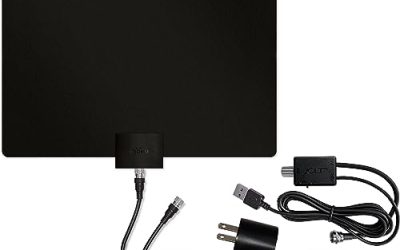
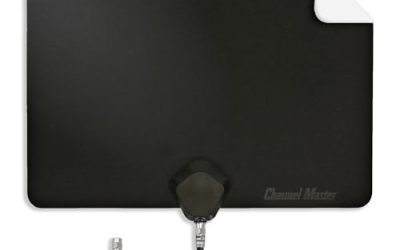
The best amplified TV antennas for most homes are the Mohu Gateway Plus for mixed indoor and attic placement, the Antop AT-500SBS HD Smart Bar when you want an adjustable amplifier, and the Antennas Direct ClearStream Eclipse when you want a thin window panel with a detachable cable. If you live within about 25 miles of your towers, you probably do not need an amplifier at all, and a passive antenna is the safer choice. The amplifier only helps when your signal is weak because of distance, trees, or a long cable run, and it can hurt when your signal is already strong.
This guide explains when an amplifier helps, how to size one to your location, and which current models deserve a look. Every model below is a real, currently sold antenna. Where a spec could not be confirmed from a manufacturer-level source, it is described by class instead of by number.
What an amplifier actually does
An amplified antenna is a passive antenna with a small powered preamplifier built into the antenna or placed in the coax line. The amplifier boosts everything it receives: the TV signal, the noise that arrived with it, and any strong out-of-band signal such as cellular. It does not add range that the antenna element could not receive in the first place. What it does is make up for losses after the antenna, mostly coax cable loss and splitter loss, so the tuner in your TV sees a usable level.
That means an amplifier solves three specific problems and no others:
- Long cable runs. Coax attenuates signal, and loss rises with frequency and length. A 50-foot run from an attic antenna to a living room TV can eat a meaningful part of a weak signal.
- Splitting to several TVs. A two-way splitter costs roughly 3.5 dB, a four-way roughly 7 dB. Splitting is the most common reason a house with a good antenna has a bad picture on the third TV.
- Marginal signal at the tuner. Stations 30 to 60 miles away on a clear path may land just under the threshold where the picture drops out. A well-placed low-noise amplifier can lift them over it.
What it cannot fix is multipath, a blocked path to the tower, or a tower on the wrong side of a hill. If the antenna element never sees the station, amplification only makes the noise louder.
How we chose
This is a research-based guide. We compared manufacturer specification sheets with the published reception comparisons from independent consumer publications, and weighted results that report channel counts from a fixed location over claims printed on the box. We favored antennas that meet the criteria below, and we flagged any where the maker’s range number looks optimistic next to independent results.
- Amplifier design: adjustable gain, a bypass or switch, or a low-noise unit placed close to the antenna.
- Band coverage: UHF for most stations plus VHF-high for channels 7 to 13, which many cities still use.
- Filtering: a 4G/5G LTE filter, because cellular signals sit close to the broadcast band and can overload an amplifier.
- Placement flexibility: window, wall, attic, or outdoor mounting.
- Cable quality: detachable, shielded coax rather than a fixed thin lead.
- NextGen TV (ATSC 3.0) compatibility with the antenna itself, since the antenna just passes radio frequencies and the TV or tuner box does the decoding.
Quick comparison
| Model | Mounting | Advertised range class | Amplifier | Best placement |
|---|---|---|---|---|
| Mohu Gateway Plus | Indoor, attic, outdoor | About 60 miles | Yes | Mid-distance, mixed terrain |
| Mohu Curve | Indoor | Mid-range class | Amplified model | Shelf or wall, decor-friendly |
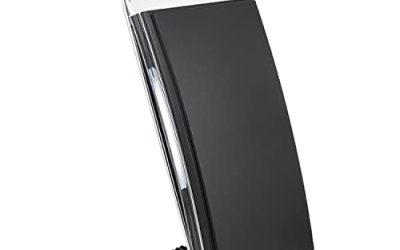
| Antop AT-500SBS HD Smart Bar | Indoor | Up to 80 miles claimed | Yes, adjustable gain dial | Window, weak-signal rooms |
| Antop AT-800SBS Smart Bar | Indoor or outdoor | Long-range class | Yes | Attic or mast |
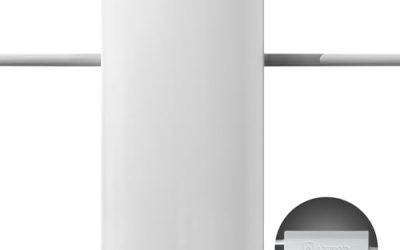
| Antennas Direct ClearStream Eclipse (amplified) | Indoor, reversible panel | Mid-range class | Amplified version | Window or wall, short cable |
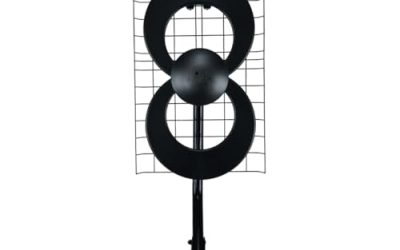
| Antennas Direct ClearStream 2MAX | Indoor or outdoor | About 60 miles | Amplified version available | Attic, mast, fringe areas |
| Winegard FlatWave Amplified FL5500A | Indoor flat panel | Mid-range class | Yes | Strong-signal urban rooms |
Treat range numbers as ceilings measured over open, flat ground with a tall tower. They describe the manufacturer’s best case, not what happens behind a brick wall.
Pick the right class before you pick a model
Use your distance to the nearest cluster of transmitters and the terrain between you and them. A reception map from the FCC or a station-lookup site such as RabbitEars gives distance, compass bearing, and whether each channel is VHF or UHF. Then use the thresholds below.
Under 20 miles to the towers
Skip amplification, or use an antenna with a bypass switch. Strong local signals can overload a preamp, causing pixelation that looks like weak reception but is actually too much signal. A flat passive panel or a basic amplified model with the amplifier turned off is the right starting point.
20 to 40 miles, moderate obstruction
This is where amplified indoor antennas earn their price. Choose an adjustable or switchable amplifier so you can find the sweet spot during a channel scan. A window placement on the side facing the towers matters more than the model.
40 to 60 miles, or heavy tree cover
Move the antenna to the attic or outdoors. An outdoor-capable amplified antenna such as the Mohu Gateway Plus, Antop AT-800SBS, or ClearStream 2MAX, with the amplifier mounted at the antenna instead of at the TV, makes the biggest difference. A preamp at the antenna cancels the cable loss before it happens. An amplifier at the TV only boosts what is left.
Over 60 miles
Indoor antennas rarely work reliably. Use an outdoor directional antenna on a mast at 20 feet or higher, with a distribution amplifier only if you split to several TVs.
Worked example: does an amplifier help your setup?
Use a simple signal budget. Suppose the antenna delivers a signal at the cable’s near end that is just 3 dB above the level your TV needs. That is a thin margin. Now add the losses between the antenna and the tuner.
- Cable: 50 feet of RG6 at UHF loses roughly 3 dB. Budget now at 0 dB, the edge of dropouts.
- Splitter: a two-way splitter to a second TV loses roughly 3.5 dB. Budget now about -3.5 dB, so both TVs lose stations.
- Add a preamp at the antenna with roughly 15 dB of gain. The gain applies before the cable and splitter losses, so the budget becomes about +11.5 dB, assuming the preamp does not add noise that swamps the weakest stations.
- Now consider a strong signal case: the antenna delivers 30 dB above the required level. The same preamp pushes it to 45 dB, which can overload the tuner. Turn the amplifier off or use an attenuator.
The takeaway is the rule of thumb: amplify when the budget goes negative, and never when the budget is already more than about 20 dB positive. These figures are illustrative round numbers, not a measurement of your home. Cable loss per 100 feet depends on cable type, and amplifier gain differs by model.
The best amplified TV antennas
1. Mohu Gateway Plus
Spec line: Amplified · indoor, attic, or outdoor placement · about 60-mile advertised range · VHF and UHF · coax lead with powered inline amplifier.
Best for: Homes 25 to 50 miles from the towers that want one antenna that can start at a window and move to an attic later.
Skip if: You live close to the towers, because independent reviewers have noted the amplifier can degrade strong signals, so turn it off or use a passive model.
- Pro: Flexible placement means one purchase covers several scenarios.
- Pro: Consistent channel counts in several independent comparisons.
- Con: The inline amplifier is another box to power and hide.
- Con: Not a replacement for a roof antenna in the fringe.
2. Antop AT-500SBS HD Smart Bar
Spec line: Amplified · adjustable gain dial · 4G LTE filter · advertised range up to 80 miles · indoor bar design · UHF and VHF.
Best for: Weak-signal rooms where you want to tune the gain instead of accepting a fixed amplifier. The adjustable dial helps in the 20 to 50 mile band.
Skip if: You need an antenna that blends with a wall, since the bar shape is more visible than a thin panel, and the 80-mile number is optimistic.
- Pro: The gain dial lets you back off when a strong signal causes pixelation.
- Pro: Cellular filtering reduces interference near towers.
- Con: Larger footprint than a flat panel.
- Con: The advertised range should be read as a best case.
3. Antennas Direct ClearStream Eclipse (amplified)
Spec line: Thin reversible panel · detachable cable · amplified version available · indoor use · paintable surface · UHF and VHF-high.
Best for: Windows and walls in town houses and apartments where aesthetics matter and the signal is moderate.
Skip if: You are in a fringe area. Independent comparisons found the unamplified Eclipse matched larger bar designs in decent signal, but a flat panel has limited gain.
- Pro: Detachable cable lets you swap in a longer or better-shielded run.
- Pro: Low-profile and reversible so you can match a wall color.
- Con: The amplifier adds nothing if the panel itself cannot see the station.
- Con: Compact element limits VHF performance versus larger antennas.
4. Antop AT-800SBS Smart Bar
Spec line: Amplified smart bar · indoor or outdoor mounting · bracket mounting hardware · long-range class · weather-resistant housing for outdoor use.
Best for: Attic or mast mounting at moderate to long distance when you want amplification at the antenna and do not want a large rooftop yagi.
Skip if: You want a no-tools setup. Outdoor placement means coax routing and a grounded installation.
- Pro: Handles both indoor and outdoor placement.
- Pro: Amplifier sits at the antenna end of the run.
- Con: Installation takes time.
- Con: Heavier and more visible than panel antennas.
As an Amazon Associate we earn from qualifying purchases at no extra cost to you.

5. Antennas Direct ClearStream 2MAX
Spec line: Indoor/outdoor · about 60-mile advertised range · UHF and VHF-high · amplified version available · directional pattern · mast mounting hardware.
Best for: Rural and fringe homes with stations in a single compass direction, where a directional pattern adds gain without adding noise from the sides.
Skip if: Your stations come from several directions, or you do not want to aim an antenna.
- Pro: Directional gain beats an omnidirectional panel at distance.
- Pro: Mast mount lets you raise it above trees.
- Con: You must aim it and rescan after any change.
- Con: Needs an outdoor-safe installation.
6. Mohu Curve
Spec line: Amplified model · curved indoor design · stands on a shelf or mounts on a wall · UHF and VHF · NextGen TV channels received in independent reception comparisons.
Best for: A shelf or entertainment-center placement where the antenna is visible and should look like decor.
Skip if: You need a long-range option. Its design is meant for moderate-distance reception.
- Pro: Attractive form factor.
- Pro: Stable channel counts for its size in independent comparisons.
- Con: Price is higher than a basic panel.
- Con: Not meant for an attic or mast.
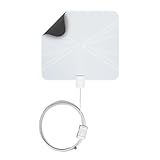
7. Winegard FlatWave Amplified FL5500A
Spec line: Amplified flat panel · indoor · UHF and VHF · detachable cable · thin and paper-like.
Best for: Strong-signal urban rooms where the antenna just needs to be unobtrusive.
Skip if: You want NextGen TV channels or reliable VHF reception. Independent comparisons found it delivered fewer VHF channels and no NextGen TV channels in one fixed location, so do not buy it for a fringe location.
- Pro: Almost invisible on a wall or window.
- Pro: Easy installation.
- Con: Mixed results in independent reception comparisons.
- Con: Not for weak-signal homes.
Fit and decision matrix
| Your situation | Choose | Why |
|---|---|---|
| Apartment, towers under 20 miles, concrete walls | Antennas Direct ClearStream Eclipse or Winegard FlatWave, amplifier off at first | Strong signal, so placement and multipath matter more than gain |
| House, 20 to 40 miles, some trees | Antop AT-500SBS or Mohu Gateway Plus | Adjustable or switchable amplification and a flexible location |
| House, 40 to 60 miles, one compass direction | Antennas Direct ClearStream 2MAX or Antop AT-800SBS on a mast | Directional gain and a preamp at the antenna |
| Several TVs on one antenna | An outdoor-capable amplified model plus a distribution amplifier | Offsets splitter loss |
| Want a decorative shelf antenna | Mohu Curve | Form factor first, moderate distance |
Setup steps that matter more than the model
- Look up your towers. Note distance, bearing, and whether each channel is VHF or UHF.
- Place high and near a window. Each foot of height helps, and glass is better than brick or metal siding.
- Keep the cable short. Use the shortest run that reaches the TV, with good RG6 if you replace it.
- Power the amplifier correctly. Use the supplied power inserter and place it on the TV side of the cable, not at the antenna, unless the instructions say otherwise.
- Scan, then adjust, then rescan. A rescan is needed after each move because the TV only remembers channels found during the last scan.
- Test with the amplifier off. If you see more channels without it, you are overloading the tuner.
Outdoor or attic installs have safety needs. Keep any mast and antenna well clear of overhead power lines, use a grounding block and ground wire per local electrical code, and do not install on a roof in wet or windy weather.
More amplified antennas worth comparing
The seven models above cover the common indoor and attic cases. The eight below fill the gaps: dedicated outdoor and attic amplified antennas for fringe homes, a signal-meter panel, and low-cost options for strong-signal rooms. Specs come from the product listings; where a figure is a maker claim, treat it as a best-case number.
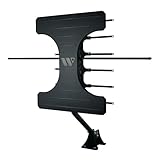
8. Winegard Elite WE7550A
Spec line: Amplified directional · outdoor or attic mounting · 70+ mile advertised range · VHF and UHF · built-in dual-stage amplifier.
Best for: Homes 40 to 60 miles from the towers with most stations in one compass direction, where the amplifier should sit at the antenna instead of at the TV. A common pick in outdoor roundups for stubborn fringe locations.
Skip if: Your stations are spread around the compass, or you cannot mount and ground an outdoor antenna.
- Pro: Preamp at the antenna removes cable loss before it starts.
- Pro: Directional gain reaches well beyond indoor panels.
- Con: Needs a mast or attic bracket and careful aiming.
- Con: Mid-range to premium cost class.
9. Winegard FlatWave Amped Pro TH-3000
Spec line: Amplified flat indoor panel · multidirectional · 60-mile advertised range · built-in signal meter · ultra-thin design.
Best for: Window or wall placement where you want on-screen help finding the best spot instead of repeated channel scans.
Skip if: You live in a weak-signal area. A thin panel still has limited element gain, and the range figure is a best case.
- Pro: The signal meter shortens placement trials.
- Pro: Nearly flat, easy to hide against glass.
- Con: Costs more than the basic FlatWave.
- Con: Not a fringe-area tool.
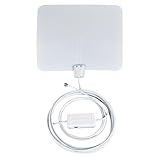
10. Mohu Leaf Ultimate
Spec line: Amplified paper-thin indoor panel · UHF and VHF · multidirectional · listed for 4K and NextGen TV signals.
Best for: Renters and apartment dwellers within roughly 25 to 40 miles of the towers who want a thin, removable antenna with an amplifier.
Skip if: Your towers are far away or behind hills, where an attic or outdoor model is the better choice. Turn the amplifier off if you live very close to the towers.
- Pro: Low profile and simple to stick to a window.
- Pro: Covers both UHF and VHF.
- Con: Limited reach for an indoor panel.
- Con: Mid-range cost class for a thin panel.

11. Televes Ellipse Mix 148883
Spec line: Amplified · high VHF and UHF · built-in TForce preamp with automatic gain control · outdoor or attic use.
Best for: Suburban and rural homes that want an amplifier with automatic gain control, which reduces the overload risk when strong and weak stations arrive together.
Skip if: You want a no-tools setup, or you only need a window antenna.
- Pro: Automatic gain control protects the tuner from strong local signals.
- Pro: Preamp sits at the antenna.
- Con: Premium cost class.
- Con: Outdoor installation and grounding required.

12. Televes DAT BOSS Mix LR 149884
Spec line: Long-range directional · high VHF and UHF · built-in TForce amplifier · FM and LTE filtering listed · roof or mast mounting.
Best for: Fringe locations beyond 50 miles, and cities with heavy cellular traffic where the LTE filter matters.
Skip if: The towers are close. This is a large antenna aimed at distance, and its amplifier is overkill for strong signals.
- Pro: Long-range design with a filtered amplifier.
- Pro: Handles both high VHF and UHF channels.
- Con: Premium cost class and a large footprint.
- Con: Aiming and rescanning are required.

13. Winegard Elite 360 Pro HA-2000
Spec line: Amplified omnidirectional outdoor antenna · 55-mile advertised range · VHF and UHF · built-in smart signal features.
Best for: Homes whose stations come from several directions, so nothing needs aiming. It suits an attic or a short mast.
Skip if: All your stations sit in one direction at long range. A directional antenna beats an omni at distance.
- Pro: No aiming after installation.
- Pro: Preamp at the antenna.
- Con: Less gain than a directional model.
- Con: Mid-range to premium cost class.

14. Channel Master FLATenna with Booster
Spec line: Thin indoor panel · adjustable signal amplifier · local-channel antenna for smart TVs.
Best for: Apartments where the booster should be adjustable, so you can raise or lower gain depending on how strong the nearby signals are.
Skip if: You need range beyond a moderate distance, or reliable VHF reception in a weak-signal home.
- Pro: Adjustable boost lets you back off near towers.
- Pro: Flat and unobtrusive.
- Con: Compact element limits fringe performance.
- Con: Entry-level to mid-range cost class.

15. Philips Hover Amplified
Spec line: Amplified indoor antenna · sits on top of the TV · supports 4K and 1080p signals.
Best for: Strong-signal rooms and bedrooms where you want a very low-cost antenna with no wall mounting.
Skip if: You are more than about 25 miles from the towers or have walls between the TV and the signal.
- Pro: Entry-level cost class and quick setup.
- Pro: No drilling or window placement needed.
- Con: Placement on top of the TV is rarely the best reception spot.
- Con: Range is a best-case figure.

All 15 amplified antennas compared
| Model | Mount | Pattern | Best distance class | Cost class |
|---|---|---|---|---|
| Mohu Gateway Plus | Indoor, attic, outdoor | Multidirectional | 25 to 50 miles | Mid-range |
| Antop AT-500SBS | Indoor | Bar, adjustable gain | 20 to 50 miles | Mid-range |
| ClearStream Eclipse | Indoor window or wall | Directional panel | Under 35 miles | Mid-range |
| Antop AT-800SBS | Indoor or outdoor | Smart bar or panel | 35 to 60 miles | Mid-range to premium |
| ClearStream 2MAX | Indoor or outdoor | Directional | 40 to 60 miles | Mid-range |
| Mohu Curve | Indoor shelf or wall | Multidirectional | Under 35 miles | Mid-range |
| Winegard FlatWave FL5500A | Indoor | Multidirectional | Under 30 miles | Mid-range |
| Winegard Elite WE7550A | Attic or outdoor | Directional | 40 to 70 miles | Premium |
| Winegard FlatWave Amped Pro | Indoor | Multidirectional | Under 40 miles | Mid-range |
| Mohu Leaf Ultimate | Indoor | Multidirectional | Under 40 miles | Mid-range |
| Televes Ellipse Mix | Attic or outdoor | Directional | 30 to 60 miles | Premium |
| Televes DAT BOSS Mix LR | Roof or mast | Directional, long range | 50 miles and up | Premium |
| Winegard Elite 360 Pro | Attic or short mast | Omnidirectional | 25 to 50 miles | Premium |
| Channel Master FLATenna with Booster | Indoor | Multidirectional | Under 30 miles | Entry-level to mid-range |
| Philips Hover Amplified | Indoor, on the TV | Multidirectional | Under 25 miles | Entry-level |
Distance classes are planning guides based on typical indoor and outdoor results, not guarantees. Terrain, trees, and building materials move every number.
Quick thresholds for choosing among all 15
- Under 20 miles with a clear path: pick a thin panel such as the Philips Hover, FLATenna with Booster, or FlatWave, and start with the amplifier off.
- 20 to 40 miles through walls or trees: pick an adjustable-gain model such as the Antop AT-500SBS, FlatWave Amped Pro, or Mohu Leaf Ultimate, and place it at a window facing the towers.
- 40 to 60 miles: move outdoors or to the attic with the Elite WE7550A, Antop AT-800SBS, ClearStream 2MAX, or Televes Ellipse Mix, and mount the amplifier at the antenna.
- Beyond 60 miles or in a cellular-heavy city: use the Televes DAT BOSS Mix LR on a mast 20 feet or higher, and keep the LTE filter in line.
- Stations in several directions and you do not want to aim: pick the Winegard Elite 360 Pro or Mohu Gateway Plus.
- Splitting to three or more TVs: budget about 3.5 dB for each two-way split and put the amplifier at the antenna, not behind the splitter.
FAQ
Do amplified TV antennas work better than regular ones?
Only in specific cases: long cable runs, signal splitting, or marginal signals. Near towers an amplifier can cause overload, and a passive antenna usually works better. The antenna element and its placement matter most.
How far can an amplified antenna pick up TV stations?
Advertised ranges of 50 to 80 miles describe ideal open terrain. In real homes with trees and walls, expect much less, often 25 to 45 miles indoors, and use an outdoor antenna past that.
Does a TV antenna amplifier need to be powered?
Yes. Most amplifiers are powered through a USB cable or an inline power inserter that sends low-voltage DC through the coax. If the power supply fails, the signal can drop below what a passive antenna would deliver.
Why do I get pixelation with an amplified antenna?
Pixelation can mean too little signal or too much. If channels improve when you turn the amplifier off or switch to bypass, the amplifier is overloading your TV tuner, usually because you are near a strong tower.
Can I use one amplified antenna for several TVs?
Yes, but each split loses signal, roughly 3.5 dB per two-way split. Use a preamp at the antenna or a distribution amplifier after it, and keep each leg short.
Do I need a special antenna for NextGen TV (ATSC 3.0)?
No special antenna is required. NextGen TV broadcasts use the same UHF and VHF bands, so any good antenna can receive them. You need a TV or a tuner box with an ATSC 3.0 tuner, and NextGen stations often sit on UHF.
Does a 4G LTE filter matter?
It can. Cellular signals near the top of the UHF band can leak into an amplifier and degrade reception. A filter is useful in cities with dense cellular coverage, and it is a good feature on any amplified antenna.
Should I buy an indoor or outdoor antenna?
Choose indoors if your towers are under about 30 miles away with a clear path. Go outdoors or into an attic if they are farther or the path is obstructed, because height and clear line of sight outweigh any amplifier.
More from Amazon
Programs that pair well with the guide above. Offers and eligibility are set by Amazon and may change.
Free shipping on eligible items, Prime Video and more. Eligible new members can start with a free trial.
Start a Prime free trialAd-free music streaming. Eligible new subscribers can start with a free trial.
Try Music Unlimited freeA Prime membership for ages 18-24 with a trial period. Eligibility is set by Amazon.
See Prime for Young AdultsAudiobooks and podcasts to listen to on the go. Eligible new members can start with a free trial.
Try Audible freeAs an Amazon Associate we earn from qualifying purchases.