Our Top Picks

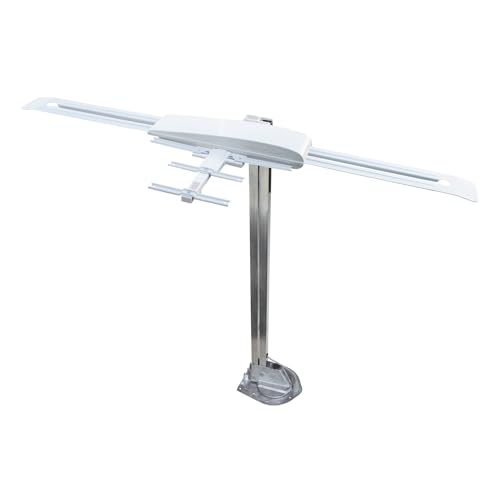
The best RV TV antennas for most campers are the Winegard Air 360+ for park-and-watch simplicity, the Winegard Sensar IV with the Wingman UHF booster for the strongest reception when you do not mind aiming, and the KING OA8500 for owners who want a directional antenna with a built-in signal meter. The right choice depends on how you camp: an omnidirectional dome suits short stays and crowded campgrounds, while a directional batwing or high-gain head suits long stays at the edge of broadcast range.
RV over-the-air antennas are not like house antennas. They have to survive wind, vibration, low bridges, and years of sun on a roof, they run on 12-volt power, and they have to work at whatever random spot you park. This guide covers the main antenna types, how to match one to your travel style, and the current models worth shortlisting. Every model below is a real, currently sold product, and specs that could not be confirmed are described by class.
How we chose
This is a research-based guide. We compared manufacturer specification pages with published reviews from RV-focused and consumer publications, and weighted the criteria that matter to someone parked in a campground instead of in a suburban living room. We looked at:
- Pattern: omnidirectional (no aiming) versus directional (aim for gain).
- Band coverage: UHF for most stations, VHF-high for channels 7 to 13, and FM where included.
- Amplification: a built-in or inline amplifier powered through the coax, ideally with a way to switch it off near strong towers.
- Mounting: whether it works as a roof-mount head, a replacement for an existing crank-up antenna, or an add-on to what you already have.
- Durability: weather-sealed housings, UV-resistant materials, and the wind-load profile at highway speed.
- Extras: signal meters, preinstalled Wi-Fi or cellular antennas, and satellite ports.
The three RV antenna types
Omnidirectional domes
A low-profile dome gathers signal from every direction, so there is no aiming and no crank mast. You park, run a channel scan, and watch. The trade-off is lower gain: a dome cannot concentrate its reception toward one tower, so it struggles in weak-signal areas. These are the right choice for weekend camping near towns.
Directional batwings and high-gain heads
A directional antenna has higher gain toward one direction. You aim it at the towers, and it ignores noise from the sides. Winegard batwing designs and KING high-gain heads sit here. They reach farther than domes but need a crank or a manual rotation, and you may have to re-aim at every campsite.
Boosters and add-ons
If you already have a batwing, a UHF booster such as the Winegard Wingman can improve UHF reception without replacing the whole antenna. These are the cheapest upgrades, but they depend on what you already own.
Quick comparison
| Model | Type | Advertised range class | Bands | Aiming | Amplified |
|---|---|---|---|---|---|
| Winegard Air 360 (AR-360B) and Air 360+ | Omnidirectional dome | Up to 55 miles | VHF, UHF, FM | None | Yes |
| Winegard Sensar IV with Wingman | Directional batwing with UHF booster | About 55 miles | VHF and UHF | Required | Yes |
| KING OA8500 | Directional, built-in signal meter | Up to 65 miles | FM, VHF, UHF | Required | Yes |
| KING OA8300 | Directional replacement head | Up to 65 miles | VHF, UHF | Required | Yes |
| Winegard RVW-395 | Dome-style roof-mount | Up to 55 miles | VHF, UHF | Reposition for best result | Passive |
| Winegard Rayzar RZ-8500 | Automatic motorized | Class-leading automatic type | VHF, UHF | Automatic | Yes |
| Winegard RV-WING | UHF booster add-on | Up to 55 miles | UHF | Follows host antenna | Non-amplified |
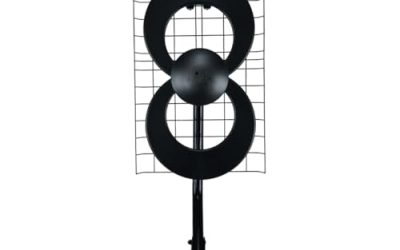
| Antennas Direct ClearStream 2 RV | Directional, fringe-oriented | Fringe class | VHF, UHF | Required | Varies by kit |
As with house antennas, range numbers are best-case, line-of-sight figures. The next section shows why.
Worked example: why the 55-mile claim shrinks at a campsite
Broadcast TV travels on a straight line, so the horizon limits range regardless of antenna gain. A common rule for the radio horizon in miles is 1.23 multiplied by the square root of the antenna height in feet, added for both the transmitter and the receiver.
- A transmitter on a 1,000-foot tower: the square root of 1,000 is about 31.6.
- An RV antenna on a roof about 12 feet high: the square root of 12 is about 3.5.
- Add them: 31.6 + 3.5 = 35.1, then multiply by 1.23 to get about 43 miles of radio horizon on flat ground.
- For a taller 1,500-foot tower the number is about 52 miles. So even a perfect antenna rated for 55 miles will not reach that far on flat ground with a normal tower.
Hills, trees, and a campground full of other RVs reduce the number further, and raising your antenna on a crank mast adds only a few feet. This is why a dome rated for 55 miles often works best at about 20 to 35 miles in practice, and why a directional antenna gets you the extra reach: gain and a narrow beam help in a weak-signal fringe, but they do not move the horizon.
The best RV TV antennas
1. Winegard Air 360 and Air 360+ V2.S
Spec line: Omnidirectional dome · amplified · up to 55-mile advertised range · VHF, UHF, and FM · no aiming · roof-mount low profile · Air 360+ adds preinstalled Wi-Fi and cellular antennas plus a satellite TV port.
Best for: Weekend and short-stay campers who want to park and scan without cranking anything. The plus version suits owners who also want a Wi-Fi extender and cellular booster antenna in the same dome.
Skip if: You often camp in remote spots at the edge of broadcast range. An omnidirectional dome cannot concentrate gain the way a batwing can.
- Pro: No aiming means almost no setup time.
- Pro: Low profile suits low bridges and wind.
- Con: Weaker than directional models in fringe areas.
- Con: Plus-model integration only helps if you use its Wi-Fi and cellular features.
As an Amazon Associate we earn from qualifying purchases at no extra cost to you.

2. Winegard Sensar IV with Wingman
Spec line: Directional batwing · amplified · about 55-mile advertised range · strong VHF and UHF · Wingman UHF booster adds up to 100 percent more UHF reception per the maker · crank mast or manual aiming.
Best for: Long-stay campers and snowbirds who park in the same spots and want maximum channel count. Several RV-focused roundups call this combination the benchmark for over-the-air reception.
Skip if: You hate aiming. You will rotate and rescan at each new campsite.
- Pro: Directional gain reaches farther than a dome.
- Pro: Strong VHF performance for channels 7 to 13.
- Con: Larger roof profile and wind load.
- Con: Requires aiming and rescanning.
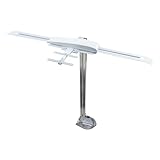
3. KING OA8500
Spec line: Directional · amplified, high gain · up to 65-mile advertised range · FM, VHF, and UHF · built-in signal meter · roof-mounted.
Best for: Owners who want help with aiming. The signal meter makes it easier to rotate for peak signal without running repeated channel scans.
Skip if: You want a no-aim solution, or you have a pop-up with limited roof space.
- Pro: Meter reduces guesswork at each campsite.
- Pro: Higher advertised range than the dome class.
- Con: Directional, so you must aim it.
- Con: Meter and aiming add steps for casual users.
4. KING OA8300
Spec line: Directional replacement head · amplified · up to 65-mile advertised range · VHF and UHF · universal brackets supplied.
Best for: Replacing a worn head on an existing crank-up antenna without changing the mast. The universal brackets suit many older RVs.
Skip if: You are starting from nothing and do not have a compatible mast and wiring.
- Pro: A quick swap that reuses existing mast hardware.
- Pro: Directional gain for weak-signal use.
- Con: Compatibility depends on your existing mast.
- Con: No signal meter on this head.
5. Winegard RVW-395
Spec line: Dome-style roof-mount · up to 55-mile advertised range · VHF and UHF digital · 75-ohm · passive per the listed spec · powder-coated exterior.
Best for: Budget-minded owners who want a low-profile roof antenna and camp near towns, where amplification is unnecessary.
Skip if: You camp in weak-signal areas. Passive designs have no gain boost.
- Pro: Simple, with no amplifier to fail.
- Pro: Rugged finish for roof life.
- Con: You may need to try different orientations for the best channel count.
- Con: Lower reach than amplified or directional options.
6. Winegard Rayzar RZ-8500
Spec line: Automatic motorized directional antenna · VHF and UHF · amplified · automatic aiming and scanning · roof-mount.
Best for: Travelers who want directional reach without manual aiming, and are willing to pay for a motorized unit.
Skip if: You want the simplest, cheapest, most weather-proof option. Moving parts add failure points.
- Pro: Directional performance without cranking.
- Pro: Fits one-person setup routines.
- Con: Premium cost class.
- Con: Motor and electronics add maintenance risk.

7. Winegard Wingman (RV-WING) UHF booster
Spec line: Add-on booster · up to 55-mile advertised range · UHF enhancement up to 100 percent per the maker · tool-free installation · non-amplified.
Best for: Owners of a compatible Winegard batwing who want more UHF channels without replacing the whole antenna.
Skip if: You do not already own a compatible antenna. It is an upgrade, not a standalone antenna.
- Pro: A low-cost upgrade path.
- Pro: Tool-free installation.
- Con: Helps UHF only.
- Con: Gains depend on the host antenna.
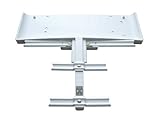
8. Antennas Direct ClearStream 2 RV
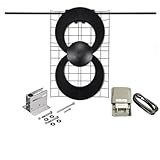
Spec line: Directional fringe-oriented antenna · VHF and UHF · RV mounting hardware · specs described by class because maker figures were not confirmed here.
Best for: Fringe-area campers who want an alternative to the big RV brands, and who are comfortable with a manual installation.
Skip if: You want an off-the-shelf drop-in replacement for a specific crank-up system.
- Pro: Fringe-focused design.
- Pro: Alternative to the main RV brands.
- Con: Fit varies by RV.
- Con: Fewer RV-specific accessories.
Fit and decision matrix
| How you camp | Best match | Why |
|---|---|---|
| Weekends at campgrounds near towns | Winegard Air 360 or Air 360+ | No aiming, quick scan |
| Months in one spot, rural | Winegard Sensar IV with Wingman | You aim once and keep the gain |
| Frequent moves, want aiming help | KING OA8500 | Signal meter shortens each setup |
| Replacing a worn head | KING OA8300 | Universal brackets |
| Limited budget, near towns | Winegard RVW-395 | Simple passive design |
| Want automation | Winegard Rayzar RZ-8500 | Motorized aiming |
Campsite routine that improves any antenna
- Check the towers first. Look up your location on an FCC reception map or a station-lookup site to see distance, bearing, and VHF or UHF for each channel.
- Park with a clear path. Avoid parking directly behind a tall RV or tree line in the direction of the towers.
- Raise the antenna if it is a crank type. Raise it fully, aim toward the towers, and use a signal meter if you have one.
- Turn the amplifier on. Make sure the power switch at the wall plate is on.
- Run a full channel scan. Scan on the TV every time you move, because the TV only keeps channels from the last scan.
- Re-aim and rescan. For directional antennas, rotate a few degrees and repeat.
- Test with the amplifier off near a tower. If you are within about 15 miles of a big tower and see pixelation, switch the amplifier off.
- Lower the antenna before driving. A raised mast can hit low bridges and overhead lines.
Safety note: when you raise or aim a roof antenna, keep it well away from overhead power lines. Never raise a metal mast under or near a line, and keep the 12-volt power supply off while you handle wiring.
More RV TV options: other antennas and satellite alternatives
The eight models above are all over-the-air antennas. The additions below cover a classic crank-up batwing, a low-profile dome, a portable antenna for tailgating, a combination dome, and three portable or roof-mount satellite systems for campers who stay beyond broadcast range. Specs come from the product listings, and advertised ranges are best-case figures.
9. Winegard Sensar III RV-3095
Spec line: Amplified directional crank-up batwing · 65-mile advertised range · VHF and UHF · roof mount · manual aiming.
Best for: Long-stay campers who want a proven directional design and are comfortable cranking and aiming. It sits in the same family as the Sensar IV above, so check which one your RV already has before buying.
Skip if: You want a no-aim dome, or you drive under low branches often and do not want to remember to lower the mast.
- Pro: Directional gain reaches well past a dome.
- Pro: Familiar crank mechanism and parts that many RV shops stock.
- Con: Must be raised, aimed, and rescanned at each stop.
- Con: Larger wind profile than a dome.

10. Winegard Air 360 LP A3-LPW1
Spec line: Low-profile omnidirectional dome · long-range HDTV class · VHF and UHF · no aiming · roof mount.
Best for: Short-stay campers with tight roof clearance who want a dome that is lower and lighter than the standard Air 360.
Skip if: You camp at the edge of broadcast range, where a directional antenna gives more gain.
- Pro: Low height suits bridges and wind.
- Pro: Nothing to raise or aim.
- Con: Lower gain than directional designs.
- Con: Entry-level to mid-range cost class, but not the strongest performer in weak signal.

11. Winegard Rayzar Amplified RV-RZ85 Portable
Spec line: Amplified portable antenna · 60-mile advertised range · for tailgating, RV, and trucking use · UHF and VHF.
Best for: Travelers who want a movable antenna for a picnic table or truck cab, or as a backup when the roof antenna fails.
Skip if: You want a permanent roof installation. A portable unit is placed by hand each time.
- Pro: Moves with you and can be placed near a window or outside.
- Pro: Amplified for the long coax run to the TV.
- Con: Reach is limited compared with a roof antenna.
- Con: You must set it up and pack it each stop.
12. Winegard Air 360+ 5G AR2-5G1
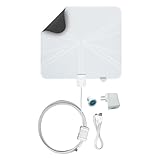
Spec line: Omnidirectional amplified dome · 55-mile advertised HDTV range · roof mount · listed with 5G and Wi-Fi antennas in the same dome.
Best for: Owners who want over-the-air TV and a roof-mounted 5G and Wi-Fi antenna in one dome, and who will connect a compatible router.
Skip if: You only want TV. The combination only pays off if you use the router side, and the dome has the same limits as any omni in fringe areas.
- Pro: One roof penetration for TV and connectivity.
- Pro: No aiming for the TV portion.
- Con: The connectivity side needs a compatible router and a data plan.
- Con: Mid-range to premium cost class.

13. Winegard PL-7000 DISH Playmaker
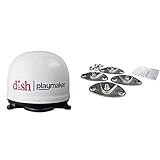
Spec line: Portable satellite dish · roof mount kit included · works with a compatible DISH receiver and active service · not an over-the-air antenna.
Best for: Campers who want satellite channels at a campsite with trees blocking a weak broadcast signal, and who already have or will buy compatible service.
Skip if: You do not want a monthly subscription. Satellite needs an active plan and a clear view of the southern sky from the US.
- Pro: Reliable channel lineup where no local broadcasts reach.
- Pro: Roof mount kit supports quick setup.
- Con: Subscription required, and the dish needs an open sky view.
- Con: Premium cost class for the hardware alone.
14. KING DT4400 DISH Tailgater
Spec line: Portable and roof-mountable satellite dish · for use with a compatible DISH receiver · not an over-the-air antenna.
Best for: Campers who want one dish that sits on a tripod at the campsite and also bolts to the roof for longer stays.
Skip if: You prefer free local channels. Satellite needs service, and trees or an awning can block the dish.
- Pro: Flexible: portable or roof-mounted.
- Pro: Established design for RVs and tailgating.
- Con: Requires service and a receiver.
- Con: Premium cost class.

15. Winegard Pathway X2 PA-6002
Spec line: Portable satellite dish · automatic satellite finding · for use with a compatible DISH receiver · not an over-the-air antenna.
Best for: Frequent movers who want automatic satellite acquisition instead of aiming a dish by hand at every site.
Skip if: You camp a lot under trees or on a tight budget. Satellite hardware and service cost more than a broadcast antenna.
- Pro: Automatic finding saves setup time.
- Pro: Portable, so it fits when you do not want a roof install.
- Con: Premium cost class.
- Con: Needs a clear view of the sky and an active plan.
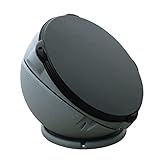
All 15 RV TV options compared
| Model | Type | Aiming | Best for | Cost class |
|---|---|---|---|---|
| Winegard Air 360 and 360+ V2.S | Omni dome | None | Weekend stays | Mid-range |
| Winegard Sensar IV with Wingman | Directional batwing | Manual | Long stays, fringe | Mid-range to premium |
| KING OA8500 | Directional with meter | Manual, meter assisted | Frequent movers | Mid-range |
| KING OA8300 | Directional replacement head | Manual | Worn head swap | Entry-level to mid-range |
| Winegard RVW-395 | Roof antenna | Depends on model | Confirm type before buying | Mid-range |
| Winegard Rayzar RZ-8500 | Motorized directional | Automatic | Hands-off reach | Premium |
| Winegard Wingman booster | UHF add-on | None | Upgrading a batwing | Entry-level |
| ClearStream 2 RV | Directional, amplified | Manual | Fringe campers | Mid-range |
| Winegard Sensar III RV-3095 | Directional batwing | Manual crank | Long stays | Mid-range |
| Winegard Air 360 LP | Low-profile dome | None | Tight clearance | Entry-level to mid-range |
| Winegard Rayzar RV-RZ85 Portable | Portable antenna | Manual placement | Tailgating, backup | Mid-range |
| Winegard Air 360+ 5G | Dome with 5G and Wi-Fi | None | TV plus connectivity | Mid-range to premium |
| Winegard PL-7000 Playmaker | Portable satellite | Manual | No local signal | Premium |
| KING DT4400 Tailgater | Portable satellite | Manual | Flexible mounting | Premium |
| Winegard Pathway X2 | Portable satellite | Automatic | Frequent movers | Premium |
How to choose: thresholds by stay length and signal
- Under 25 miles from the towers on a flat campsite: any dome, such as the Air 360 or Air 360 LP, is enough.
- 25 to 45 miles, with trees: use a directional batwing such as the Sensar IV or Sensar III, aimed toward the towers, with the amplifier on.
- 45 to 60 miles in open ground: choose a directional antenna with a signal meter or automatic aiming (OA8500 or Rayzar RZ-8500). The radio horizon, not the printed range, is the limit.
- No usable signal after aiming and rescanning at three or more spots: consider satellite. Plan for service cost and a clear sky view.
- Stays of three nights or fewer: favor no-aim domes. Stays of two weeks or more: a directional antenna or satellite dish repays its setup time.
- Roof clearance under about 13 feet 6 inches to the top of a mast or dish: lower anything raised before you drive.
FAQ
What is the best TV antenna for an RV?
For most campers, the Winegard Air 360+ is the easiest choice because it needs no aiming. For maximum reach, a directional model such as the Winegard Sensar IV with Wingman or the KING OA8500 is better.
Do I need an amplified antenna for my RV?
Usually yes for roof antennas, because the coax run from roof to TV loses signal. Look for a model that lets you switch the amplifier off near strong towers, since too much signal can cause pixelation.
Is an omnidirectional or directional RV antenna better?
Omnidirectional domes are easier and quicker to use, and directional antennas reach farther. Choose a dome for short stays near towns, and a directional model for long stays or rural areas.
How far can an RV TV antenna reach?
Advertised ranges are 55 to 65 miles, but the radio horizon limits the real reach to roughly 40 to 50 miles on flat ground. In campgrounds with trees and hills, expect far less.
Why do I get no channels after moving the RV?
Your TV only remembers channels from its last scan. After every move, run a full channel scan, re-aim directional antennas, and check that the amplifier switch is on.
Can I use a house TV antenna on my RV?
For tailgating or short stops, a small portable indoor antenna can work. For regular use, a roof antenna built for vibration, weather, and 12-volt power is more reliable than a house model.
Do RV antennas receive NextGen TV (ATSC 3.0)?
The antenna does not decode anything, so any antenna that covers the UHF band can pass NextGen TV signals. Your TV or a separate tuner box needs an ATSC 3.0 tuner to display them.
Should I upgrade my existing antenna or replace it?
If you own a compatible Winegard batwing, a UHF booster such as the Wingman can add UHF reception cheaply. If the head is worn or damaged, a replacement head such as the KING OA8300 may fit existing mast hardware.
More from Amazon
Programs that pair well with the guide above. Offers and eligibility are set by Amazon and may change.
Free shipping on eligible items, Prime Video and more. Eligible new members can start with a free trial.
Start a Prime free trialAd-free music streaming. Eligible new subscribers can start with a free trial.
Try Music Unlimited freeA Prime membership for ages 18-24 with a trial period. Eligibility is set by Amazon.
See Prime for Young AdultsAudiobooks and podcasts to listen to on the go. Eligible new members can start with a free trial.
Try Audible freeAs an Amazon Associate we earn from qualifying purchases.