Our Top Picks

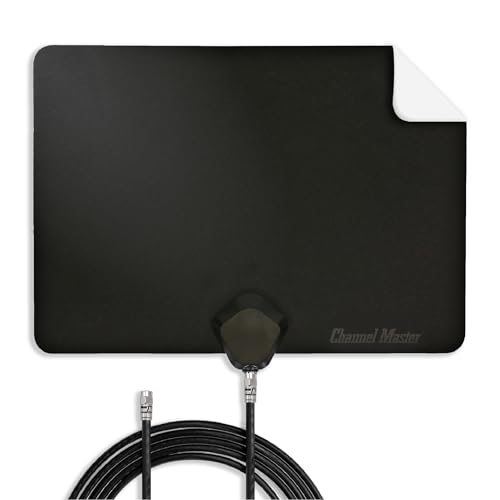
The best indoor TV antennas are the Mohu Leaf 50 for a flat window-mounted panel, the Winegard FlatWave Amped FL5500A for a long cable run to the TV, the Antop HD Smart Bar AT-500SBS when the towers are far away, and the ClearStream Eclipse Amplified for a compact unit in a city apartment. An indoor antenna works best within roughly 30 to 40 miles of the towers; beyond that, placement and a bar-style design matter more than any rated-range number on the box.
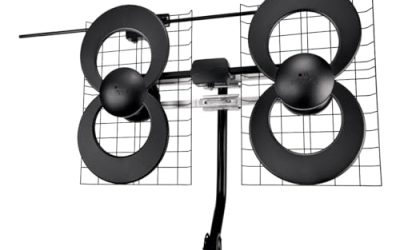
Indoor antennas appeal because they need no mast, no drilling and no landlord permission. The trade-off is that walls, roofing and nearby electronics sit between the antenna and the signal, so an indoor antenna rated for 60 miles typically delivers a fraction of that. This guide compares eight current indoor models by rated range, amplification, form factor and cable length, and it replaces guesswork with a step-by-step placement routine and a distance-band table so you can predict which class will work at your address.
Quick answer: which indoor antenna fits which room
- Studio or one-bedroom in a city: ClearStream Eclipse Amplified, a round, adhesive-mounted unit.
- Window mounting with the TV across the room: Winegard FlatWave Amped FL5500A, which has a long lead and USB power.
- Flat panel that disappears against glass: Mohu Leaf 50.
- Tabletop look, living room shelf: Mohu Curve Amplified or Philips Hover Amplified.
- Stations 40 or more miles away: Antop HD Smart Bar AT-500SBS or Antop Mini Big Boy AT-406BV.
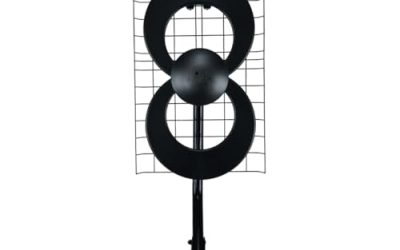
- No amplifier, strong signal: ClearStream 2Max, which is passive with an optional amplifier.
How we chose these antennas
This is a research-based comparison built from manufacturer specification pages and published comparison guides, not from our own installation work. We limited the list to antennas designed for indoor placement that cover both UHF and VHF, that are sold in the United States in 2026, and that differ in form factor or amplification so each pick answers a different buyer need. Rated ranges come from manufacturers and describe best-case outdoor conditions, so we use them to compare models rather than to promise results. Where a specification such as cable length was not confirmed, we say so.
Selection criteria:
- Rated range with and without amplification.
- Form factor: flat panel, bar, round or tabletop.
- Amplifier power source and whether gain can be reduced.
- Cable length, which determines how far the antenna can sit from the TV.
- Coverage of VHF-high channels 7 to 13 as well as UHF.
Comparison table
| Model | Rated range | Amplified | Form | Band coverage | Best for |
|---|---|---|---|---|---|
| Mohu Leaf 50 | 60 miles | Yes | Flat panel | UHF and VHF | Window or wall flat mounting |
| Mohu Curve Amplified | 60 miles | Yes | Tabletop sculptural | UHF and VHF | Visible placement on a shelf |
| Winegard FlatWave Amped FL5500A | 55 miles | Yes, USB powered | Thin flat panel | UHF and VHF | Long cable run, window mounting |
| ClearStream Eclipse Amplified | 50 miles (35 miles standard version) | Yes | Round, adhesive mount | UHF and VHF | Compact apartment installs |
| ClearStream 2Max | 60 miles | No, optional amplifier | Loop and bar hybrid | UHF and VHF | Passive reception with good VHF |
| Philips Hover Amplified | 50 miles | Yes | Tabletop upright | UHF and VHF | Shelf or desk placement |
| Antop HD Smart Bar AT-500SBS | 80 miles | Yes, adjustable | Bar | UHF and VHF | Longer-reach indoor use |
| Antop Mini Big Boy AT-406BV | 70 miles | Yes | Compact, indoor or outdoor | UHF and VHF | Small footprint with extra reach |
The 80-mile and 70-mile figures describe ideal conditions. Inside a house or apartment, expect reliable reception within a distance that is well below the label.
What matters in an indoor antenna
Form factor and mounting
Flat panels stick to glass or walls and suit renters who want an unobtrusive look. Bar and loop designs are bulkier but usually capture VHF channels better because their elements are longer. Tabletop designs trade performance for convenience: they sit where it is easy to put them, which is rarely the best spot for reception. Choose the form that lets you place the antenna high and near a window facing the towers.
Amplification and the near-tower problem
Amplified antennas help when you are 35 or more miles from the towers, when the cable is long, or when the signal feeds several TVs. If the towers are within about 15 miles, an amplifier can overload the tuner and produce pixelation. A passive antenna, or an amplified one with adjustable gain such as the Antop AT-500SBS, avoids that failure.
Cable length
A long lead lets you put the antenna at the best window rather than beside the TV. The FlatWave lists a long cable; for the other models we could not confirm lengths, so check the listing for the exact number. If the cable is short, an extension adds loss of roughly 5 to 6 dB per 100 feet of RG6 at UHF, which is small for a few feet but matters on long runs.
VHF-high coverage
Some markets keep major networks on channels 7 to 13. Compact flat designs can be weak there. Check which RF channel your target stations use on a reception map, and prefer a bar or loop design such as the ClearStream 2Max when a VHF channel is a must-have.
The eight indoor antennas
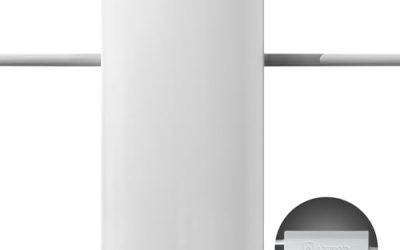
Mohu Leaf 50
Specs: Amplified · 60-mile rating · flat panel · UHF and VHF.
Best for: A flat, window-mounted antenna within about 20 to 30 miles of the towers, where it tends to perform best.
Skip if: You are far from the towers or behind terrain.
- Pros: Thin and easy to hide; a window mount raises it above furniture and electronics.
- Cons: Flat panels reach less than the rating suggests indoors; amplifier needs power.
As an Amazon Associate we earn from qualifying purchases at no extra cost to you.

Mohu Curve Amplified
Specs: Amplified · 60-mile rating · tabletop sculptural form · UHF and VHF.
Best for: A living room shelf where appearance matters and the signal is already decent.
Skip if: The best reception spot is a window you cannot reach from a shelf.
- Pros: Looks like decor; no mounting hardware.
- Cons: Tabletop height limits reach; the free-standing design is easy to knock out of alignment.
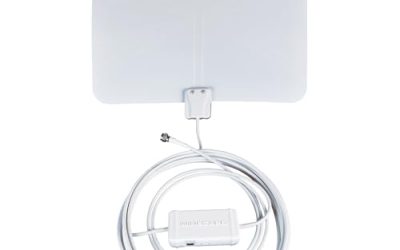
Winegard FlatWave Amped FL5500A
Specs: Amplified through USB power · 55-mile rating · thin flat panel · long cable included.
Best for: Rooms where the TV is far from the best window.
Skip if: You live very close to the towers and want a passive antenna.
- Pros: USB power can come from the TV; the long lead gives placement freedom.
- Cons: A flat panel can miss weaker VHF stations.
ClearStream Eclipse Amplified
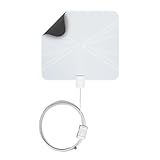
Specs: Amplified · 50-mile rating (35-mile standard version) · round design · adhesive mount.
Best for: Apartments in dense markets with strong nearby towers.
Skip if: Your towers are farther than about 35 miles.
- Pros: Compact and easy to stick high on a wall or window.
- Cons: Short rated reach; limited VHF performance for its size.
ClearStream 2Max
Specs: Passive with optional amplifier · 60-mile rating · loop and bar hybrid · UHF and VHF.
Best for: Households that need VHF-high channels and prefer not to use an amplifier.
Skip if: You need a flat panel that hides on a window.
- Pros: Better VHF coverage from the larger element; works without power.
- Cons: Bulky; the optional amplifier is a separate purchase.
Philips Hover Amplified
Specs: Amplified · 50-mile rating · tabletop upright · UHF and VHF.
Best for: A desk or shelf placement in a small room with a decent signal.
Skip if: You need long reach or a window mount.
- Pros: Compact upright design; easy rotation to fine-tune.
- Cons: Rated reach is modest; tabletop spots are rarely the strongest location.

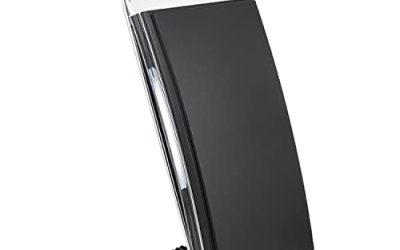
Antop HD Smart Bar AT-500SBS
Specs: Amplified with adjustable gain · 80-mile rating · bar design · UHF and VHF.
Best for: Indoor installs 30 to 50 miles from the towers where a flat panel falls short.
Skip if: You want a hidden flat panel.
- Pros: Longest rated reach on this list; adjustable gain handles different signal strengths.
- Cons: Larger and more visible.
Antop Mini Big Boy AT-406BV
Specs: Amplified · 70-mile rating · compact body usable indoors or outdoors · UHF and VHF.
Best for: Small spaces that still need extra reach, with the option to move it outside later.
Skip if: You are close to the towers and want a passive antenna.
- Pros: Compact with long rated reach; flexible mounting.
- Cons: Amplifier requires power; the outdoor use needs weatherproof routing of the cable.

All fourteen indoor antennas compared
This table merges the eight antennas from the main list with the six added above. Ranges are manufacturer ratings from current listings, shown where one was available; indoors, plan on a fraction of the label.
| Model | Form | Power | Rated range | Best distance band indoors |
|---|---|---|---|---|
| Mohu Leaf 50 | Flat panel | Passive on the original Leaf 50 listing | 50 miles class | Under 25 miles |
| Mohu Curve Amplified | Tabletop | Amplified | Not confirmed | 20 to 35 miles |
| Winegard FlatWave Amped FL5500A | Flat panel | Amplified | 60 miles | 25 to 40 miles |
| ClearStream Eclipse Amplified | Round | Amplified | 50 miles class | 20 to 35 miles |
| ClearStream 2Max | Loop and bar | Passive, optional amp | Not confirmed | 20 to 35 miles |
| Philips Hover Amplified | Tabletop upright | Amplified | Not confirmed | 15 to 35 miles |
| Antop HD Smart Bar AT-500SBS | Bar | Amplified, adjustable | Long-reach class | 30 to 45 miles |
| Antop Mini Big Boy AT-406BV | Compact panel | Amplified | Long-reach class | 30 to 45 miles |
| Channel Master FLATenna 35 | Flat panel | Passive | 35 miles class | Under 25 miles |
| Channel Master FLATenna with Booster | Flat panel | Adjustable booster | Not confirmed | 20 to 40 miles |
| Mohu Leaf Amplified | Flat panel | Amplified with bypass | 60 miles | 20 to 40 miles |
| Winegard FlatWave Amped Pro TH-3000 | Flat panel | Amplified, signal meter | 60 miles | 25 to 40 miles |
| Winegard FlatWave FL-5000 | Flat panel | Passive | 40 miles | Under 25 miles |
| ClearStream 1MAX | Keyhole panel | Passive | 40 miles plus | 15 to 30 miles |
How to choose: thresholds that settle the decision
- Under 15 miles from the towers: go passive (FLATenna 35, FL-5000, 1MAX). Amplifiers near strong towers cause pixelation.
- 15 to 35 miles: an amplified or adjustable-gain flat panel placed high in a window facing the towers; use the signal meter on the TH-3000 if you expect to move it.
- 35 to 45 miles: a bar-style or larger panel, and test two windows before committing. Beyond about 45 miles, plan on an attic or outdoor antenna.
- Long cable (over about 50 feet) or two-plus TVs: favor an amplified model; each two-way split costs about 3.5 dB.
- VHF-high stations (channels 7 to 13): pick a bar, loop or 1MAX-class design rather than a thin panel.
- Renters: a window-mounted adhesive panel needs no drilling and no permission.
Before buying, check a reception map for your address to see each station’s channel band and strength. Do the same after buying: after every move, rescan channels and note how many you gain or lose.
Distance bands: what class to expect to work indoors
| Distance to towers | Typical indoor outcome | Class to buy |
|---|---|---|
| 0 to 15 miles | Strong signal almost anywhere | Passive flat panel or round antenna |
| 15 to 30 miles | Good in a window, mixed deeper in the home | Flat panel, amplified only for long cable |
| 30 to 45 miles | Window or upper-floor mounting needed | Amplified panel or bar |
| 45 to 60 miles | Hit or miss, depends on terrain | Amplified bar, high placement, consider an attic |
| 60 miles and beyond | Unreliable indoors | Attic or outdoor antenna |
Step-by-step placement routine
This routine finds the strongest indoor location in under an hour and works for any antenna on the list.
- Look up your address on a reception map to learn the direction, distance and channel type of each station you want.
- Connect the antenna with its included lead and run a full channel scan at the TV first. Note how many channels appear.
- Move the antenna to a window facing the towers, as high as the lead allows. Rescan and note the count.
- Try the highest wall position and the window in the opposite direction. Rescan each time.
- If channels freeze, check signal strength in the TV menu. Reduce amplifier gain or remove the amplifier if the signal is above the tuner’s comfortable range.
- Pick the position with the most stable channels, not the highest channel count, and fix it in place.
Worked example: choosing for a third-floor apartment
An apartment on the third floor faces away from the towers, which sit 28 miles to the northeast. The TV is on a south wall, 12 feet from the best window.
- Distance is 28 miles, which lands in the 15 to 30 mile band: a flat panel can work in a window.
- The window faces away from the towers, so the signal travels through the building. That behaves like a farther tower, so move up one band to 30 to 45 miles and favor an amplified panel.
- The TV is 12 feet from the window, so the lead must cover that distance. A model with a long included cable, like the Winegard FlatWave Amped FL5500A, avoids a lossy extension.
- Test two positions: the northeast-facing bedroom window and the living room window. Rescan at each and keep the one that gives stable channels.
Result: an amplified flat panel in the northeast window, with gain reduced if any channel pixelates. If channels still drop, the next step up is the Antop AT-500SBS, not a larger rated range on another flat panel.
Reasons indoor antennas disappoint
- Placing the antenna low or behind the TV, where the building and electronics block the signal.
- Forgetting to rescan after moving, so the TV keeps the old channel list.
- Using an amplifier near the towers, which overloads the tuner.
- Expecting a rated range figure to hold through walls and across hills.
- Putting the antenna near routers, LED drivers or power adapters that add noise.
Six more indoor antennas worth comparing
The eight antennas above cover the main form factors. These six add the budget passive benchmark that most competing guides lead with, a booster version of it, an amplified Mohu panel, a signal-meter panel, a passive FlatWave and a convertible indoor-outdoor unit. Details come from manufacturer listings, and the entries describe a class where an exact figure could not be confirmed.
Channel Master FLATenna 35
Specs: Indoor · passive flat panel · 35-mile class rating · 12-foot coax lead · reversible design
The FLATenna 35 is the common benchmark for a budget indoor antenna. It has no amplifier, so it has nothing to overload near the towers and no power supply to plug in. It is a thin panel that sticks to a window or wall, and the lead is long enough to place it away from the TV. It works best in the UHF-heavy markets where stations sit within roughly 25 miles.
Best for: Strong-signal apartments and houses that want the simplest possible setup. Skip if: your stations are beyond about 30 miles or are mostly on VHF channels.
Pros: Entry-level cost class; passive; slim and easy to hide.
Cons: Limited reach; placement matters more than with amplified panels.
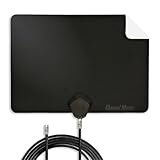
Channel Master FLATenna with Booster
Specs: Indoor · flat panel · adjustable signal booster · UHF and VHF
This is the same flat-panel idea with an adjustable amplifier added. The adjustable part is the useful part: it lets you dial gain down when the signal is strong and up when a channel is marginal, instead of living with a fixed amplifier that may overload the tuner. It suits a house that is 20 to 40 miles out with a long cable run.
Best for: Households that want a flat panel with some reach and a way to tame the gain. Skip if: you live within about 10 miles of the towers and a passive panel would do.
Pros: Adjustable gain; slim; mid-range cost class.
Cons: Needs a power connection; still a panel, so VHF can be weaker.

Mohu Leaf Amplified
Specs: Indoor · amplified with Jolt Switch · 60-mile rating · ultra-thin · UHF and VHF
The amplified version of the Leaf panel. It sticks to glass like the standard Leaf but adds a powered amplifier and a switch to bypass it, so you can compare reception with and without gain on the same channel scan. The bypass is handy if a nearby tower causes overload.
Best for: Mid-distance windows where the standard Leaf falls just short. Skip if: you want a passive antenna with no power cord.
Pros: Amplifier with bypass switch; slim; works on glass or wall.
Cons: Power cord is needed; rated range is an outdoor best case.

Winegard FlatWave Amped Pro TH-3000
Specs: Indoor · amplified · 60-mile rating · ultra-thin · built-in signal meter
A flat panel with a built-in signal meter. Rotating a flat antenna a few inches can swing reception sharply, and the meter shows the change immediately, which saves repeated channel scans. It is aimed at buyers who expect to try two or three windows before settling.
Best for: Homes where the best spot is not obvious. Skip if: you only need a basic panel for a strong nearby signal.
Pros: Live signal reading; amplified; thin.
Cons: Mid-range cost class; amplifier needs power.
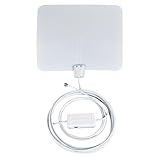
Winegard FlatWave FL-5000
Specs: Indoor · passive · 40-mile rating · ultra-thin · dual-color finish
The non-amplified sibling of the FL5500A listed above. Without gain, it is a cleaner pick for strong-signal homes, and it sidesteps overload and interference that come with an amplifier. The dual-color face lets it blend in against light or dark walls.
Best for: Near-tower homes that want a thin passive panel. Skip if: your towers are more than about 30 miles away or blocked by hills.
Pros: Passive; slim; no power needed.
Cons: Short range; no gain to offset long cable or splitters.

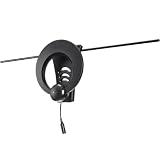
Antennas Direct ClearStream 1MAX
Specs: Indoor or outdoor · passive · 40-mile-plus rating · UHF and VHF · multi-directional
A compact keyhole panel that hangs on a wall or sits on a shelf indoors and can later move outdoors or to an attic. It covers both UHF and VHF, which helps in markets where a major network sits on channels 7 to 13. It is a sensible choice if you are unsure whether indoors will be enough.
Best for: Buyers who want an indoor option with an upgrade path to an attic or outdoor spot. Skip if: you want a thin panel that vanishes against glass.
Pros: Passive; flexible mounting; handles both bands.
Cons: Thicker than a flat panel; modest range.
Frequently asked questions
What is the best indoor TV antenna?
The best choice depends on distance. For most apartments within 30 miles, the Mohu Leaf 50 or ClearStream Eclipse Amplified is enough; farther out, the Antop AT-500SBS is a stronger option.
How far can an indoor antenna reach?
Reliable indoor reception usually falls within 30 to 40 miles. Labels showing 60 to 80 miles describe open-air conditions that most rooms do not provide.
Is an amplified indoor antenna better?
Only when you are far from the towers, have a long cable or split the signal. Near the towers an amplifier can overload the tuner and make the picture worse.
Where should I put an indoor antenna?
Put it as high as possible, in a window facing the towers, away from metal and electronics. Rescan channels after each move because the TV remembers only the last scan.
Do indoor antennas work for VHF channels?
Some do. Flat panels tend to be weaker on VHF-high channels 7 to 13, while bar and loop designs such as the ClearStream 2Max handle them better.
Why do I lose channels at night or in bad weather?
Signal conditions change with atmosphere and interference. Higher placement, lower amplifier gain or a bar-style antenna usually stabilizes reception.
Do I need a special antenna for ATSC 3.0?
No. Antennas catch radio signals regardless of format. You need a TV or tuner that supports ATSC 3.0 to decode the newer broadcasts.
Can I use an indoor antenna with several TVs?
Yes, through a splitter, though each two-way split costs about 3.5 dB. An amplified antenna helps cover that loss on longer setups.
Final recommendation
Start with distance. Inside 30 miles, a flat panel such as the Mohu Leaf 50 or the Winegard FlatWave Amped FL5500A in a window is the simplest fix. From 30 to 50 miles, move to the Antop HD Smart Bar AT-500SBS or the Antop Mini Big Boy AT-406BV and place it high. If VHF channels matter, the ClearStream 2Max is the safer shape. Run the placement routine before you decide the antenna is the problem, because the right spot often matters more than the model.
More from Amazon
Programs that pair well with the guide above. Offers and eligibility are set by Amazon and may change.
Free shipping on eligible items, Prime Video and more. Eligible new members can start with a free trial.
Start a Prime free trialAd-free music streaming. Eligible new subscribers can start with a free trial.
Try Music Unlimited freeA Prime membership for ages 18-24 with a trial period. Eligibility is set by Amazon.
See Prime for Young AdultsAudiobooks and podcasts to listen to on the go. Eligible new members can start with a free trial.
Try Audible freeAs an Amazon Associate we earn from qualifying purchases.