Our Top Picks
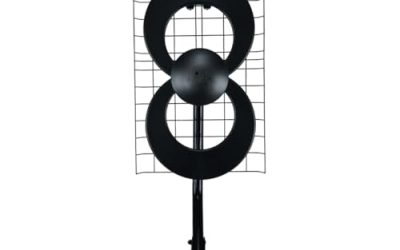
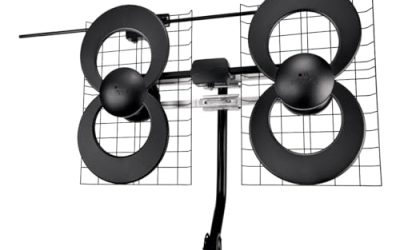
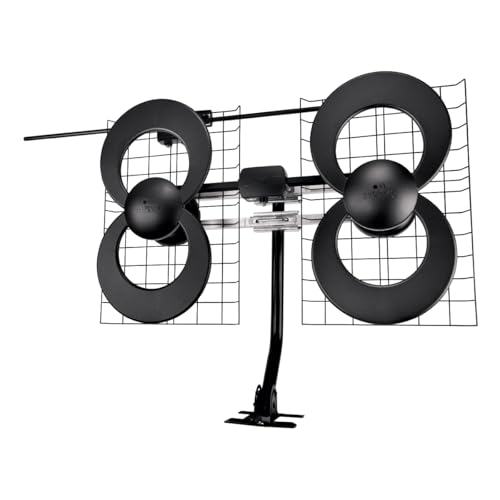 Best mid-range indoor/outdoorAntennas Direct ClearStream 4V Outdoor TV Antenna27.8 x 6 x 17.4 inches4.1 poundsCheck on Amazon

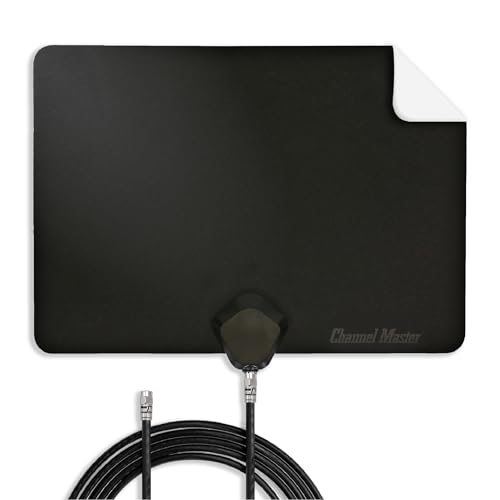

The best digital TV antennas depend on your distance to the towers: the Mohu Leaf Plus or Winegard Amped Pro for indoor use within about 30 to 40 miles, the Antennas Direct ClearStream 2Max for a mid-sized indoor or outdoor option, and the ClearStream 4V or Winegard Elite 7550 when towers are 40 miles or farther away. Every over-the-air TV antenna is “digital” in practice, so the real task is matching the antenna to the channels and the distance.
Since the 2009 switch to digital broadcasting, there is no such thing as a special “digital” antenna. Labels like “HD” and “4K” are marketing; any antenna that covers the right frequencies works. What actually changes your result is band coverage (VHF and UHF), gain and directionality, amplification, and placement. This guide explains those, gives a channel-matching method, compares eight to nine real models by spec class, and answers common questions including ATSC 3.0 (NEXTGEN TV). Range numbers are manufacturer ratings and best-case.
Quick picks
- Best budget indoor flat antenna: Mohu Leaf Metro, for towers within about 25 miles.
- Best amplified indoor antenna: Mohu Leaf Plus or Winegard Amped Pro, rated around 60 miles.
- Best simple rabbit-ear style: Philips Modern Loop for nearby towers.
- Best design-friendly indoor antenna: ClearStream Eclipse.
- Best mid-range indoor/outdoor: Antennas Direct ClearStream 2Max.
- Best outdoor all-rounder: Antennas Direct ClearStream 4V.
- Best amplified outdoor: Winegard Elite 7550.
- Best low-profile attic option: Channel Master STEALTHtenna.
How we chose these antennas
This is a research-based guide built from manufacturer specification sheets, published ranges, band coverage, and independent antenna guides. We kept models that are currently sold, that cover both VHF and UHF, and that represent each placement class (flat indoor, amplified indoor, loop, indoor/outdoor, outdoor, attic). Where a figure could not be verified, we describe the antenna by class and omit the number.
- Band coverage. VHF-high (RF 7 to 13) and UHF (RF 14 to 36) both carry major networks.
- Range class versus your distance. Pick a class one step above your real distance.
- Amplification. Helpful at long distance or with splitters, harmful close to towers.
- Placement flexibility. Window, wall, attic, mast.
- Build and cable. Cable length and connector quality affect real-life results.
Digital antenna basics that decide the result
There is no special “HD” antenna
Digital broadcasts use the same radio bands as analog once did. If an antenna covers VHF and UHF, it can receive HD broadcasts. Claims of “4K antenna” or “8K antenna” are marketing language; the picture format is decided by the broadcaster and your TV, not by the antenna.
Channel numbers versus RF channels
Your TV shows virtual channel numbers such as 7.1, but the station may transmit on a different RF channel such as 33. The RF channel decides which part of the spectrum the antenna must capture. Look up your address on a signal-map tool and write down the RF channel of every station you want.
Band thresholds
- RF 2 to 6 (VHF-low): rare, needs an antenna with larger elements.
- RF 7 to 13 (VHF-high): common for some network affiliates, needs VHF coverage.
- RF 14 to 36 (UHF): where most stations now broadcast.
ATSC 1.0 and ATSC 3.0
Most stations still broadcast ATSC 1.0. A growing number also offer ATSC 3.0, marketed as NEXTGEN TV. The antenna is the same for both; you need a tuner (in the TV or an external box) that supports 3.0 to decode those channels.
Spec comparison table
| Model | Placement | Manufacturer-rated range | Bands | Amplified | Notes |
|---|---|---|---|---|---|
| Mohu Leaf Metro | Indoor flat | About 25 miles | VHF/UHF | No | Compact, adhesive backing, about 10 ft cable |
| ClearStream Eclipse | Indoor circular | About 35 miles | VHF/UHF | No | Paintable design, about 12 ft cable |
| Philips Modern Loop | Indoor loop/rabbit ear | About 30 miles | VHF/UHF | No | Weighted base, extendable dipoles |
| Mohu Leaf Plus | Indoor flat | About 60 miles | VHF/UHF | Yes | Paper-thin, paintable, about 16 ft cable |
| Winegard Amped Pro | Indoor flat | About 60 miles | VHF/UHF | Yes | Reversible, companion smartphone app |
| ClearStream 2Max | Indoor or outdoor | 50 to 60 mile class | VHF/UHF | No | Larger design, includes a short mast |
| Channel Master STEALTHtenna | Attic or outdoor | About 50 miles | VHF/UHF | No | Small, powder-coated aluminum |
| ClearStream 4V | Outdoor or attic | About 70 miles | VHF/UHF | No (preamp optional) | Multi-directional |
| Winegard Elite 7550 | Outdoor | 70+ miles | VHF/UHF | Yes | Embedded amplifier |
Ranges are best-case figures. Third-party sources sometimes differ by 5 to 10 miles for the same antenna, so use them to rank models rather than to promise coverage.
The best digital TV antennas
1. Mohu Leaf Plus
Spec line: Indoor flat · VHF/UHF · amplified · rated about 60 miles · paper-thin and paintable · about 16 ft cable
Best for: Apartments and homes where towers are 25 to 45 miles away and the antenna must stay unobtrusive.
Skip if: You live within about 10 miles of the towers (the amp may overload) or more than 50 miles away behind hills.
- Pros: slim and easy to hide, amplified, VHF/UHF coverage, simple setup.
- Cons: performance depends heavily on window placement, and the rated range is optimistic for indoor use.
2. Winegard Amped Pro
Spec line: Indoor flat · VHF/UHF · amplified · rated about 60 miles · reversible · smartphone aiming app
Best for: Renters who want help aiming through a companion app and a reversible panel.
Skip if: You are close to towers and do not need amplification.
- Pros: aiming aid, reversible design, amplified.
- Cons: still an indoor antenna with indoor limits, and the amp can add noise.
As an Amazon Associate we earn from qualifying purchases at no extra cost to you.
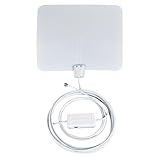
3. Mohu Leaf Metro
Spec line: Indoor flat · VHF/UHF · passive · rated about 25 miles · adhesive backing · about 10 ft cable
Best for: City dwellers close to the towers.
Skip if: Your towers are beyond about 25 miles or you want VHF-low channels.
- Pros: low cost, compact, no amplifier to overload.
- Cons: short range and a short cable.
4. Philips Modern Loop
Spec line: Indoor loop with extendable dipoles · VHF/UHF · passive · rated about 30 miles · weighted base
Best for: Shelf or table placement near a window, with towers within about 25 miles.
Skip if: You need a hidden or wall-mounted antenna.
- Pros: adjustable dipoles for VHF tuning, no power supply.
- Cons: visible, and limited range.
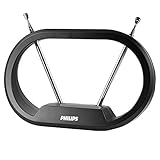
5. ClearStream Eclipse
Spec line: Indoor circular design · VHF/UHF · passive · rated about 35 miles · paintable · about 12 ft cable
Best for: Households that want an indoor antenna that looks like wall art.
Skip if: Towers are over 35 miles away or behind terrain.
- Pros: decorative design, from a well-regarded antenna maker.
- Cons: modest range, and unamplified.
6. Antennas Direct ClearStream 2Max
Spec line: Larger bowtie design · VHF/UHF · passive · rated in the 50 to 60 mile class · indoor or outdoor · includes a short mast
Best for: A single antenna that can sit in an attic, on a balcony, or on a mast.
Skip if: You want a hidden slim indoor panel.
- Pros: flexible placement, no amplifier overload risk, a long-standing design.
- Cons: bulky indoors, and moderate gain compared with larger outdoor models.
7. Channel Master STEALTHtenna
Spec line: Attic or outdoor · VHF/UHF · passive · rated about 50 miles · powder-coated aluminum
Best for: Attics and small mounts where a full-size antenna does not fit.
Skip if: Your signal is marginal or beyond roughly 40 miles.
- Pros: small and light, durable finish.
- Cons: lower gain.
8. Antennas Direct ClearStream 4V
Spec line: Multi-bay bowtie with reflector · VHF/UHF · rated about 70 miles · multi-directional · passive
Best for: Homes 35 to 60 miles from towers in different directions.
Skip if: You live in an apartment with no outdoor or attic access.
- Pros: strong reach, no rotator required, good with a mast preamp.
- Cons: large, and not an indoor design.

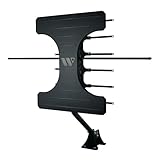
9. Winegard Elite 7550
Spec line: Directional outdoor · VHF/UHF · embedded amplifier · rated 70+ miles
Best for: Weak signals and long cable runs.
Skip if: You are close to towers.
- Pros: amplification built in, high range class.
- Cons: needs a power inserter, and the amplifier is another part that can fail.
More digital antennas by placement class
The nine models above span flat indoor panels through outdoor masts. The seven below add more flat indoor choices at different price points, a compact indoor or outdoor bowtie, and a low-cost outdoor Yagi-style option. Ranges are manufacturer ratings and best-case.
10. Mohu Leaf Ultimate
Spec line: Indoor flat · amplified · UHF/VHF · multi-directional · ultra-thin
Best for: Apartments and homes at moderate distance from towers that want a hidden amplified panel with more reach than basic flat models. Skip if: You live within about 10 miles of the towers, where the amplifier can overload the tuner.
Pros: ultra-thin, amplified, multi-directional, marketed for NEXTGEN TV use with a compatible tuner. Cons: indoor placement limits real reach and the amplifier can add noise.
Place it high on a window facing the towers and rescan after each move.

11. Winegard FlatWave FL5500A
Spec line: Indoor flat · amplified · multidirectional · rated about 60 miles · ultra-thin
Best for: Renters who want a slim amplified panel for a window or wall at moderate distance. Skip if: You are very close to strong towers or far out behind hills.
Pros: thin and easy to hide, amplified, simple setup. Cons: indoor reach falls short of the rating and the amplifier can overload near towers.
It is a useful alternative to similar amplified panels when stock or price differs.
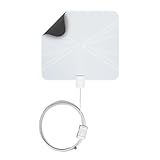
12. Winegard FlatWave FL-5000
Spec line: Indoor flat · passive · multidirectional · rated about 40 miles · ultra-thin
Best for: City homes close to the towers that want a cheap passive panel with no power supply. Skip if: Your towers are far away or you need amplification for a splitter.
Pros: low cost, no amplifier to overload, thin panel. Cons: short reach and sensitive to window placement.
Passive panels are a good first test when towers are close.

13. Channel Master FLATenna
Spec line: Indoor flat · passive · digital HDTV · 12 ft coaxial cable
Best for: Dwellers close to the towers who want a simple, low-cost flat antenna with no power supply. Skip if: You need long reach or a strong amplified signal.
Pros: inexpensive, simple setup, a passive design that avoids overload. Cons: limited range and a fixed cable length.
It suits a quick channel check before committing to a bigger antenna.
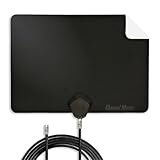
14. Mohu Blade
Spec line: Indoor flat · amplified · rated about 50 miles · slim panel
Best for: Small apartments at moderate distance from towers that need a low-profile amplified panel. Skip if: You are close to the towers or sit in a weak-signal spot behind hills.
Pros: slim profile, amplified, entry-level cost. Cons: indoor limits apply and the rated range is optimistic.
Mount it on a window with the flat face toward the towers.

15. Antennas Direct ClearStream 1MAX
Spec line: Compact multi-directional · UHF/VHF · indoor or outdoor · passive
Best for: Small attic or window installs fairly near the towers that need a compact, sturdy antenna. Skip if: Your towers are far away or behind terrain.
Pros: compact build, indoor or outdoor mounting, no amplifier overload risk. Cons: modest gain and short reach.
It is the smallest-load option in the ClearStream bowtie family.
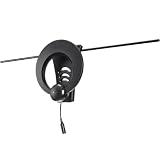
16. GE Outdoor HD Digital TV Antenna
Spec line: Outdoor Yagi-style · VHF/UHF · directional · J-mount included · passive
Best for: Entry-level installs where you will aim the antenna once and want a low-cost way to learn what your roofline can receive. Skip if: You need guaranteed fringe reach or heavy-duty hardware for an exposed tall mast.
Pros: low cost, mounting hardware included, simple to aim. Cons: lighter build than premium Yagis and any listed range is a best case.
It makes a sensible first antenna before you commit to a larger one.

Step-by-step: match the antenna to your channels
Use this logic before you buy. It turns a station list into a decision.
- List your must-have stations. Write down the four to eight networks you actually watch.
- Find each RF channel and distance. A signal map gives the RF channel, the distance, and the bearing for each.
- Check the bands. If every RF channel is 14 to 36, any UHF-capable antenna will do, and a UHF-focused design is fine. If any is 7 to 13, you need VHF-high coverage.
- Find your farthest must-have station. Add 10 to 20 miles of margin if you are indoors, or 10 miles if outdoors.
- Pick the class: up to 25 miles (flat or loop indoor); 25 to 45 (amplified indoor or mid-size); 45 to 70 (outdoor, bowtie or Yagi); over 70 (large outdoor with a preamp).
- Check the directions. If bearings differ by more than about 30 degrees, choose a multi-directional design or add a rotator.
- Decide on amplification. Close to strong towers, go passive. Far or with splits, amplify at the antenna.
Example: A viewer wants six stations. Five are on UHF at 22 to 28 miles. One network is on RF 9 at 31 miles. VHF-high is required, the farthest distance is 31 miles, and indoor margin pushes the target to about 45 miles. The class is an amplified indoor antenna with VHF coverage, such as the Mohu Leaf Plus or Winegard Amped Pro, or a mid-size ClearStream 2Max in a window or attic.
All sixteen digital antennas compared by distance class
| Model | Placement | Amplified | Rated range class | Price tier |
|---|---|---|---|---|
| Mohu Leaf Plus | Indoor flat | Yes | About 60 miles | Mid-range |
| Winegard Amped Pro | Indoor flat | Yes | About 60 miles | Mid-range |
| Mohu Leaf Metro | Indoor flat | No | About 25 miles | Entry-level |
| Philips Modern Loop | Indoor loop | No | About 30 miles | Entry-level |
| ClearStream Eclipse | Indoor circular | No | About 35 miles | Mid-range |
| ClearStream 2Max | Indoor or outdoor | No | 50 to 60 mile class | Mid-range |
| Channel Master STEALTHtenna | Attic or outdoor | No | About 50 miles | Mid-range |
| ClearStream 4V | Outdoor or attic | No | About 70 miles | Mid-range |
| Winegard Elite 7550 | Outdoor directional | Yes | 70+ miles | Mid-range |
| Mohu Leaf Ultimate | Indoor flat | Yes | Class not verified | Mid-range |
| Winegard FlatWave FL5500A | Indoor flat | Yes | About 60 miles | Entry-level |
| Winegard FlatWave FL-5000 | Indoor flat | No | About 40 miles | Entry-level |
| Channel Master FLATenna | Indoor flat | No | Class not verified | Entry-level |
| Mohu Blade | Indoor flat | Yes | About 50 miles | Entry-level |
| ClearStream 1MAX | Indoor or outdoor compact | No | Class not verified | Entry-level |
| GE Outdoor HD Digital Antenna | Outdoor Yagi-style | No | Class not verified | Entry-level |
Use the range column to rank models, not to promise coverage. Third-party listings often differ by 5 to 10 miles for the same antenna.
How to choose with concrete thresholds
- Farthest wanted station within 25 miles and line of sight: a passive flat panel or loop is enough, and an amplifier can hurt.
- 25 to 45 miles: an amplified flat panel in a high window, or a mid-size attic or outdoor bowtie.
- 45 to 70 miles: an outdoor or attic bowtie or Yagi, mounted as high as is safe, with a mast preamp if the cable run is long.
- Any wanted station on RF channels 7 to 13: require VHF-high coverage in the specs.
- Bearings more than about 30 degrees apart: pick a multi-directional design or plan a rotator.
- More than two TVs on one antenna: use an amplified model or a distribution amplifier to offset splitter loss.
Decision matrix
| Situation | Distance to farthest station | Best match |
|---|---|---|
| City apartment, near towers | Under 25 miles | Mohu Leaf Metro or Philips Modern Loop |
| Wants a decorative indoor antenna | Under 30 miles | ClearStream Eclipse |
| Suburb, indoor only | 25 to 45 miles | Mohu Leaf Plus or Winegard Amped Pro |
| Attic or balcony | 30 to 50 miles | ClearStream 2Max or STEALTHtenna |
| Rooftop, towers in several directions | 35 to 60 miles | ClearStream 4V |
| Weak signal or long cable | 40 to 65 miles | Winegard Elite 7550 |
Placement tips that improve any digital antenna
- Go high and near a window. Glass is far less blocking than walls, and height reduces obstruction.
- Face the towers. Even omnidirectional designs benefit from orientation.
- Keep away from electronics. Routers, LED bulbs, and power bricks can create interference.
- Rescan every time you move the antenna. Your TV only remembers channels from its last scan.
- Do not stack splitters. Every split costs about 3.5 dB.
- Mind the safety. For outdoor mounting, stay far from power lines and ground the mast and coax per local code.
Common mistakes when buying a digital antenna
- Trusting the biggest range number. Indoor antennas labeled for 60 miles or more often work reliably to only a fraction of that. Choose a class by your actual farthest station, not by the box.
- Buying UHF-only when a favorite network is on VHF. Check the RF channel of each station first. A missing network after setup is usually a band problem, not a defective antenna.
- Skipping the rescan. Many “my antenna does not work” complaints disappear after a fresh channel scan from the TV menu.
- Using an amplifier near the towers. If you live within about 10 to 15 miles of the transmitters, a passive antenna is usually cleaner. Overload looks like picture breakup that gets worse when you add gain.
- Placing the antenna behind the TV. The set itself and nearby electronics can add interference. Move the antenna to a window or a higher spot and rescan.
- Using long, thin cable. If the antenna comes with a short cable, extend with quality RG6 coax rather than thin lead wire, and keep splices to a minimum.
A useful rule of thumb: fix placement first, then amplification, then upgrade the antenna. Moving a flat antenna from a wall behind the TV to a window can recover more channels than a larger purchase.
Frequently asked questions
What is the best digital TV antenna?
For indoor use, the Mohu Leaf Plus or Winegard Amped Pro. For outdoor, the ClearStream 4V. The right one depends on distance and band coverage.
Within 25 miles, a simple flat antenna like the Mohu Leaf Metro is often enough.
Do I need a special antenna for digital or HD TV?
No. Any antenna that covers VHF and UHF can receive digital and HD broadcasts.
“HD” and “4K” labels are marketing, because picture quality is set by the broadcaster and your TV.
Will my antenna work with ATSC 3.0 (NEXTGEN TV)?
Yes. The antenna receives radio signals, and a compatible tuner decodes ATSC 3.0.
If your TV lacks a 3.0 tuner, you can add an external tuner box.
Is an amplified indoor antenna better?
Only at longer distances or with splitters. Close to towers, an amplifier can overload the tuner.
If you see pixelation after adding an amp, try a passive antenna or reduce gain.
How far can an indoor digital antenna receive?
Realistically about 25 to 45 miles, even if the box says 60.
Walls, window orientation, and terrain all reduce range, so choose a class above your actual distance.
Why do I lose channels after moving the antenna?
Your TV stores channels from its last scan. A new position changes which signals arrive, so channels can appear or disappear.
Run a fresh channel scan every time you move or re-aim the antenna.
Do I need VHF coverage?
Only if a station you want broadcasts on RF 7 to 13. Many stations are UHF, but several major networks still use VHF-high.
Check each station’s RF channel on a signal map before you buy a UHF-only antenna.
Can one antenna serve several TVs?
Yes, with a splitter or a distribution amplifier. Each 2-way split costs about 3.5 dB.
For three or more TVs, place an amplifier at the antenna or use a distribution amp.
Final recommendation
List your stations, look up their RF channels and distances, and then choose the class: flat indoor under 25 miles, amplified indoor to about 45 miles, and outdoor or attic beyond that. If a station is on VHF-high, confirm VHF coverage. Place the antenna high and near a window or on a mast, rescan, and add amplification only when needed.
More from Amazon
Programs that pair well with the guide above. Offers and eligibility are set by Amazon and may change.
Free shipping on eligible items, Prime Video and more. Eligible new members can start with a free trial.
Start a Prime free trialAd-free music streaming. Eligible new subscribers can start with a free trial.
Try Music Unlimited freeA Prime membership for ages 18-24 with a trial period. Eligibility is set by Amazon.
See Prime for Young AdultsAudiobooks and podcasts to listen to on the go. Eligible new members can start with a free trial.
Try Audible freeAs an Amazon Associate we earn from qualifying purchases.