Our Short List of 3
All 5 Picks at a Glance
| Product | Specs | Action |
|---|---|---|
| 1. Klein Tools VDV812-606 Universal Compression F Connectors (RG6/6Q, 10-Pack) | Check price on Amazon | |
 2. PPC EX6XL Universal Compression Connectors (RG6, 50-Pack) | Check price on Amazon | |
 3. IDEAL RTQ XR RG6 Compression F-Connectors 92-650 (Jar of 50) | Check price on Amazon | |
 4. PCT-TRS-6 Universal RG-6 Locking Compression Connectors (10-Pack) | Check price on Amazon | |
 5. Klein Tools VDV812-615 Universal Compression F Connectors (RG59, 10-Pack) | Check price on Amazon |
Key takeaways
- The best coax compression connectors compared: universal RG6, quad-shield and RG59 F fittings matched to the right cable, tool and weather seal.
A compression fitting looks like the simplest part of an antenna install, a small metal sleeve that either works or does not. In practice it is where most home coax runs succeed or fail, because the fitting is where weather, vibration and signal all meet. A termination at an indoor wall plate can survive for years, while the same fitting at the mast lives through rain, heat cycles and wind flex. This guide compares five compression F connectors for the jobs home installers face: everyday RG6 runs, quad-shield cable, outdoor drops and the RG59 still found in older houses.
One note on the lineup: two of the five picks come from Klein Tools, its RG6 universal fitting and its RG59 sibling, earning separate places because they serve different cables. Everywhere below, the honest limits of the class apply. A fitting only performs when it matches the exact cable in your hand and the tool family it was designed for. It cannot rescue a bad strip. And its strength figures are maker figures, measured on new cable in a lab, not on a corroded rooftop run.
Disclosure: As an Amazon Associate, I earn from qualifying purchases.
How to Choose
Match the fitting to the exact cable, not the cable family. RG6 is not one cable. Dual-shield, tri-shield and quad-shield RG6 share the same center conductor and dielectric, but each shield layer adds diameter under the jacket. A fitting bored for standard RG6 will not seat over quad shield: the sleeve stops short, the stroke cannot close it, and the result is a joint that feels tight and pulls off by hand. Quad cable needs a quad-rated or genuinely universal fitting. The logic runs the other way too: an oversized universal fitting on thin dual-shield cable can compress without gripping the jacket firmly. Read the shield type printed on the jacket and buy for that cable.
Buy the tool and the fittings as one system. Compression tools close a fitting by driving its sleeve a set distance, the stroke. That stroke differs between brands and product lines, and a tool adjusted for one family can under-drive or over-drive another. The safest path is the one printed on the box: use the tool family named for your fitting, or an adjustable tool tested on scrap cable. A test termination you can tug hard without movement tells you more than any chart.
Prep decides the connection. Every fitting here assumes the standard two-step strip: roughly a quarter inch of bare center conductor, a quarter inch of exposed dielectric, braid folded back evenly, no stray whisker touching the conductor. Nick the center conductor and you have built a break that flexes apart later. Leave the dielectric long and the fitting cannot seat; leave it short and the conductor barely reaches the port. The fitting gets blamed for most such failures; in nearly every case the strip was the cause. A dedicated stripper, covered in our coax installation tools guide, removes the guesswork.
Weatherproof beyond the O-ring. Several fittings here carry an internal O-ring or gasket, and that seal matters, but it seals only the cable entry at the back of the fitting. The threaded joint at the antenna or ground block is still bare metal facing the sky. Outdoors, add a weather boot or self-amalgamating tape over the whole joint, keep a drip loop in the cable so water runs off instead of along the jacket, and inspect the connection every few years.
Treat strength numbers as maker figures. When a datasheet quotes cable retention, that is the pull force the maker measured on fresh cable with a perfect strip and the specified tool. It is a useful way to compare fittings against each other, not a promise about a ten-year-old run with a sun-baked jacket and a corroded port. Let the number be a tiebreaker rather than the decision.
The 5 Best Coax Compression Connectors
1. Klein Tools VDV812-606 Universal Compression F Connectors (RG6/6Q, 10-Pack)
Klein’s universal sleeve design is the forgiving option for RG6 work. Cable diameter varies between brands and even between production runs of the same brand, and a fixed-bore fitting that fits one spool can refuse the next. The patented sleeve on the VDV812-606 adapts to that variation across standard and quad-shield RG6, suiting households whose cable came from more than one source. Small viewing windows let you confirm the cable is fully seated before you compress, catching the most common assembly mistake at the only moment it is free to fix. Construction is solid brass with a dark nickel-plated finish, per the maker.
The trade-off is pack size and tool loyalty. Ten fittings suit a single antenna project with spares, not a whole-house rewire, and Klein intends these for its own compression tools. On a mixed-brand tool the stroke may differ, so make a test piece first. For a typical attic antenna, ground block and two wall plates, this is the lowest-drama choice here.
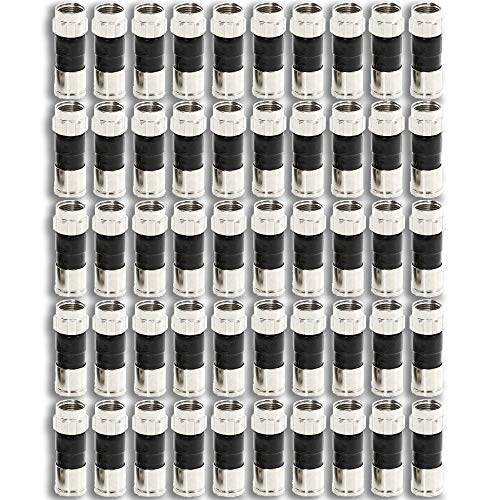
2. PPC EX6XL Universal Compression Connectors (RG6, 50-Pack)
The EX6XL is the fitting the cable industry standardized on, and its datasheet explains why installers trust it. The extended body fits Series 6 cable from 60 percent braid through quad shield, so one bag covers nearly any RG6 a home project turns up. The maker rates it from 0 to 3 GHz with return loss of at least -30 dB across that range, comfortably ahead of anything an antenna run will ask of it. An integrated O-ring seals the cable entry, and the body is nickel-plated brass.
The headline number, a minimum cable retention of 45 pounds, is a maker figure measured on new cable, and this guide treats it that way: strong evidence of a well-designed grip, not a guarantee for your rooftop. The 50-pack suits anyone terminating a full house. The EX6XL wants a tool with the correct stroke for its extended body, so confirm your tool lists the EX series before the ladder goes up.
3. IDEAL RTQ XR RG6 Compression F-Connectors 92-650 (Jar of 50)
IDEAL’s RTQ line takes the opposite approach to Klein’s universal sleeve: instead of one sleeve that adapts, the RTQ XR is engineered around the three common RG6 builds, regular, tri-shield and quad, with fit ranges printed in the maker’s documentation. If your cable is a known quantity from a single spool, that specificity is a virtue, because the grip lands exactly where the design intends. The fittings are nickel-plated brass, and IDEAL places the line for indoor and outdoor use under its WeatherProof designation, a maker designation rather than an independent certification.
The jar of 50 is the format installers actually store, resealable and easy to grab from. IDEAL specifies its own 30-603 and 30-793 tools plus the LinearX adjustable tool. Choose this one when your cable is identified and you want a documented fit instead of an adaptive one.
4. PCT-TRS-6 Universal RG-6 Locking Compression Connectors (10-Pack)
PCT builds fittings for the cable-plant world, and the TRS-6 brings a feature the others here do not emphasize: a locking design intended to resist the slow loosening that vibration and thermal cycling work into a threaded joint. On an antenna mast, where wind keeps every connection in faint motion for years, resistance to backing off is worth real attention. The TRS-6 is sold as a universal RG-6 fitting covering the common shield builds, and the 10-pack fits a single installation with spares for the inevitable dropped fitting in the grass.
PCT publishes less consumer-facing documentation than Klein or IDEAL, so the discipline from How to Choose matters doubly: confirm your tool’s stroke suits it with a test termination, and weatherproof the finished joint rather than trusting any single seal. For a mast-mounted antenna in a windy location, that locking behavior is why it makes the list.
5. Klein Tools VDV812-615 Universal Compression F Connectors (RG59, 10-Pack)
Plenty of houses still carry RG59, run decades ago for cable TV and CCTV, and forcing an RG6 fitting onto it produces exactly the loose, intermittent connection that gives old cable a bad name. RG59 has a thinner dielectric and smaller overall diameter, and it needs its own fitting. The VDV812-615 applies Klein’s universal sleeve approach to RG59, with the same seating windows and solid brass, nickel-plated construction as its RG6 sibling.
Two honest notes belong here. First, a correct fitting does not upgrade the cable: RG59 loses more signal per foot at modern TV frequencies than RG6, so long RG59 runs are candidates for replacement, not just re-termination. Second, this pick shares a brand with our first pick by merit, not by bundle; the two serve different cables. For short legacy runs or one stubborn room where the RG59 is buried in finished walls, this is the right way to end that cable.
Comparison Table
| Fitting | Cable fit | Seal approach | Tool family | Pack |
|---|---|---|---|---|
| Klein VDV812-606 | RG6, RG6 quad | Sleeve seal at cable entry | Klein VDV211 / VDV212 | 10 |
| PPC EX6XL | RG6, 60% braid to quad | Integrated O-ring | EX-series stroke tools | 50 |
| IDEAL RTQ XR 92-650 | RG6 regular / tri / quad | WeatherProof line designation | IDEAL 30-603 / 30-793 / LinearX | 50 jar |
| PCT-TRS-6 | RG6 universal | Locking design against loosening | Standard compression tools, test first | 10 |
| Klein VDV812-615 | RG59 | Sleeve seal at cable entry | Klein VDV211 / VDV212 | 10 |
FAQ
Can I use an RG6 fitting on RG59 cable, or the other way around?
No. The two cables differ in dielectric and overall diameter, so an RG6 fitting on RG59 compresses onto air and grips weakly, while an RG59 fitting will not pass over RG6 at all. Each cable gets its own fitting size, which is why this guide carries a dedicated RG59 pick.
Why did my outdoor connection fail after a couple of seasons?
Usually water, not the fitting alone. The O-ring or sleeve seals the back of the connector, but the threaded joint at the antenna stays exposed; moisture wicks in, corrodes the contact surfaces and raises loss until channels drop. A weather boot or sealing tape over the joint, plus a drip loop, prevents most of it.
Do universal fittings really fit quad-shield cable?
Within their stated range, yes. A universal sleeve absorbs the diameter differences between standard and quad-shield RG6 of the same cable series. The limit is the series itself: a universal RG6 fitting is not an RG59 or RG11 fitting, and cable outside the printed diameter range still will not seat.
Can I reuse a compression fitting after removing it?
No. Compression is a one-time deformation: the sleeve has already collapsed onto the cable jacket and cannot grip a second time. Cut the old fitting off with a small margin of cable, strip fresh, and terminate with a new fitting. This is the practical reason to buy a few spares.
Conclusion
For most home antenna projects, the Klein VDV812-606 is the fitting to reach for first, because its universal sleeve forgives diameter differences between cable brands. For a full house of terminations on identified cable, the PPC EX6XL and the IDEAL RTQ XR jar are the trade-grade answers, one adaptive and one specified. The PCT-TRS-6 earns its place where wind works joints loose, and the Klein VDV812-615 keeps legacy RG59 honest. Whichever bag you open, the result is decided before the tool closes: the right fitting for the exact cable, a clean strip, the matching tool, and weatherproofing over the finished joint.
More from Amazon
Programs that pair well with the guide above. Offers and eligibility are set by Amazon and may change.
Free shipping on eligible items, Prime Video and more. Eligible new members can start with a free trial.
Start a Prime free trialAd-free music streaming. Eligible new subscribers can start with a free trial.
Try Music Unlimited freeA Prime membership for ages 18-24 with a trial period. Eligibility is set by Amazon.
See Prime for Young AdultsAudiobooks and podcasts to listen to on the go. Eligible new members can start with a free trial.
Try Audible freeAs an Amazon Associate we earn from qualifying purchases.