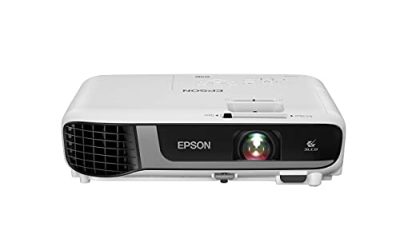
Our Short List of 3

- Best for: Living rooms that stay partly lit, with streaming built in.
- 4K PRO-UHD (pixel-shifted) with 3-chip 3LCD
- 2,800 lumens colour brightness and 2,800 lumens white brightness
- HDR10 and HLG support
- Android TV built in; 10 W speaker; Bluetooth

- Best for: Movie nights that move between rooms.
- 4K UHD with Dolby Vision
- 1,800 ANSI lumens; HybridBeam (laser + LED) light source
- Google TV with official Netflix
- Up to 200-inch screen; portable design with handle

- Best for: Bright-room gaming on the biggest screen.
- True 4K UHD DLP, standard throw, lamp light source
- 4,000 lumens
- 240 Hz refresh rate; 4.2 ms input lag at 1080p with Enhanced Gaming Mode
- HDR10 and HLG support
All 3 Picks at a Glance
| Product | Specs | Action |
|---|---|---|
| Epson Home Cinema 2350 |
| Check price on Amazon |
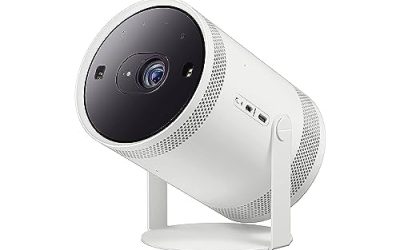
| NEBULA Cosmos 4K SE |
| Check price on Amazon |
| Optoma UHD38x |
| Check price on Amazon |
Our Top Picks
Picking a 4K home projector is really a decision about the room it will live in and the mix of films, sport and games it will show. A bright lamp model suits a living room that never goes fully dark, a portable smart unit suits homes where movie night moves between rooms, and a fast DLP design suits players who want a wall-sized screen without controller delay. Room light, seating distance and sound plans matter more than the badge on the box.
The three models below serve distinct households: families wanting one bright all-rounder with streaming built in, viewers who carry their cinema from room to room, and gamers chasing the quickest response on a big image. Each was chosen from its Amazon listing name and specifications — resolution method, published brightness, smart platform and gaming figures — so the comparison rests on what the product pages actually state.
Quick Picks
As an Amazon Associate we earn from qualifying purchases.
| Product | Best for | Key spec |
|---|---|---|
| Epson Home Cinema 2350 | Family living rooms that stay partly lit | 2,800 lumens colour and white brightness, 3LCD |
| NEBULA Cosmos 4K SE | Movie nights that move between rooms | 4K UHD with Dolby Vision, Google TV |
| Optoma UHD38x | Bright-room big-screen gaming | 4,000 lumens, 4.2 ms input lag at 1080p |
How to Choose
Read brightness on the scale each brand publishes
Brightness figures only help when you read them on the scale the maker publishes. Epson quotes colour brightness and white brightness separately, and equal numbers mean colour stays strong at full output. Anker NEBULA quotes ANSI lumens for the Cosmos 4K SE, a stricter measurement that usually reads lower than a headline lamp figure. Optoma’s 4,000 lumens describe a bright lamp DLP built for rooms with ambient light. Because the scales differ, never rank these three by the raw number alone; instead, match the rating style to how much light your room lets in at viewing time.
Know how each model builds its 4K picture
‘4K’ on a home projector covers more than one technique, and the listing wording tells you which one you are getting. Epson’s 4K PRO-UHD uses pixel shifting on a three-chip 3LCD engine, which also removes the rainbow fringing some viewers notice on single-chip designs. The Optoma UHD38x is a DLP design that shifts its imager to reach true 4K UHD resolution as listed. The NEBULA Cosmos 4K SE pairs its 4K UHD output with Dolby Vision, so the deciding factors are panel type, HDR format support and your own sensitivity to DLP artefacts, not the resolution label alone.
Decide whether streaming lives inside the projector
A projector with a smart platform built in removes a box, a remote and an HDMI port from your setup. The Epson Home Cinema 2350 runs Android TV and adds a 10 W speaker plus Bluetooth, enough for casual viewing without extra kit. The NEBULA Cosmos 4K SE runs Google TV with official Netflix support, which matters if that service anchors your watching. The Optoma lists no built-in platform, so budget a streaming stick or console for it. Decide which route suits your household before comparing picture specifications, because it changes daily use more than most spec gaps.
Match speed and placement to how you play and sit
Gamers should read the latency and refresh figures before anything else. The Optoma UHD38x lists a 240 Hz refresh rate and 4.2 ms input lag at 1080p in its Enhanced Gaming Mode, numbers aimed squarely at fast play, while the Epson simply promises low input latency for gaming. Placement matters just as much: the NEBULA is a portable design with a handle that can fill up to a 200-inch screen, whereas the lamp models expect a fixed shelf or mount. Measure your throw distance and seating position before ordering any of them.
The 3 Best Options
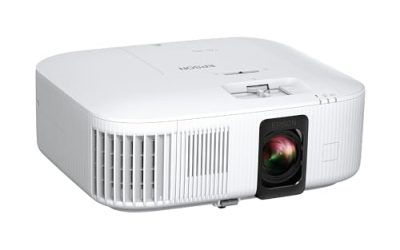
Epson Home Cinema 2350
- Best for: Living rooms that stay partly lit, with streaming built in.
- 4K PRO-UHD (pixel-shifted) with 3-chip 3LCD
- 2,800 lumens colour brightness and 2,800 lumens white brightness
- HDR10 and HLG support
- Android TV built in; 10 W speaker; Bluetooth
Living rooms that stay partly lit, with streaming built in.
It is a lamp model, so plan on a fixed shelf or mount position and eventual lamp replacement rather than carrying it between rooms.
The Epson Home Cinema 2350 is the centre of this shortlist: a lamp-based 3LCD projector bright enough for a family living room that rarely goes dark. Its 4K PRO-UHD picture comes from pixel shifting, and because three-chip 3LCD shows no rainbow effect, it suits households where several viewers watch together. Android TV is built in, the 10 W speaker covers casual viewing, and Bluetooth lets you hand sound to a speaker or headphones. Epson also rates it for low input latency, so family gaming stays on the menu alongside films and sport. It is the first pick to audition for all-in-one households.
NEBULA Cosmos 4K SE
- Best for: Movie nights that move between rooms.
- 4K UHD with Dolby Vision
- 1,800 ANSI lumens; HybridBeam (laser + LED) light source
- Google TV with official Netflix
- Up to 200-inch screen; portable design with handle
Movie nights that move between rooms.
Its ANSI rating is not directly comparable with lamp-projector lumens, so plan on dimming the room for the best picture.
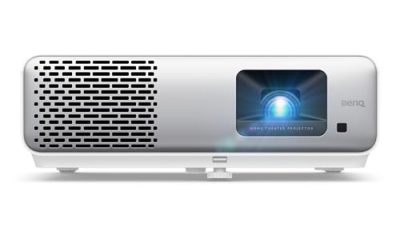
The NEBULA Cosmos 4K SE treats the projector as a portable appliance rather than a fixed installation. A handle, a Google TV interface with official Netflix and a HybridBeam laser and LED light source mean you can carry it to whichever room suits the evening, set it down and watch. Its 4K UHD picture supports Dolby Vision and can scale to a 200-inch screen, while the 1,800 ANSI lumen rating is quoted on the stricter scale, so judge it against darkened-room use rather than headline lamp figures. That combination makes it the easiest of the three to live with in a smaller home.
Optoma UHD38x
- Best for: Bright-room gaming on the biggest screen.
- True 4K UHD DLP, standard throw, lamp light source
- 4,000 lumens
- 240 Hz refresh rate; 4.2 ms input lag at 1080p with Enhanced Gaming Mode
- HDR10 and HLG support
Bright-room gaming on the biggest screen.
Stock signals for this listing vary, so confirm a live featured offer for the exact ASIN on the product page before ordering, and note that no streaming platform is built in.
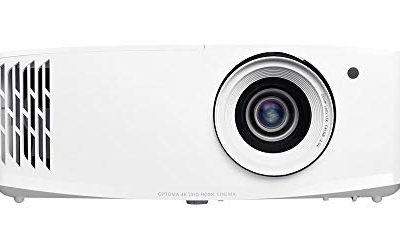
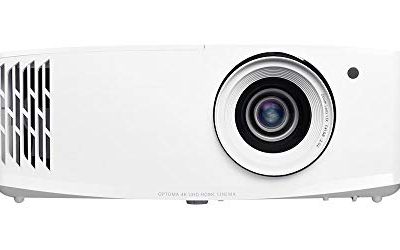
The Optoma UHD38x is the pace pick: a true 4K UHD DLP projector with a 4,000-lumen lamp, built for bright rooms and fast games. The headline figures for players are a 240 Hz refresh rate and 4.2 ms input lag at 1080p with Enhanced Gaming Mode engaged, which puts big-screen play close to monitor responsiveness. HDR10 and HLG support cover film nights, and the standard-throw lens expects a conventional shelf or ceiling position. There is no smart platform listed, so a console or streaming stick becomes part of the setup. It asks for the most deliberate setup of the three, and rewards it.
Which One Fits Your Situation
A family living room that never fully darkens
Choose the Epson Home Cinema 2350. Its equal 2,800-lumen colour and white brightness figures are published for exactly this kind of space, where lamps, windows and kitchen light leak into viewing. Three-chip 3LCD keeps colours steady without rainbow artefacts for mixed audiences, Android TV removes the need for a separate streamer, and the built-in speaker plus Bluetooth cover everyday sound without extra purchases.
Movie night that moves from room to room
Pick the NEBULA Cosmos 4K SE. The handle and portable design are made for carrying between a bedroom, a living room and a spare wall, while Google TV with official Netflix means the service most households open first is already inside, and the laser-LED light source avoids lamp warm-up habits. Just plan on dimming the lights, because its ANSI-rated output is tuned for darker spaces.
A gamer who wants a wall-sized screen
Go with the Optoma UHD38x. Its 4.2 ms input lag at 1080p and 240 Hz refresh rate are the figures competitive players look for, and the 4,000-lumen lamp keeps the image punchy in rooms that cannot black out. You still get true 4K UHD for slower, cinematic titles, but remember to bring your own console or streaming stick, since no smart platform is listed.
A renter who cannot drill or mount anything
The NEBULA Cosmos 4K SE again fits best here. It sits on a shelf or table, travels in one hand and needs no ceiling mount, cabling run or permanent fixing, which keeps a deposit safe. The Epson is the fallback if the room stays bright all evening, but it expects a settled position rather than being packed away after each film.
Common Mistakes
- Comparing lumen numbers across brands as though every maker used the same scale, then feeling misled when an ANSI-rated model looks dimmer than a lamp headline figure in the same room.
- Assuming every projector labelled 4K renders it the same way, without checking whether the listing describes pixel shifting on a 3LCD engine, a DLP design or another method entirely.
- Forgetting the source: buying a projector with no built-in smart platform and no spare HDMI plan for the streaming services the household actually watches every night.
- Judging a gaming projector by resolution alone while ignoring the input lag and refresh rate figures printed in its listing, which decide how responsive play actually feels.
- Ordering a renewed unit or a non-US variant by mistake instead of the exact new model named in the roundup, because similar names hide different listings.
Frequently Asked Questions
Is pixel-shifted 4K the same as native 4K?
Not exactly, but the practical gap is smaller than the wording suggests. Pixel shifting fires the imager more than once per frame to build a 4K image, and both the Epson PRO-UHD and the Optoma DLP design use a form of it. Seating distance and screen size influence perceived sharpness more than the technique label.
How bright should a 4K home projector be?
It depends on the room rather than a universal number. A darkened room can look rich with an ANSI-rated portable like the NEBULA, while a living room with lamps and windows needs a stronger lamp rating like the Epson’s equal colour and white figures or the Optoma’s higher output. Always check which scale the figure uses.
Do I still need a streaming stick with these projectors?
Only with the Optoma UHD38x, whose listing names no built-in platform, so a console, stick or media box supplies your services. The Epson runs Android TV and the NEBULA runs Google TV with official Netflix, so both play their supported services straight from the projector menu, with the Epson adding Bluetooth for external sound.
Can one of these replace a gaming monitor?
For big-screen play, the Optoma UHD38x comes closest, with 4.2 ms input lag at 1080p and a 240 Hz refresh rate in its Enhanced Gaming Mode. The Epson also lists low input latency for gaming. A desk monitor still wins on pixel density at close range, so treat the projector as the shared-screen option.
More from Amazon
Programs that pair well with the guide above. Offers and eligibility are set by Amazon and may change.
Free shipping on eligible items, Prime Video and more. Eligible new members can start with a free trial.
Start a Prime free trialAd-free music streaming. Eligible new subscribers can start with a free trial.
Try Music Unlimited freeA Prime membership for ages 18-24 with a trial period. Eligibility is set by Amazon.
See Prime for Young AdultsAudiobooks and podcasts to listen to on the go. Eligible new members can start with a free trial.
Try Audible freeAs an Amazon Associate we earn from qualifying purchases.