Our Short List of 3

- Best for: Listeners who prize imaging and midrange purity in small to medium rooms
- Design: Two-way bass reflex, passive
- Driver: 12th-generation Uni-Q array, 5.25 inch aluminum woofer with 1 inch vented aluminum dome tweeter
- Technology: Metamaterial Absorption Technology (MAT) behind the tweeter
- Frequency response: 79 Hz to 28 kHz (±3 dB)

- Best for: Mixed music and movie systems that need real bass weight without a subwoofer
- Tweeter: 1 inch Pinnacle Ring Radiator
- Woofer: 6.5 inch Turbine Cone
- Port: Rear-firing X-Port with Eigentone Filter
- Certification: Hi-Res Audio certified; Dolby Atmos and IMAX Enhanced certified

- Best for: Low-power or tube-amp owners and anyone who listens loud in bigger rooms
- Tweeter: 1 inch LTS titanium diaphragm in a 90 x 90 silicone composite hybrid Tractrix horn
- Woofer: Cerametallic cone
- Port: Rear-firing Tractrix port
- Terminals: Dual binding posts, bi-wire and bi-amp capable
All 5 Picks at a Glance
| Product | Specs | Action |
|---|---|---|
| KEF LS50 Meta (Pair, Carbon Black) |
| Check price on Amazon |
| Polk Audio Reserve R200 (Pair, Black) |
| Check price on Amazon |
| Klipsch RP-600M II (Walnut) |
| Check price on Amazon |
 KEF Q150 (Pair, Black) |
| Check price on Amazon |
 ELAC Debut 2.0 B6.2 (Pair, Black) |
| Check price on Amazon |
Key takeaways
- Five audiophile bookshelf speakers compared: KEF LS50 Meta, Polk R200, Klipsch RP-600M II, KEF Q150 and ELAC B6.2, with specs and amp advice.
The real decision with audiophile bookshelf speakers is not which one collects the most praise in forums. It is which design fits the amplifier you already own, the distance between your chair and the speakers, and how close the cabinets will have to sit to a wall. A low-sensitivity speaker fed by a weak receiver sounds thin no matter how refined its drivers are, and a rear-ported cabinet shoved flat against drywall turns clean bass into boom.
This guide is for listeners building a serious two-channel system, upgrading from entry-level speakers, or choosing high-quality front speakers that will also serve a home theater. Every pick below is a passive bookshelf model sold on Amazon, selected from the driver designs, sensitivity figures, and cabinet details published on its own product page, so you can match each speaker to your room and electronics before ordering.
Quick Picks
As an Amazon Associate we earn from qualifying purchases
| Product | Best for | Key spec from title |
|---|---|---|
| KEF LS50 Meta (Pair, Carbon Black) | Imaging and midrange purity in small to medium rooms | Uni-Q driver with Metamaterial Absorption Technology |
| Polk Audio Reserve R200 (Pair, Black) | Music and movies in larger rooms without a subwoofer | 6.5 inch Turbine Cone woofer with rear X-Port |
| Klipsch RP-600M II (Walnut) | Low-power amps and loud listening in big rooms | 90 x 90 Tractrix horn with titanium tweeter |
| KEF Q150 (Pair, Black) | Coherent nearfield sound at a desk or in a small room | 5.25 inch Uni-Q driver array |
| ELAC Debut 2.0 B6.2 (Pair, Black) | A first serious stereo system on a sensible budget | 6.5 inch aramid fiber woofer, 44 Hz low end |
How to Choose
Sensitivity Decides How Much Amplifier You Need
Sensitivity, printed as a decibel figure on the listing, tells you how loud a speaker plays on a small amount of power, and it decides whether your current amplifier is genuinely enough. The Klipsch RP-600M II sits at the efficient end of this group thanks to its horn, so even a modest receiver can drive it to satisfying levels. The KEF LS50 Meta is rated at 85 dB, which is thirsty: it asks for several times the power to reach the same volume. Compare the rating on each listing with your amp’s honest output, and leave headroom for orchestral peaks and electronic music.
Port Location Controls How Close to the Wall You Can Sit
Most speakers in this roundup vent through a port at the back of the cabinet: the Polk R200 uses its X-Port there, the KEF Q150 fires its CFD-shaped port rearward, and the Klipsch RP-600M II exits through a Tractrix port behind the woofer. A rear port needs open air behind it to work as designed. Pressed against a wall, the same port that should add clean weight instead bloats the upper bass and muddies male vocals. If your shelf or stand forces the cabinet within a couple of inches of drywall, either pull the speakers forward, choose a listening position farther out, or accept a smaller, leaner presentation.
Concentric, Horn, or Conventional Two-Way Drivers
Driver layout shapes the sound more than any single specification. KEF’s Uni-Q designs place the tweeter at the acoustic center of the woofer, so high and low frequencies leave from one point and the stereo image stays stable when you move around the room. Klipsch takes the opposite route: a horn concentrates the tweeter’s output, trading some smoothness for dynamics and volume. The Polk and ELAC models use the conventional separate woofer and dome tweeter arrangement, which is easier to voice evenly and easier to manufacture well at lower cost. None of these approaches is automatically better; they suit different rooms and tastes.
Rated Bass Extension and the Subwoofer Question
The low-frequency figure on a listing tells you how much of the music a pair can honestly cover alone. The ELAC B6.2 is rated down to 44 Hz and the KEF Q150 to 51 Hz, which covers the fundamentals of most acoustic and rock recordings. The LS50 Meta stops at 79 Hz, so double bass, piano lows, and film effects lose their foundation without help. A subwoofer is not an admission of failure; it is the normal partner for a small two-way. Decide before ordering whether your budget and floor space include one, because that answer changes which speaker belongs on your shortlist.
The 5 Best Options
KEF LS50 Meta (Pair, Carbon Black)
- Best for: Listeners who prize imaging and midrange purity in small to medium rooms
- Design: Two-way bass reflex, passive
- Driver: 12th-generation Uni-Q array, 5.25 inch aluminum woofer with 1 inch vented aluminum dome tweeter
- Technology: Metamaterial Absorption Technology (MAT) behind the tweeter
- Frequency response: 79 Hz to 28 kHz (±3 dB)
Listeners who prize imaging and midrange purity in small to medium rooms
The 85 dB sensitivity and demanding load need a high-current amplifier; a small AV receiver will leave it sounding flat
If imaging is the reason you listen, the LS50 Meta is the reference point in this group. Its Uni-Q array puts the tweeter at the center of the woofer, so vocals and instruments stay locked in place even when you shift in your chair, and the Metamaterial Absorption Technology behind the tweeter keeps the top end clean as the volume rises. The trade-offs are real: it is the least sensitive speaker here, and its rated bass gives up below the lowest notes of a piano, so it rewards a strong amplifier and, for many listeners, a subwoofer.
Polk Audio Reserve R200 (Pair, Black)
- Best for: Mixed music and movie systems that need real bass weight without a subwoofer
- Tweeter: 1 inch Pinnacle Ring Radiator
- Woofer: 6.5 inch Turbine Cone
- Port: Rear-firing X-Port with Eigentone Filter
- Certification: Hi-Res Audio certified; Dolby Atmos and IMAX Enhanced certified
Mixed music and movie systems that need real bass weight without a subwoofer
At 13.9 inches deep plus the space its rear port needs, it will not fit shallow shelves or tight media cabinets
The R200 is the biggest cabinet in this roundup, and it plays like it. Polk’s Turbine Cone woofer moves serious air for a bookshelf design, while the rear X-Port is shaped to keep that output free of the chuffing noise plain ports make at high volume. The Pinnacle Ring Radiator tweeter extends the top end well beyond a standard dome, which suits high-resolution music files and the Dolby Atmos and IMAX Enhanced material the listing certifies this speaker for. Choose it when one pair has to cover long stereo listening sessions and movie nights in a medium or large room.
Klipsch RP-600M II (Walnut)
- Best for: Low-power or tube-amp owners and anyone who listens loud in bigger rooms
- Tweeter: 1 inch LTS titanium diaphragm in a 90 x 90 silicone composite hybrid Tractrix horn
- Woofer: Cerametallic cone
- Port: Rear-firing Tractrix port
- Terminals: Dual binding posts, bi-wire and bi-amp capable
Low-power or tube-amp owners and anyone who listens loud in bigger rooms
The horn-loaded tweeter can sound forward with bright electronics, so it pairs best with neutral or warm amplification
Klipsch builds speakers for people who listen loud, and the RP-600M II follows that script. A titanium tweeter sits at the throat of a large Tractrix horn, which focuses the sound and lets the speaker reach high volumes with far less amplifier power than the KEF models need. The Cerametallic woofer keeps the low end tight when the volume climbs, and dual input terminals leave the door open to bi-wiring or bi-amping later. The furniture-grade walnut finish makes it the easiest pair here to live with visually, though the horn presentation is lively rather than laid back.
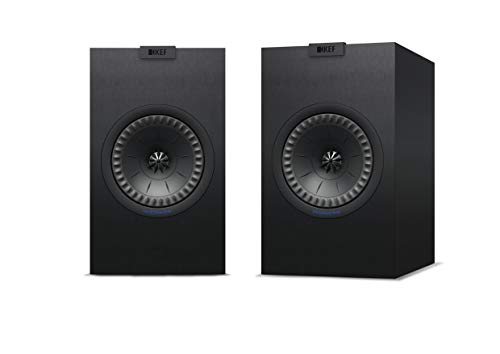
KEF Q150 (Pair, Black)
- Best for: Coaxial imaging in a compact footprint for desks and small rooms
- Driver: Uni-Q array, 5.25 inch aluminum woofer with 1 inch vented aluminum dome tweeter
- Frequency response: 51 Hz to 28 kHz (±3 dB)
- Sensitivity: 86 dB
- Impedance: 8 ohms (minimum 3.7 ohms)
Coaxial imaging in a compact footprint for desks and small rooms
The 86 dB sensitivity means small amplifiers run out of headroom quickly in larger rooms; keep it in the space it was sized for
The Q150 takes the same Uni-Q idea as the LS50 Meta and packages it for smaller rooms and smaller systems. The tweeter sits inside the 5.25 inch aluminum woofer, so sound arrives from a single point and stays coherent when you listen up close at a desk or from a sofa a few feet away. Its rear port is shaped using computational fluid dynamics to cut turbulence, which helps the bass stay articulate at the modest volumes this speaker is usually played at. It is the natural pick when space and amplifier power, not output, are the limits.
ELAC Debut 2.0 B6.2 (Pair, Black)
- Best for: A first serious stereo system built around a modest amplifier or receiver
- Tweeter: 1 inch cloth dome
- Woofer: 6.5 inch aramid fiber
- Design: Two-way bass reflex
- Frequency response: 44 Hz to 35 kHz
A first serious stereo system built around a modest amplifier or receiver
At 14.76 inches tall it is a large bookshelf cabinet, so measure your shelf height and depth before ordering
The Debut 2.0 B6.2 was designed to show how much performance careful engineering can pull from an attainable two-way, and it remains the value anchor of this group. The aramid fiber woofer holds its shape under stress, the cloth dome tweeter is voiced smooth rather than flashy, and the rated response reaches down to 44 Hz, so many rooms will not miss a subwoofer at all. The cabinet finish is plain black ash vinyl and the styling is understated, but the engineering budget clearly went into the drivers and crossover instead of the cosmetics.
Which One Fits Your Situation
A Desk or Nearfield Setup in a Small Room
Sit close and the KEF Q150 makes the most sense. Its Uni-Q driver keeps the image coherent at arm’s length, where conventional two-way speakers can separate into a tweeter up high and a woofer down low. The cabinet is compact enough for real desks, and its 51 Hz low end is honest at the volumes nearfield listening actually uses. Add a small subwoofer later only if gaming or film sound demands it.
One Pair for Records and Movie Nights
The Polk R200 is the only speaker here sized and certified for both jobs at once. Its Turbine Cone woofer and X-Port deliver the weight film soundtracks need, the tweeter is Hi-Res Audio certified for detailed stereo listening, and the same model can move to surround duty later because it is sold as a full-range bookshelf design. Give it stands and space behind the cabinet, and it anchors a system that does not need a subwoofer on day one.
A Low-Power Amp or a Big, Loud Room
Reach for the Klipsch RP-600M II. Horn loading means a small integrated amp or a low-powered tube design still produces convincing volume, and the Cerametallic woofer holds together when the room asks for more. In a large space where the KEF models would strain, the Klipsch stays relaxed. Just keep the rest of the chain neutral, because the horn will faithfully pass along any brightness your electronics add.
Your First Real Stereo Around an Existing Receiver
Start with the ELAC Debut 2.0 B6.2. Its 87 dB sensitivity is friendly to the receivers and integrated amps most people already own, the 44 Hz low end postpones the subwoofer purchase, and the smooth cloth dome tweeter forgives imperfect recordings while you build a library. It is also the easiest speaker in this group to upgrade around, since a better amplifier later will simply reveal more of what the drivers can do.
Common Mistakes
- Pairing a low-sensitivity speaker like the LS50 Meta with a low-power receiver, then blaming the speaker for thin, flat sound.
- Pushing rear-ported cabinets flat against the wall, which bloats the bass and buries vocal clarity.
- Setting speakers on a resonant shelf at the wrong height instead of stands that put the tweeters near ear level.
- Judging a pair in the first ten minutes, before experimenting with toe-in and distance from the back wall.
- Spending the remaining budget on exotic speaker cable while the amplifier is underpowered for the speakers chosen.
Frequently Asked Questions
Do all five of these speakers need a separate amplifier?
Yes. Every model in this roundup is passive, which means the cabinet holds drivers and a crossover but no amplification. You will need a stereo receiver, an integrated amplifier, or an AV receiver, plus ordinary speaker wire. Check the recommended power range in each listing against your amp’s rating before ordering, especially with the KEF LS50 Meta, which is the most demanding load here.
How far from the wall should rear-ported bookshelf speakers sit?
A practical starting point is eight to twelve inches of clear space behind the cabinet, then adjust by ear in small steps. The Polk R200, KEF Q150, and Klipsch RP-600M II all vent through rear ports, so their bass balance changes noticeably with distance. If the sound turns boomy, move them forward; if it turns thin, move them back slightly.
Can bookshelf speakers this size fill a room without a subwoofer?
For music, often yes. The ELAC B6.2 reaches 44 Hz and the Polk R200 produces genuine low-end weight, so both cover most recordings convincingly on their own. The LS50 Meta, rated to 79 Hz, is the exception: it is designed for clarity in the range it covers and benefits from a subwoofer for full-range listening. Room size and your taste in bass decide the rest.
What should I check on the Amazon listing before ordering?
Confirm three things: that the listing is for a pair rather than a single speaker, that the finish shown matches the color you want, since several of these models sell in multiple finishes under separate listings, and that the seller and return terms are clear. Finishes and stock rotate between sellers on popular models, so a minute spent checking the exact listing saves a return later.
More from Amazon
Programs that pair well with the guide above. Offers and eligibility are set by Amazon and may change.
Free shipping on eligible items, Prime Video and more. Eligible new members can start with a free trial.
Start a Prime free trialAd-free music streaming. Eligible new subscribers can start with a free trial.
Try Music Unlimited freeA Prime membership for ages 18-24 with a trial period. Eligibility is set by Amazon.
See Prime for Young AdultsAudiobooks and podcasts to listen to on the go. Eligible new members can start with a free trial.
Try Audible freeAs an Amazon Associate we earn from qualifying purchases.