Our Short List of 3

- Display technology: DLP
- Native resolution: 1920 x 1080 (1080p)
- Brightness: 200 ANSI lumens
- Smart platform: Google TV with licensed Netflix

- Display technology: DLP
- Native resolution: 1920 x 1080 (1080p)
- Brightness: 450 ISO lumens
- Smart platform: Google TV with licensed Netflix
- Display technology: DLP
- Native resolution: 1920 x 1080 (1080p)
- Brightness: 450 ISO lumens
- Smart platform: Google TV with licensed Netflix
All 5 Picks at a Glance
| Product | Specs | Action |
|---|---|---|
| Anker Nebula Capsule 3 |
| Check price on Amazon |
| XGIMI MoGo 3 Pro with PowerBase Stand |
| Check price on Amazon |
| Dangbei Freedo |
| Check price on Amazon |
 Kodak Luma 350 |
| Check price on Amazon |
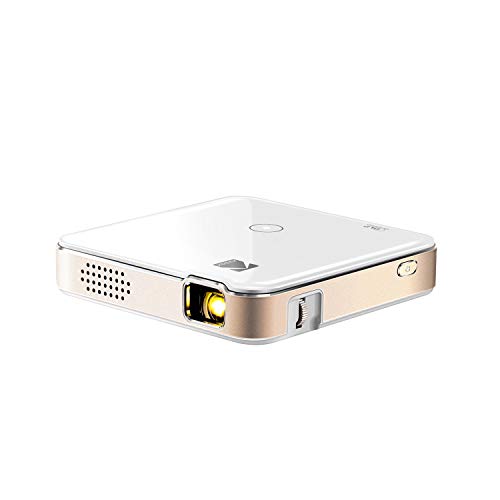 Kodak Luma 150 |
| Check price on Amazon |
Our Top Picks
A handheld projector is the smallest class of projector there is: a battery-powered unit small enough to hold in one hand, carry in a jacket pocket or the side pouch of a backpack, and set up on a nightstand, a picnic table or a hotel dresser. There is no installation, no mount and no cable run. Charge it, point it at a wall or ceiling, and a movie night happens wherever you happen to be.
That definition matters, because the word “portable” gets stretched a long way in projector listings. Plenty of so-called portable models are really small home projectors that still need a wall outlet and a shelf of their own. Every pick in this roundup is genuinely handheld: each one runs on a built-in battery or an included battery stand, weighs little enough to carry without thinking about it, and keeps its setup tools — autofocus, auto keystone or a tilting stand — built into the body.
The five models below split into two camps. The first three are modern smart handhelds with native 1080p resolution, licensed streaming apps and automatic image setup. The last two are true pocket squares from Kodak: far smaller and simpler, with lower resolution, made for travel kits where every ounce counts. All five stream or mirror content without a separate media player in most situations, and all five work in the dim or dark rooms where handheld projectors make sense.
As an Amazon Associate, we earn from qualifying purchases.
Anker Nebula Capsule 3
- Display technology: DLP
- Native resolution: 1920 x 1080 (1080p)
- Brightness: 200 ANSI lumens
- Smart platform: Google TV with licensed Netflix
The Nebula Capsule 3 is the most complete handheld projector in this group. It keeps the soda-can cylinder shape the Capsule line is known for, stretches it a little taller, and packs in a native 1080p DLP image, a Google TV platform with officially licensed Netflix, and a built-in battery rated for up to two and a half hours of playtime. For most people shopping this category, it is the pick that asks for the fewest compromises.
Brightness is the honest limitation. At 200 ANSI lumens, the Capsule 3 wants a dark or dim room, and it looks best at moderate image sizes rather than stretched to its maximum. Within those conditions the picture is sharp, the autofocus and auto keystone correction square the image without manual fiddling, and the 8-watt speaker with Dolby Digital support is strong enough that a small room does not need a separate Bluetooth speaker. It charges over USB-C, so the same power bank that tops up a phone can extend a camping movie night.
XGIMI MoGo 3 Pro with PowerBase Stand
- Display technology: DLP
- Native resolution: 1920 x 1080 (1080p)
- Brightness: 450 ISO lumens
- Smart platform: Google TV with licensed Netflix
The XGIMI MoGo 3 Pro is the brightest handheld here, and brightness is the spec that decides how large an image a small projector can hold. Its 450 ISO lumens roughly double the light output of the Capsule 3, which means a bigger, punchier picture in the same dark room, or a watchable one with a lamp still on across the room. The native 1080p DLP image is paired with Google TV and licensed Netflix, so the streaming side needs no extra hardware.
The design is built around a stand. The body rises from an integrated base that tilts for aiming, including ceiling projection, and XGIMI’s ISA 2.0 setup handles autofocus and keystone correction automatically. This listing pairs the projector with the PowerBase Stand, which is where the battery lives: the stand carries the charge for up to two and a half hours of cordless viewing, and the projector also runs from USB-C power banks. Sound comes from dual 5-watt Harman Kardon speakers, the strongest audio hardware in this roundup alongside the bigger image.
Dangbei Freedo
- Display technology: DLP
- Native resolution: 1920 x 1080 (1080p)
- Brightness: 450 ISO lumens
- Smart platform: Google TV with licensed Netflix
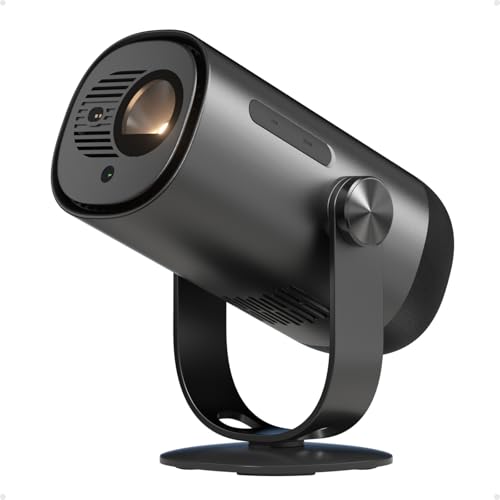
The Dangbei Freedo takes a different approach to aiming the picture. Instead of a fixed body on a tilting base, the projector sits in an integrated gimbal stand that swings through a wide arc, so it can throw an image at a wall, angle it up a sloped ceiling, or lie back for a full ceiling view above a bed. For renters, dorm rooms and anyone whose best screen is the ceiling, that range of motion is the reason to pick it.
On paper the Freedo matches the MoGo 3 Pro closely: native 1080p DLP, 450 ISO lumens, Google TV with licensed apps, and automatic focus and keystone setup. The battery is built into the unit rather than the stand, rated for up to two and a half hours of video, and USB-C charging means a power bank can refill it between sessions. Dolby Audio processing covers the sound, and the whole unit is shaped like a large travel tumbler, with a carrying case included in the box for travel.
Kodak Luma 350
- Display technology: DLP
- Native resolution: 854 x 480 (accepts up to 4K input)
- Brightness: 150 ANSI lumens
- Smart platform: onboard Android with app store
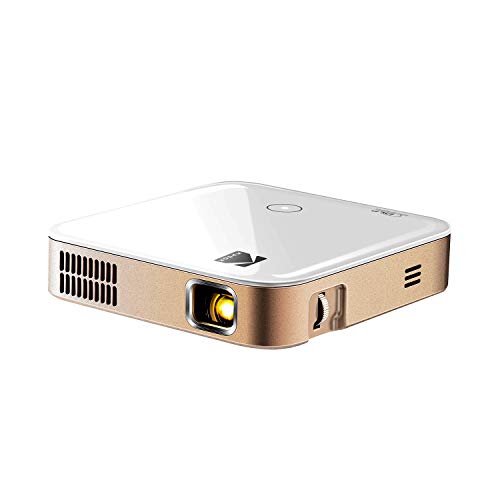
The Kodak Luma 350 is where this roundup moves from handheld to truly pocketable. It is a flat square slab, under an inch thick and weighing about twelve ounces, that slips into a purse, a laptop sleeve or a seat-back organizer. Nothing else in this list disappears into a bag the way the Luma 350 does, and for frequent travelers that size is the entire point.
The trade-offs are resolution and brightness. The native picture is 854 x 480, although the projector accepts input signals up to 4K and scales them down, and output is rated at 150 ANSI lumens, so a dark room and a modest image size are essential. In exchange, the Luma 350 runs an onboard Android platform with its own app store, mirrors phones over Wi-Fi with Miracast and AirPlay, connects over Bluetooth to headphones or a speaker, and takes HDMI and USB sources when wireless will not do. The 7,500 mAh battery is rated for up to two hours of viewing, longer in Eco mode, and the image can stretch up to 150 inches in ideal darkness, though it looks far better kept smaller.
Kodak Luma 150
- Display technology: DLP
- Native resolution: 854 x 480 (supports 1080p input)
- Brightness: 60 ANSI lumens
- Battery: built-in rechargeable, up to 2.5 hours
The Kodak Luma 150 is the smallest and simplest projector in this roundup, a budget pocket pick for people who want the absolute minimum of gear. It shares the Luma 350’s flat square shape and 854 x 480 native resolution but trims the brightness to 60 ANSI lumens and drops the onboard smart platform. What it keeps is the essentials: a built-in rechargeable battery rated for up to two and a half hours, a built-in speaker, and wireless screen mirroring for phones.
That makes the Luma 150 a casting device first. Send video from a phone over Wi-Fi, or connect a source directly through HDMI, USB or a microSD card, and it handles casual viewing in a dark room: a cartoon on a tent wall, a slideshow on a hotel ceiling, a presentation run-through in a small office. The dimmer image rules out larger screens and brighter rooms, but at under four inches square and less than an inch thick, it is the one projector here that fits a jacket pocket without a second thought.
How to Choose
Start with brightness and room light. Brightness is the spec that governs everything else in a handheld projector. Models in the 60 to 200 lumen range, like the two Kodak Lumas and the Capsule 3, need a genuinely dark room and a moderate image size. The 450-lumen models, the MoGo 3 Pro and the Freedo, hold a larger image and tolerate a little ambient light. No handheld projector works in daylight, so if the room cannot be darkened, this entire category is the wrong tool.
Decide how much resolution you need. Native 1080p models stay sharp at 80 to 100 inches and handle subtitles, sports graphics and game interfaces cleanly. The 854 x 480 Kodaks are fine for casual video at smaller sizes but show their limits with fine text. If the projector will double for presentations or shared documents, stay with a 1080p pick.
Check the smart platform, not just the Wi-Fi. A licensed Google TV build, as on the Capsule 3, MoGo 3 Pro and Freedo, runs Netflix and the other major services directly, with a remote and an app store. The Luma 350’s older Android build and the Luma 150’s mirroring-only approach work well but lean more on a phone. Confirm the services you actually watch are supported on the platform you choose, because licensing differs between models.
Think about battery honestly. Ratings of two to two and a half hours cover most single movies, but long films, double features and gaming sessions will outlast them. USB-C charging, shared by the three larger picks, is the practical fix: any decent power bank becomes a range extender. Also note where the battery lives. The MoGo 3 Pro’s battery is in its PowerBase Stand, so the stand is part of the travel kit, not an optional extra.
Match the stand to your surfaces. Ceiling viewing is a signature handheld use case, and it needs tilt range. The Freedo’s gimbal and the MoGo 3 Pro’s tilting base aim upward easily. The flat Kodaks sit level and need a stack of books or a small tripod thread solution to angle up. Autofocus and auto keystone, standard on the three 1080p models, remove most of the remaining setup friction.
Frequently Asked Questions
Can a handheld projector replace a TV?
For casual viewing in a dark room, it can cover the role part time, especially the 1080p models here at moderate image sizes. It cannot match a television for brightness, daytime use or fine detail, so most owners treat a handheld projector as a second screen for travel, bedrooms and outdoor nights rather than a full replacement.
How big an image can a handheld projector make?
The models here are rated for images up to 120 to 150 inches, but those maximums assume total darkness and accept a dim, soft picture. In practice, handheld projectors look their best between about 40 and 80 inches, where brightness and sharpness stay convincing.
Do handheld projectors work with phones?
Yes. All five picks connect to phones in some way: the Google TV models support casting, the Kodaks mirror over Wi-Fi with Miracast and AirPlay, and every model here also accepts a wired HDMI connection with the right adapter. Mirroring copy-protected streaming apps can be restricted by the app itself, which is one reason a built-in licensed platform is worth having.
How long do the batteries really last?
The ratings in this roundup run from two to two and a half hours, and real viewing usually lands close to those figures at moderate brightness. Raising brightness, enlarging the image and streaming over Wi-Fi all draw more power. A USB-C power bank is the standard backup for the three larger picks.
Final Verdict
The Anker Nebula Capsule 3 is the best handheld projector for most buyers: native 1080p, licensed Google TV, a real built-in battery and automatic setup in a can-size body. Buyers who want the biggest, brightest picture this category offers should step up to the XGIMI MoGo 3 Pro with its PowerBase Stand, while the Dangbei Freedo is the pick for ceiling viewing thanks to its gimbal. At the pocket end, the Kodak Luma 350 is the traveler’s smart slab, and the Kodak Luma 150 is the budget minimum — the smallest way to put a movie on a wall.
Product and ASIN Reference
| Product | ASIN |
|---|---|
| Anker Nebula Capsule 3 | B0CHW11C8H |
| XGIMI MoGo 3 Pro with PowerBase Stand | B0D8KFC85K |
| Dangbei Freedo | B0DM8X8L1P |
| Kodak Luma 350 | B07RB7P439 |
| Kodak Luma 150 | B07RLXZ88F |
More from Amazon
Programs that pair well with the guide above. Offers and eligibility are set by Amazon and may change.
Free shipping on eligible items, Prime Video and more. Eligible new members can start with a free trial.
Start a Prime free trialAd-free music streaming. Eligible new subscribers can start with a free trial.
Try Music Unlimited freeA Prime membership for ages 18-24 with a trial period. Eligibility is set by Amazon.
See Prime for Young AdultsAudiobooks and podcasts to listen to on the go. Eligible new members can start with a free trial.
Try Audible freeAs an Amazon Associate we earn from qualifying purchases.