Key takeaways
- Moderately upright backs: Best for critical listening and music reading. Aim for a back angle of roughly 100–110 degrees rather than a very reclined 120-degree lounge profile.
- Rounded or gently curved backs: Reduce large, flat reflective faces and look less bulky than square club chairs.
- Open or narrow arms: Make it easier to play guitar, reach a controller, or stand up without bumping an instrument.
- Swivel bases: Useful in multipurpose rooms, but select a stable base that does not wobble or squeak during quiet passages.
- Very deep cushions: Comfortable for casual listening but often push your head too far from the intended listening position and encourage slouching.
- High backs and wing sides: They provide a more enclosed feel, but can visually crowd a small room and create uneven reflections if placed close to a wall.
The best accent chairs for music rooms are compact upholstered lounge chairs with a supportive, moderately upright shape: choose a low-back reading chair for nearfield listening, a swivel chair for a flexible studio, or a slim armchair when the room also needs to accommodate instruments and stands.
Our top picks
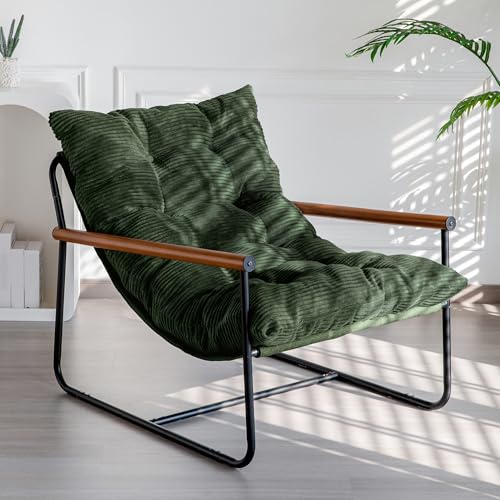


As an Amazon Associate we earn from qualifying purchases at no extra cost to you. Ratings are shown as listed on Amazon.
Best accent chairs for music rooms by situation
| Room or listening situation | Best chair type | Useful target dimensions | Why it works |
|---|---|---|---|
| Small bedroom or listening nook | Armless upholstered lounge chair | 24–29 in wide; 28–34 in deep | Preserves floor space and reduces hard surfaces near the speakers |
| Dedicated stereo room | Firm, upright armchair | 28–34 in wide; 30–36 in deep | Keeps your ears at a consistent height and supports longer sessions |
| Music room used for guitar or keyboard practice | Swivel accent chair | 28–36 in wide; 30–36 in deep | Turns between the instrument, speakers, and music stand |
| Shared living room | Lightweight wooden-frame lounge chair | 26–32 in wide; under 35 lb | Can be moved without dominating the room |
| Recording or production room | Compact task-style upholstered chair | 17–20 in seat height; adjustable if possible | Better for keyboard, controller, and desk work than a deep lounge chair |
What matters most: fabric, shape, and acoustic behavior
Fabric: choose absorption without creating a maintenance problem
Fabric upholstery is usually the most practical choice for a music room. Woven polyester, wool blends, and performance fabrics add a small amount of high-frequency absorption compared with leather, vinyl, wood, or molded plastic. The effect is modest: a chair will not replace broadband panels or bass trapping, but it can reduce the amount of hard, reflective furniture in a lively room.
A tightly woven fabric is a good all-purpose choice because it resists snagging from guitar hardware, headphone cables, and instrument cases. Wool blends feel warm and tend to age well, while polyester performance fabric is often easier to spot-clean. Bouclé and very loose weaves are comfortable but can catch on zippers and may show wear sooner in a room where instruments are frequently moved.
Leather and faux leather are easy to wipe clean, but they reflect more sound and can produce audible creaks when you shift position. If you prefer them, balance the chair with a rug, curtains, or wall treatment rather than placing several hard-surfaced seats around the room.
Shape: support and reflection are linked
- Moderately upright backs: Best for critical listening and music reading. Aim for a back angle of roughly 100–110 degrees rather than a very reclined 120-degree lounge profile.
- Rounded or gently curved backs: Reduce large, flat reflective faces and look less bulky than square club chairs.
- Open or narrow arms: Make it easier to play guitar, reach a controller, or stand up without bumping an instrument.
- Swivel bases: Useful in multipurpose rooms, but select a stable base that does not wobble or squeak during quiet passages.
- Very deep cushions: Comfortable for casual listening but often push your head too far from the intended listening position and encourage slouching.
- High backs and wing sides: They provide a more enclosed feel, but can visually crowd a small room and create uneven reflections if placed close to a wall.
Recommended chair categories
Best for small rooms: compact armless lounge chair
An armless chair measuring about 24 to 29 inches wide is the safest choice when the room is under roughly 120 square feet or must also hold a keyboard, guitar rack, or record storage. Look for a seat height of 17 to 19 inches and a depth no greater than 34 inches. These dimensions provide normal adult support without consuming the clearance needed around stands and cables.
A model with exposed wood or metal legs is preferable to a fully boxed base because it looks lighter and makes vacuuming easier. Put a felt pad under each foot; small rattles can be surprisingly noticeable during quiet listening.
Best for long listening: firm upholstered armchair
For sessions lasting an hour or more, choose a firm seat with a back that supports the shoulder blades while leaving the head free. A seat cushion around 3 to 5 inches thick with medium-firm foam is a useful starting point. Excessively soft cushions flatten over time, change your ear height, and make it harder to maintain a repeatable listening position.
Arm width matters. Broad, padded arms can add 4 to 8 inches to the total footprint without improving listening comfort. Narrow arms or an armless design leave more room for side tables, headphone stands, and instrument cases.
Best for a hybrid studio: compact swivel chair
A swivel accent chair is convenient when one seat serves as a listening position, guitar seat, and workstation. Select one with a controlled swivel and a base that does not roll. Casters can be useful at a desk but are less stable for playing guitar or monitoring a mix.
Keep the chair’s rotation centered on the listening position. If the chair regularly ends up at different angles, your ear-to-speaker geometry changes from session to session. Mark the preferred location on the floor with a small, removable piece of tape.
Decision matrix: match the chair to the room
| Priority | Choose | Avoid | Typical market range |
|---|---|---|---|
| Lowest cost, occasional use | Simple fabric chair with removable cushion | Complex reclining mechanisms | $120–$250 |
| Frequent listening or reading | Firm foam seat, supportive back, 17–19 in seat height | Deep, sinking cushions | $250–$600 |
| Very limited floor area | Armless chair under 30 in wide | Club chairs wider than 34 in | $150–$450 |
| Shared room that changes layout | Chair under 35 lb with felted legs | Heavy recliners and delicate exposed mechanisms | $180–$500 |
| Pets, children, or instrument traffic | Tightly woven, removable, cleanable upholstery | Loose bouclé and pale untreated fabric | $200–$650 |
How large should the chair be?
Measure the usable zone, not merely the empty wall. Allow at least 24 inches of passage beside the chair, 30 inches in front if you regularly stand with an instrument, and enough rear clearance for the back not to touch the wall. A chair that is 30 inches wide can require a 54-inch-wide zone once practical access is included.
For example, suppose a room has 92 inches of clear width between a speaker stand and a side wall. A 30-inch chair leaves 62 inches, but a 24-inch passage on one side and a 30-inch instrument-access zone on the other consume 54 inches. The remaining 8 inches is a comfortable margin. A 40-inch club chair would leave no useful clearance, even though it technically fits.
Also measure the chair’s height against the speaker tweeters. Your ears should remain close to the intended listening axis; if a very low chair places your ears several inches below the tweeters, use a manufacturer’s tilt guidance or adjust the speaker stands rather than adding an unstable cushion.
Acoustic placement without clutter
- Place the chair symmetrically between the left and right speakers when stereo imaging matters.
- Keep the back at least 6–12 inches from a wall where possible; a small gap reduces rubbing, bumps, and trapped dust.
- Do not place a tall wingback chair directly between a speaker and the listening position.
- Use a fabric rug under the chair if the floor is hardwood or tile, but avoid creating a raised edge where cables cross.
- Choose one substantial upholstered chair rather than several mismatched hard chairs. The room will usually sound and look more controlled with fewer large reflective surfaces.
Durability and ownership realities
The first parts to wear are commonly the front edge of the seat, the fabric where arms contact the upholstery, and the swivel or glider mechanism. Sit on the cushion rather than its front edge, and avoid dragging the chair by its arms. For a frequently used chair, removable covers are valuable even when they are not machine washable; they can be professionally cleaned or replaced more easily than fixed upholstery.
Vacuum fabric monthly with a soft upholstery attachment, blot spills instead of rubbing them, and follow the care code sewn under the cushion. Tighten exposed-frame fasteners every six to twelve months. If the chair begins to creak, identify whether the noise comes from the base, frame joint, or floor contact before applying lubricant; lubricant on fabric or a wooden joint can create a larger repair problem.
Budget for a quality chair rather than buying purely by appearance. A $300 chair used three times a week for five years costs about $0.38 per use: $300 divided by 780 sessions. A $900 chair used daily for the same period costs about $0.49 per use. The more expensive option is only worthwhile if its frame, cushion, and upholstery remain comfortable and repairable for longer.
Bottom line
For most music rooms, choose a firm fabric chair about 28–32 inches wide, 30–34 inches deep, and 17–19 inches high at the seat. Pick armless construction for a small space, a compact swivel for a hybrid studio, and a supportive armchair for long listening. Prioritize stable dimensions, cleanable upholstery, and a position that preserves speaker symmetry; acoustic treatment and careful placement will do far more than the chair alone.