Key takeaways
- Choose a 2–3 mm two-layer mat with a stated dissipative resistance range for most home and repair benches. Move to 3–4 mm rubber when durability, grip, and frequent cleaning matter more than portability. Prioritize documented resistance, correct grounding, and maintainable construction over color or extra…
The best anti static workbench mats are two-layer rubber or vinyl mats with a dissipative surface, a documented resistance of roughly 106–109 ohms, and a properly installed common-point ground; the right choice depends on bench size, soldering heat, cleaning habits, and how often the station is used.
Our top picks

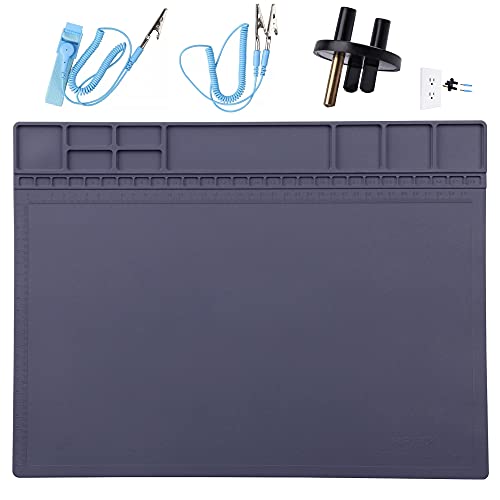
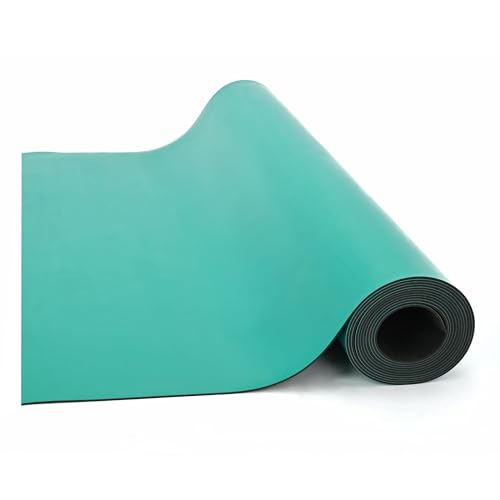
As an Amazon Associate we earn from qualifying purchases at no extra cost to you. Ratings are shown as listed on Amazon.
Quick picks by workbench situation
| Workbench situation | Best mat type | Recommended size | Why it fits |
|---|---|---|---|
| Occasional home electronics repair | Two-layer vinyl or rubber | 450 × 600 mm | Affordable coverage for a laptop-sized work area without occupying the whole desk |
| Frequent soldering and assembly | Thick, heat-resistant two-layer rubber | 600 × 900 mm | More durable under tools, soldering equipment, and repeated cleaning |
| Wide production or repair bench | Modular roll or multi-piece mat system | 600 × 1,200 mm or larger | Covers the active work zone while allowing damaged sections to be replaced |
| Portable field service | Lightweight foldable dissipative mat | 400 × 600 mm | Easy to carry, though usually less resistant to creasing and heat than rubber |
| High-value components and regular handling | Commercial two-layer mat with compliance documentation | 600 × 900 mm | Provides more predictable electrical performance and traceable specifications |
What to look for in the best anti static workbench mats
1. A dissipative, not merely conductive, surface
ESD mats are designed to drain static charges in a controlled way. A surface that is too conductive can discharge energy too quickly, while an insulating mat can allow charge to remain on the bench. Look for a stated surface resistance or point-to-point resistance rather than labels such as “anti-static” alone.
A practical target for a workbench mat is commonly within the dissipative range, around 106 to 109 ohms, although the exact acceptable range depends on the mat design and the applicable ESD control program. A two-layer mat normally has a dissipative top layer and a conductive or dissipative lower layer that spreads the charge toward the grounding connection.
2. Thickness matched to the workload
| Mat thickness | Typical use | Advantages | Trade-offs |
|---|---|---|---|
| 1.5–2 mm | Portable and light-duty benches | Low cost, easy to roll and store | More vulnerable to cuts, curling, and damage from hot tools |
| 2–3 mm | General electronics repair | Good balance of stability, comfort, and portability | May still show dents under heavy equipment |
| 3–4 mm | Frequent assembly and soldering | Better dimensional stability and resistance to wear | Heavier and usually more expensive |
| Over 4 mm | Specialized or permanently installed benches | Excellent cushioning and robust construction | Harder to roll, trim, or reposition; thickness alone does not improve ESD performance |
For most fixed workstations, a 2–3 mm mat is the sensible starting point. Choose 3–4 mm when the bench receives daily tool use, frequent component handling, or abrasive cleaning. Do not use thickness as a substitute for resistance specifications: a thick insulating desk pad is not an ESD control mat.
3. Material and heat resistance
Rubber generally offers better grip, tear resistance, and long-term dimensional stability than inexpensive soft vinyl. Vinyl mats can be lighter and less costly, and they are adequate for many occasional-use stations, but they may curl after storage and can mark more easily.
Neither material should be treated as a soldering surface for a hot iron, heat gun, or torch. Use an iron holder and a separate heat-resistant rest. A mat can tolerate incidental contact better than a bare plastic desk, but repeated hot-tool contact can blister, harden, or permanently change the surface.
Head-to-head: rubber versus vinyl
| Criterion | Rubber mat | Vinyl mat |
|---|---|---|
| Typical thickness | 2–4 mm | 1.5–3 mm |
| Grip and stability | Usually excellent | Good, but varies with backing |
| Cut and wear resistance | Usually better for daily use | Acceptable for lighter workloads |
| Portability | Heavier and less compact | Usually lighter and easier to roll |
| Odor when new | May have a noticeable rubber odor | May have a plastic odor |
| Best choice | Permanent repair or production bench | Budget, temporary, or portable station |
How to size a mat without wasting coverage
Measure the area where boards, tools, and component trays will actually sit, then add a margin of about 50–100 mm on each exposed side. For example, an active zone measuring 500 × 700 mm needs at least:
(500 + 100) × (700 + 100) = 600 × 800 mm
A 600 × 900 mm mat would cover that zone with room for hand movement. If the bench is 1,200 mm wide but you normally work in one 700 mm section, a full-width mat is not automatically better. Covering the active area reduces cost and makes it easier to identify where grounding and cleaning are required.
Keep the mat flat. A curled edge is a trip and snag hazard, and repeated folding can create permanent creases or cracks in the conductive layers. Let a rolled mat relax flat before connecting it to ground.
Grounding setup: the part a good mat cannot replace
- Place the mat on a clean, nonmetallic or suitably isolated bench. Remove paper, plastic film, and ordinary desk pads that can insulate the mat from its intended grounding path.
- Attach the manufacturer-compatible ground cord to the mat’s snap or grounding stud. Do not improvise by piercing the mat with a wire; this can damage the conductive layer.
- Connect the cord to a verified protective ground or approved common-point ground. Follow local electrical requirements and the cord manufacturer’s instructions.
- Use a wrist strap when handling exposed ESD-sensitive assemblies. The mat protects the work surface; it does not automatically discharge the person standing at the bench.
- Verify continuity with an ESD surface and ground tester. A basic multimeter can identify an open connection, but it may not measure a mat under the conditions required by an ESD control program.
Never connect an ESD mat to a random metal pipe, radiator, painted screw, or an unverified outlet ground. A common-point ground can simplify setup by bringing the mat and wrist-strap connections to one known point before connection to the facility ground.
Cleaning and durability: what wears first
Dust, flux residue, skin oils, and silicone-containing cleaners can change surface behavior and increase contact resistance. Clean the mat with a manufacturer-approved ESD cleaner or a mild, residue-free solution applied to a lint-free cloth. Do not flood the mat, soak its grounding snap, or use abrasive pads.
Allow the surface to dry fully before measuring resistance or returning components to the bench. Avoid waxes, furniture polish, solvent-heavy degreasers, bleach, and ordinary anti-static sprays unless the mat manufacturer specifically permits them. Some leave an insulating film; others can soften the top layer.
The areas most likely to fail are the front edge, corners, grounding snap, and places where soldering tools or sharp component leads repeatedly contact the surface. Inspect for cuts, bubbling, glossy worn patches, curling, and contamination that cleaning does not remove. A visible defect does not always prove that the ESD function has failed, but it is a reason to perform a resistance check rather than assume the mat is still compliant.
Cost and ownership decision
Market pricing generally falls into three broad bands: roughly $15–$35 for small light-duty mats, $35–$90 for larger two-layer mats, and $90–$200 or more for heavy commercial mats, documented systems, or large modular coverage. Add the cost of a compatible ground cord, wrist strap, and, for a controlled workplace, periodic verification.
For example, a $45 mat used three times weekly for two years provides about 312 uses. The mat cost is approximately $45 ÷ 312 = $0.14 per use, before accessories. A cheaper mat that curls, cracks, or needs replacement after six months may cost more per use than a thicker mat used daily for several years.
Bottom line
Choose a 2–3 mm two-layer mat with a stated dissipative resistance range for most home and repair benches. Move to 3–4 mm rubber when durability, grip, and frequent cleaning matter more than portability. Prioritize documented resistance, correct grounding, and maintainable construction over color or extra thickness. The mat is only one part of ESD protection: grounding, wrist-strap use, humidity control, and sensible handling practices determine whether the workstation actually reduces static risk.