Key takeaways
- Best for deep snow and hills: An 80V two-stage cordless snow blower, such as the Greenworks 80V 24-inch Two-Stage Snow Thrower or EGO Power+ 28-inch two-stage models. Their wider intake, powered wheels and auger-and-impeller design are better suited to packed snow, inclines and larger driveways.
- Best balance for most suburban driveways: The EGO Power+ SNT2405 or a comparable 56V–60V, 24-inch two-stage blower. It offers substantially more capacity than a small single-stage machine without the fuel, oil or engine maintenance of a gas model.
- Best for light-to-moderate snow: A 60V cordless single-stage blower, such as the Greenworks 60V 22-inch model. It is lighter and easier to store, but less capable in plow-packed snow and steep areas.
- Best budget choice for a small, flat driveway: A corded 15A snow blower, such as the Toro Power Curve 1800. It avoids battery replacement costs, but its cord limits maneuverability and requires a suitable outdoor extension cord.
- Best for occasional storms and limited storage: A compact 40V–56V cordless single-stage blower with a 16- to 20-inch clearing width. It is easier to carry and takes less floor space, though you may need more passes.
The best electric snow blowers depend on your driveway: choose a cordless 60V–80V two-stage machine for deep, wet snow and slopes, a cordless single-stage model for routine paved clearing, or a corded blower for the lowest upfront cost on a small, flat area.
Our top picks

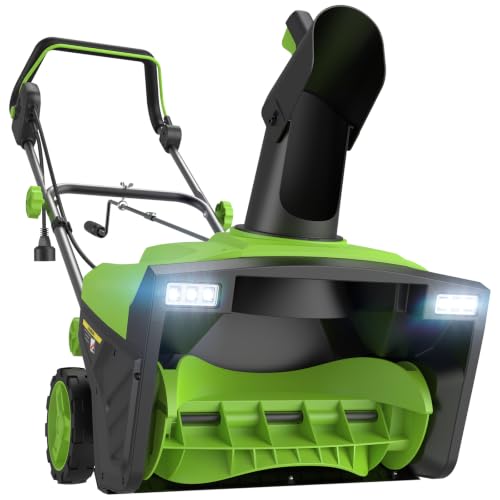
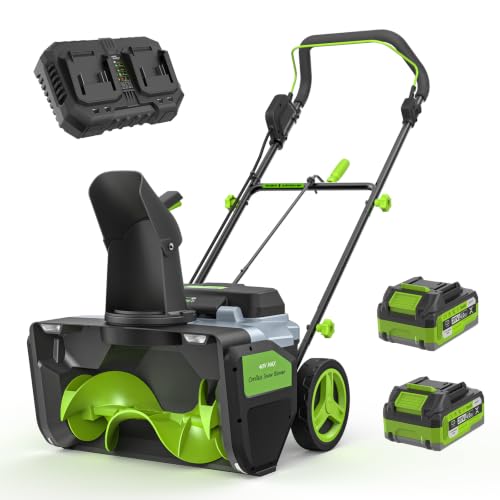

As an Amazon Associate we earn from qualifying purchases at no extra cost to you. Ratings are shown as listed on Amazon.
Quick picks by snow-clearing situation
- Best for deep snow and hills: An 80V two-stage cordless snow blower, such as the Greenworks 80V 24-inch Two-Stage Snow Thrower or EGO Power+ 28-inch two-stage models. Their wider intake, powered wheels and auger-and-impeller design are better suited to packed snow, inclines and larger driveways.
- Best balance for most suburban driveways: The EGO Power+ SNT2405 or a comparable 56V–60V, 24-inch two-stage blower. It offers substantially more capacity than a small single-stage machine without the fuel, oil or engine maintenance of a gas model.
- Best for light-to-moderate snow: A 60V cordless single-stage blower, such as the Greenworks 60V 22-inch model. It is lighter and easier to store, but less capable in plow-packed snow and steep areas.
- Best budget choice for a small, flat driveway: A corded 15A snow blower, such as the Toro Power Curve 1800. It avoids battery replacement costs, but its cord limits maneuverability and requires a suitable outdoor extension cord.
- Best for occasional storms and limited storage: A compact 40V–56V cordless single-stage blower with a 16- to 20-inch clearing width. It is easier to carry and takes less floor space, though you may need more passes.
Corded versus cordless: the decision that matters most
Corded snow blowers are usually the value leaders for short, level driveways close to an outdoor receptacle. A 15A motor can move ordinary fresh snow effectively, and there is no battery to charge or replace. The trade-off is operational: the cord can snag on shrubs, vehicles and snowbanks, and it is easy to run over if you turn carelessly. Use only a properly rated outdoor extension cord, keep it behind you, and do not use a cord that is cracked, warm or undersized.
Cordless snow blowers are much easier to position around multiple cars, sidewalks and winding paths. Their performance is determined by both voltage and battery capacity. A 56V or 60V machine with two 5Ah batteries may clear considerably more snow per charge than a compact blower with one 4Ah battery, but the pack is heavier and more expensive to replace.
For a property with frequent wet storms, long walks or a slope, cordless is usually worth the extra cost. For a 30- to 50-foot flat driveway that can be cleared from one outlet, corded remains a rational choice.
Head-to-head comparison of useful electric snow-blower types
| Type | Typical width | Typical intake height | Practical clearing area per charge or session | Throwing distance | Best use |
|---|---|---|---|---|---|
| Corded single-stage | 18–21 in | 8–12 in | Continuous while connected; commonly suited to 500–1,500 sq ft | 20–30 ft | Flat, paved driveways and light-to-moderate snowfall |
| 40V–60V cordless single-stage | 16–22 in | 8–12 in | About 500–2,000 sq ft with a 4–6Ah battery, depending on snow | 20–40 ft | Routine storms, sidewalks and smaller properties |
| 56V–60V cordless two-stage | 24 in | 16–20 in | About 1,000–3,000 sq ft with two high-capacity batteries | 40–50 ft | Deep snow, longer driveways and moderate slopes |
| 80V cordless two-stage | 24–28 in | 18–20 in | About 2,000–4,000 sq ft with two 8Ah-class batteries | 45–50 ft | Large areas, heavy snow and more demanding clearing |
These are planning ranges rather than guarantees. Wet snow, plow berms, cold batteries, rough pavement and repeated stopping can reduce coverage sharply. Manufacturers also measure throwing distance under favorable conditions, so treat the maximum as a design indication rather than an everyday result.
Clearing width and intake height: do not confuse them
A wider machine reduces the number of passes, but only if you can safely maneuver it between cars, gates and storage doors. A 24-inch blower covers 20% more width per pass than a 20-inch model. On a 40-foot-long, 10-foot-wide driveway, that difference can reduce the theoretical number of full-width passes from 24 to 20.
Intake height matters when the plow leaves a dense ridge at the end of the driveway. A single-stage blower with an 8- to 12-inch intake may struggle when the ridge is taller than its housing. A two-stage machine with a 16- to 20-inch intake is a better match for repeated plow berms and storms exceeding a foot. It is also heavier, louder and more demanding to store.
How to match battery runtime to your driveway
Battery-runtime claims are most useful when converted into area. Suppose your driveway and walkways total 1,600 square feet. A 22-inch blower has a 1.83-foot clearing width. Allowing for overlap, turning and missed edges, estimate an effective width of 1.6 feet. The theoretical travel distance is about 1,000 feet:
1,600 square feet ÷ 1.6 feet effective width = 1,000 linear feet.
If the machine advances at an average of 1.5 feet per second while actively throwing snow, that is about 11 minutes of movement, but real use may take 20 to 30 minutes after turning, pausing and handling deeper sections. A battery system advertised for roughly 30 to 45 minutes of light-duty runtime may therefore be adequate for one ordinary storm, but marginal in heavy wet snow.
For dependable coverage, buy more battery capacity than the minimum claimed runtime. Two 5Ah batteries are a practical starting point for a medium driveway; two 7.5Ah or 10Ah packs make more sense for a large area or back-to-back storms. Keep batteries indoors at moderate temperature and install them immediately before clearing. Cold-soaked batteries deliver less usable power.
Slope handling and packed snow
On a slope, weight and traction matter more than maximum throwing distance. Powered wheels or tracks reduce pushing effort, while a lightweight single-stage blower may require continuous force uphill. Look for variable-speed drive, large tires with a deep tread and a differential or easy-turn system. A 24-inch two-stage blower is generally more stable than a narrow lightweight model, but its weight can make it harder to control when moving downhill.
Single-stage machines work best on smooth pavement because their rubber-edged auger helps pull the machine forward and clear close to the surface. They are less suitable for gravel, uneven pavers and frozen ruts. Two-stage machines usually leave a thin layer behind but handle uneven surfaces, deep snow and hardened ridges more effectively.
Storage, weight and ownership realities
Measure the actual storage route, not just the available floor area. A 24-inch two-stage blower may be roughly 25 to 30 inches wide at its widest point, weigh 100 to 150 pounds with batteries, and require the chute to be folded or rotated. A compact single-stage model may weigh 30 to 60 pounds and fit on a shelf or beneath a workbench.
The parts that commonly wear first are the scraper bar, skid shoes, auger belt, shear pins and rubber auger paddles. On a single-stage model, the rubber paddles gradually lose height and clearing quality. On a two-stage model, skid shoes wear against abrasive pavement and should be adjusted before the housing contacts the ground. Keep spare shear pins or the manufacturer’s specified fasteners available; substituting ordinary bolts can prevent the auger from protecting its gearbox.
After each use, stop the machine, remove the battery or unplug it, and clear packed snow from the chute and housing with a brush or plastic tool. Do not use your hands near an intake, even when the motor appears stopped. Letting snow melt and refreeze inside the chute is a common cause of the next startup problem. Store the machine dry, and charge batteries according to the manufacturer’s temperature guidance.
Decision matrix: which model style fits you?
| Your situation | Recommended choice | Why | Accept the trade-off |
|---|---|---|---|
| Budget under roughly $250 and a nearby outlet | Corded 18- to 21-inch model | Lowest equipment cost and unlimited operating time | Cord management and limited range |
| Small driveway, limited storage, occasional snow | Compact cordless single-stage | Light, quick to deploy and easy to carry | Shorter runtime and weaker performance in berms |
| Medium driveway, regular winter storms | 56V–60V 20- to 24-inch cordless model | Good compromise between capacity, weight and maneuverability | Battery replacement cost |
| Large driveway, wet snow or moderate slope | 56V–80V two-stage with two batteries | More intake capacity, traction and throwing control | Higher price, weight and storage space |
| Frequent deep snow and large clearing area | 80V, 24- to 28-inch two-stage model | Largest electric capacity and strongest snow handling | Requires a substantial battery investment |
What to buy
Choose a corded model if your priority is low cost and your clearing area is compact and flat. Choose a cordless single-stage blower if portability and storage matter more than deep-snow capacity. For the broadest range of conditions, a 56V–60V two-stage machine around 24 inches is the safest all-purpose recommendation. Move to an 80V two-stage model when your driveway is large, slopes upward, receives frequent plow berms or regularly gets heavy wet snow.
Before paying for a wider blower, confirm four practical details: the battery package includes enough capacity for your measured area, the machine fits through your narrowest doorway, the chute throws snow where your property allows, and replacement batteries and wear parts are still available. Those ownership details often matter more than a few extra feet of advertised throwing distance.