Key takeaways
- The seal usually wears before the cedar does. Gaskets compress, hinges loosen, and magnets lose alignment. Choose a model with replaceable or serviceable parts where possible.
- Humidification packs are consumables. Replace them when they become firm or depleted; do not attempt to refill disposable packs with tap water.
- Overfilling restricts circulation. A packed humidor may show a good average reading while cigars near the humidification source become too damp.
- Frequent adjustment causes instability. Change one variable at a time and wait at least a day before making another correction.
- Cleaning should be dry and limited. Remove tobacco debris with a soft brush or cloth. Mold, persistent sour odors, or insect damage may require isolating the cigars and replacing contaminated wood.
The best cigar humidors for most buyers are a well-sealed wooden desktop humidor for up to 50 cigars, a compressor-equipped cabinet for larger collections, or a travel case when portability matters more than presentation.
Our top picks

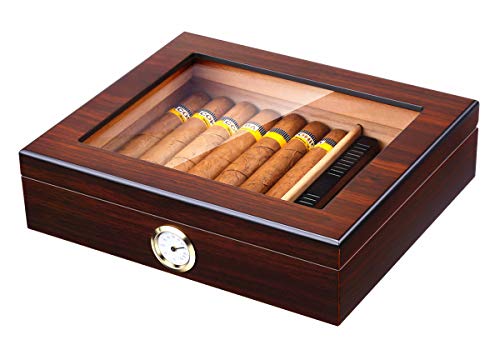


As an Amazon Associate we earn from qualifying purchases at no extra cost to you. Ratings are shown as listed on Amazon.
Quick picks by storage situation
| Situation | Best humidor type | Useful capacity | What to prioritize | Typical price range |
|---|---|---|---|---|
| New smoker with a small rotation | Spanish-cedar desktop box | 20–50 cigars | Reliable seal, removable tray, simple hygrometer | $50–$150 |
| Frequent smoker or gift collection | Large desktop humidor | 50–150 cigars | Thick cedar lining, adjustable dividers, stable humidity | $120–$350 |
| Collector with limited time for maintenance | Electronic cabinet humidor | 150–500+ cigars | Temperature control, fan circulation, alarm functions | $400–$1,500+ |
| Travel, boating, or outdoor storage | Airtight protective travel case | 5–40 cigars | Crush resistance, gasket, replaceable humidification pack | $30–$180 |
| Short-term overflow storage | Airtight food-safe plastic container | 25–100 cigars | True airtight seal, cedar trays or dividers | $20–$80 |
Best cigar humidors: the choices that make the most sense
Best overall for most people: a Spanish-cedar desktop humidor
A traditional desktop humidor remains the best balance of capacity, cost, appearance, and low operating complexity. Look for a solid wood or thick veneered box with a Spanish-cedar interior, a fitted lid, brass or stainless-steel hinges, and an adjustable divider.
Well-known lines such as Adorini desktop humidors and Savoy humidors are representative of this category. Models vary considerably, so the brand name matters less than the construction. A 50-count humidor rarely holds 50 full-size cigars comfortably once you add dividers and leave room for air circulation. A practical target is 30–40 cigars.
The main weakness is temperature stability. A passive wooden box does not cool its contents. If the room regularly moves above approximately 75°F (24°C), humidity may become harder to manage and cigar aging can suffer. Keep the box away from windows, radiators, kitchens, and exterior walls exposed to large temperature swings.
Best for serious collections: a temperature-controlled cabinet
An electronic cabinet humidor is the better choice when the collection is too large for several desktop boxes or when the room is warm and variable. NewAir’s CC-100H cigar humidor is an example of the wine-cooler-style cabinet format, while higher-capacity cigar cabinets use shelves, a fan, and active humidity management.
Cabinets offer better temperature consistency than passive boxes, but they introduce more parts that can fail: fans, sensors, control boards, water reservoirs, and door gaskets. The advertised capacity also assumes loose storage. Boxes of cigars, large tubos, and thick Churchill sizes reduce usable space quickly.
Choose a cabinet with a stated temperature range, a replaceable or calibratable hygrometer, a quiet fan, and a door seal that can be replaced. Avoid placing it in a garage or unheated room unless the manufacturer specifically supports those conditions.
Best for travel: an airtight protective case
For travel, a hard case is more dependable than a wooden desktop humidor. Cigar Caddy and Xikar travel humidors are established examples of this design. They typically use a molded airtight shell, a pressure-equalizing gasket, foam or molded holders, and a humidification pack.
The case protects against impact and brief environmental changes, but it is not a substitute for long-term temperature control. A sealed case left in a hot car can become dangerously warm inside. Use one for transport, not for storing valuable cigars indefinitely in uncontrolled heat.
Best low-cost alternative: an airtight container with cedar inserts
An airtight plastic container can outperform a cheap decorative humidor if its gasket seals properly. Add Spanish-cedar trays or dividers and use a two-way humidity pack sized for the container. This solution is inexpensive, easy to inspect, and often requires less seasoning than a dry wooden box.
Its disadvantages are appearance, limited odor control, and less buffering against rapid temperature changes. Use food-safe plastic, do not use scented containers, and keep cigars away from direct contact with any loose humidification solution.
What separates a dependable humidor from a frustrating one
Capacity: buy for your real inventory, not the headline number
Humidor capacities are usually based on smaller Corona-size cigars. A practical planning rule is to use 60–75% of the advertised capacity for mixed sizes. For example, a 50-count box has approximately 30–38 comfortable spaces after allowing for Churchill cigars, dividers, and circulation.
For a collection that grows, buying one size larger is usually cheaper than replacing a full humidor later. However, an oversized box that is nearly empty can be harder to manage than a correctly sized one because humidity is distributed through a larger volume.
Seal quality: the first thing to inspect
A good seal reduces humidification consumption and prevents daily humidity swings. Close the empty lid gently over a thin sheet of paper. If the paper slides out with almost no resistance at several points around the perimeter, inspect the gasket, lid alignment, and warping before buying.
A traditional wooden humidor does not need to be vacuum-tight, but it should close evenly without a visible gap. Magnetic closures are convenient; hinges should hold the lid squarely rather than pulling one corner higher than the other.
Hygrometer accuracy: a display is not proof
Many built-in analog hygrometers are decorative rather than precise. A digital hygrometer with stated accuracy of about ±2–3% relative humidity is preferable. Test it before relying on it with a salt or humidity calibration procedure, then compare it with a second calibrated unit if the collection is valuable.
Place the sensor near the middle of the storage space, not directly beside the humidification device or against a wall. Expect readings to change slowly after opening the lid; reacting to every short-term fluctuation can cause over-humidification.
Lining material: Spanish cedar is useful, not magical
Spanish cedar is favored because it buffers moisture, contributes a suitable aroma, and helps deter some storage pests. A thin cedar veneer can work, but very thin decorative lining offers less buffering than substantial cedar trays and dividers.
American red cedar is much more assertive aromatically and can overpower cigars. MDF, pine, and strongly scented woods are poor interior choices. In a travel case or plastic container, use untreated Spanish-cedar inserts rather than improvised scented wood.
Temperature stability: often overlooked
Relative humidity depends on temperature, so a room that moves from 65°F to 80°F can produce confusing hygrometer readings even when the amount of moisture has barely changed. Passive humidors should live in a stable indoor room, ideally around 65–70°F (18–21°C).
Active cabinets can manage temperature more consistently, but they still need ventilation and clearance around their cooling components. A cabinet that sits tightly against a wall may run warmer, consume more power, and experience shorter component life.
Seasoning and setup: a lower-risk process
-
Inspect the interior. Remove dust and loose fibers with a clean, dry cloth. Do not use household cleaners, oils, or fragrances.
-
Test the seal. Check the lid, hinges, gasket, and closure before adding cigars. Fixing a leak first avoids wasting humidification supplies.
-
Season the wood gradually. Use a two-way humidity pack designed for seasoning or a manufacturer-approved method. Do not wipe the cedar with free water; excess liquid can warp the box and create a persistently wet surface.
-
Wait for stability. Depending on the wood and climate, allow roughly 7–14 days. A stable reading over at least 24–48 hours is more useful than one brief reading.
-
Add cigars without packing tightly. Leave space between stacks and keep cigars away from direct contact with liquid reservoirs.
-
Recheck after loading. Opening the lid and adding dry cigars will temporarily change readings. Make small adjustments and wait rather than adding multiple humidification devices at once.
For a simple sizing calculation, suppose a humidor is advertised for 50 cigars, but your collection includes 20 Churchill cigars and 15 Robustos. If the Churchills occupy roughly 1.5 times the space of a standard Corona, the equivalent load is about 45 Corona-sized cigars: 20 × 1.5 + 15 × 1 = 45. That leaves little room for dividers or expansion, so a nominal 75-count model is a more sensible choice.
Ownership realities and common mistakes
- The seal usually wears before the cedar does. Gaskets compress, hinges loosen, and magnets lose alignment. Choose a model with replaceable or serviceable parts where possible.
- Humidification packs are consumables. Replace them when they become firm or depleted; do not attempt to refill disposable packs with tap water.
- Overfilling restricts circulation. A packed humidor may show a good average reading while cigars near the humidification source become too damp.
- Frequent adjustment causes instability. Change one variable at a time and wait at least a day before making another correction.
- Cleaning should be dry and limited. Remove tobacco debris with a soft brush or cloth. Mold, persistent sour odors, or insect damage may require isolating the cigars and replacing contaminated wood.
Bottom line
Choose a Spanish-cedar desktop humidor with about 25–40% more nominal capacity than your current collection if you want the simplest dependable solution. Choose an electronic cabinet when capacity and temperature stability justify the added maintenance. Choose a hard travel case for transport, and consider an airtight container with cedar inserts when appearance matters less than seal quality. Whatever the format, verify the hygrometer, protect the humidor from heat, and judge capacity by usable space rather than the number printed on the box.