Key takeaways
- Thin sheet and beginner projects: 0.030-inch E71T-11, preferably on a small spool. It is easier to feed and gives a little more control at lower heat than larger wire, though it can still burn through thin metal if voltage and travel speed are too high.
- General home and farm repair: 0.030-inch E71T-11 for a small 120 V machine; 0.035-inch E71T-11 if the welder is rated for it and most work is heavier steel.
- Thicker steel and frequent use: 0.035-inch E71T-11 on a larger spool, provided the machine’s drive rolls, liner, contact tip, and output support that wire.
- Minimum storage and commitment: A 1- or 2-pound spool. Buy a 10-pound spool only when the machine accepts it and you use wire often enough to keep it dry between jobs.
Best Flux Core Welding Wire for Gasless MIG Welding
For most gasless MIG jobs, the best all-around choice is 0.030-inch (0.8 mm) E71T-11 wire on a 2-pound (0.9 kg) spool; choose 0.035-inch (0.9 mm) wire for thicker steel and outdoor repair, and use 0.030-inch wire with low settings for thin sheet. Match the wire to your machine’s feed capability and the steel thickness, then account for the extra slag cleanup that flux-cored welding requires.
Quick picks by job
- Thin sheet and beginner projects: 0.030-inch E71T-11, preferably on a small spool. It is easier to feed and gives a little more control at lower heat than larger wire, though it can still burn through thin metal if voltage and travel speed are too high.
- General home and farm repair: 0.030-inch E71T-11 for a small 120 V machine; 0.035-inch E71T-11 if the welder is rated for it and most work is heavier steel.
- Thicker steel and frequent use: 0.035-inch E71T-11 on a larger spool, provided the machine’s drive rolls, liner, contact tip, and output support that wire.
- Minimum storage and commitment: A 1- or 2-pound spool. Buy a 10-pound spool only when the machine accepts it and you use wire often enough to keep it dry between jobs.
Wire, spool and cleanup comparison
| Wire choice | Typical spool options | Best fit | Practical trade-off |
|---|---|---|---|
| 0.030-inch (0.8 mm) E71T-11 | 1–2 lb (0.45–0.9 kg); some machines accept 10 lb (4.5 kg) | Thin-to-medium steel, light fabrication, small 120 V welders | Fine control at lower output; slower deposition than 0.035-inch wire |
| 0.035-inch (0.9 mm) E71T-11 | 2 lb (0.9 kg) or 10 lb (4.5 kg), depending on brand and machine fit | Medium-to-thicker steel, repairs and longer welds | Deposits more metal per pass, but needs compatible feeding parts and adequate machine output |
| 0.030-inch E71T-GS | Commonly small hobby spools; check the exact package | Applications and machines specifically suited to this classification | Not a universal substitute for E71T-11; follow the wire and welder manufacturers’ instructions |
Spool sizes and classifications vary by manufacturer, so treat the table as a buying guide rather than a guarantee that a particular welder will accept every listed spool. Verify both wire diameter and spool hub dimensions in the machine manual. Flux-cored welds also leave slag that must be chipped and brushed off; wire diameter does not eliminate that step.
Our top picks
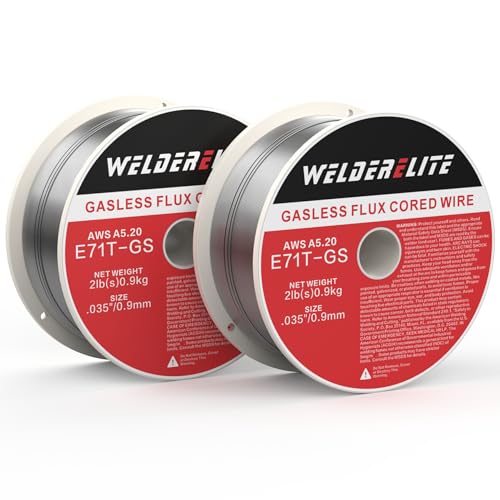


As an Amazon Associate we earn from qualifying purchases at no extra cost to you. Ratings are shown as listed on Amazon.
Which diameter should you choose?
Choose 0.030 inch for thinner material and smaller machines
On sheet metal and light-gauge steel, the main challenge is avoiding burn-through while still getting a sound joint. Smaller 0.030-inch wire is a practical starting point because it is commonly paired with compact welders and can be run at lower output. It does not make a welder automatically suitable for very thin panels: short tack welds, clean fit-up, and settings within the machine’s chart matter just as much.
For a first pass on scrap of the same thickness, set the machine using its recommended chart, then inspect the bead and the back of the joint. If the sheet is melting away, reduce heat or use shorter, separated tacks and let the area cool. Avoid simply moving faster if that leaves poor fusion.
Choose 0.035 inch when the work is heavier
On thicker brackets, equipment repairs and structural sections within a hobby welder’s rated capacity, 0.035-inch wire can deposit more weld metal per pass. That can make longer or heavier jobs more practical, but it is not a shortcut to welding steel beyond the machine’s output or duty cycle. A larger wire may also feed poorly if the contact tip, drive-roll groove, liner or spool tension is wrong.
For thick plate or safety-critical structures, confirm the joint preparation, process, wire classification and welding procedure with a qualified professional. Flux-cored wire and a powerful-looking bead do not by themselves establish that a joint is suitable for structural service.
E71T-11 or E71T-GS?
E71T-11 is a common self-shielded flux-cored classification used for all-position work in suitable applications. E71T-GS is another self-shielded type, but the “GS” classification should not be treated as interchangeable with E71T-11 for every job. Check the manufacturer’s data sheet for position, polarity, single- or multiple-pass limits, and base-metal recommendations.
Also check polarity before welding. Many self-shielded wires run electrode-negative (DCEN), but the correct setup is the one specified by the wire manufacturer and your welder’s manual. Reversing polarity without checking can cause an unstable arc, excess spatter or poor weld quality.
Spool size: save money without buying wire you cannot use
A small spool costs more per pound in some product lines, but it is often the sensible choice for occasional repairs. It takes less storage space, limits how much wire can be exposed to damp air, and may fit compact welders that cannot hold a full-size spool. A 10-pound spool can reduce the frequency of reloads for regular work, but only if the hub fits the machine and the wire will be used before storage conditions damage it.
For example, if a project is expected to use about 1.5 pounds of wire, a 2-pound spool leaves roughly 0.5 pound for setup, test beads and minor waste. A 10-pound spool leaves about 8.5 pounds after the same job. The larger spool may be better value per pound, but the extra wire is only a saving if it remains usable and the welder can feed it reliably.
Slag cleanup is part of the buying decision
Self-shielded flux-core wire works without a shielding-gas cylinder, which is useful outdoors and simplifies a basic setup. The trade-off is more smoke and spatter than many clean gas-shielded MIG setups, plus a layer of slag over the bead. Allow time to chip the slag with a chipping hammer and brush the weld with a wire brush before inspecting or making another pass.
For a project where appearance and minimal cleanup matter most, compare the complete process—not just wire cost. Flux core may be convenient, but it is not always the neatest option for visible thin-sheet work. Keep the work area ventilated, remove flammable material, and use appropriate welding PPE.
Check machine compatibility before buying
- Confirm the welder supports the wire diameter and spool dimensions.
- Fit the correct drive-roll groove and contact tip; a mismatched groove can flatten or slip on the wire.
- Set spool drag only tight enough to prevent overrun. Excessive tension can strain the feed system.
- Use the specified polarity and the machine’s starting settings for the wire and metal thickness.
- Store opened wire sealed and dry. Rust or moisture can contribute to poor feeding, porosity and an erratic arc.
Bottom line
For a compact gasless MIG welder and mixed household repairs, start with a 2-pound spool of 0.030-inch E71T-11, after checking the machine manual. Move to 0.035-inch E71T-11 for heavier, more frequent work only when the welder and its feeding parts are rated for it. Choose wire by the thinnest or thickest material you actually weld, not by spool price alone—and budget time for slag removal and dry storage.