Key takeaways
- Metric versus SAE: Metric sockets are sized in millimeters; SAE sockets use inch fractions. Match the system to your fasteners. If your work spans vehicles and household equipment of different ages or origins, dual coverage is more flexible.
- Six-point versus twelve-point: Six-point sockets contact more of a hex fastener’s flats, making them a sensible default for tight or stubborn fasteners. Twelve-point sockets offer more engagement positions when access or turning angle is limited, but can be less forgiving on worn fasteners. Verify the profile listed for the exact set.
- Shallow versus deep: Shallow sockets save space and often clear nearby obstacles. Deep sockets reach nuts on long studs. A complete-feeling range usually needs both where your work requires them.
- Accessories: Check for extensions, a universal joint, a spark-plug socket, adapters, and ratchet count. An extension can solve a reach problem, but it does not change the drive size or make an undersized tool suitable for more torque.
- Case and retention: A molded case makes transport and inventory easier only if the sockets stay in their labeled positions. Look at how the latches close and whether the tray can be removed or reorganized for a toolbox. Loose sockets are easy to misplace and may rattle against one another.
Best GearWrench Socket Sets: The Right Pick for Each Toolkit
The best GearWrench socket set for most home and automotive toolkits is a 1/4- and 3/8-inch drive set with both metric and SAE sockets; choose a dedicated 1/2-inch set instead if you regularly work on larger fasteners or need higher torque capacity.
There isn’t one ideal set for every job. The useful choice depends on the fasteners you encounter, how much room you have around them, whether you need shallow and deep sockets, and how you’ll keep the pieces organized. GearWrench sells multiple configurations, and contents can vary by kit and market, so check the exact package’s size range and accessory list before buying.
Our top picks


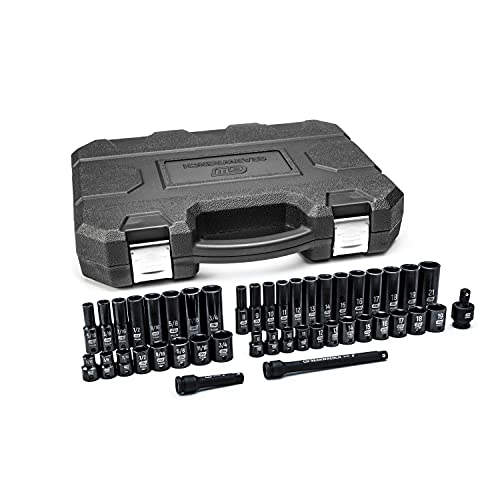

As an Amazon Associate we earn from qualifying purchases at no extra cost to you. Ratings are shown as listed on Amazon.
Quick comparison: which configuration fits?
| Toolkit need | Drive size | Coverage to look for | Best reason to choose it |
|---|---|---|---|
| Small repairs and compact storage | 1/4 inch | Metric and/or SAE; shallow and deep | Small sockets and a low-profile ratchet fit tight spaces |
| General automotive and household work | 3/8 inch | Metric and SAE; shallow and deep | Useful balance of reach, strength, and manageable tool size |
| Suspension, wheels, and larger hardware | 1/2 inch | Commonly larger metric or SAE sizes | Pairs with larger sockets and breaker bars for higher-load work |
| One case for mixed jobs | 1/4, 3/8, and 1/2 inch | Combined metric and SAE ranges | Broad coverage, at the cost of bulk and possible gaps within each range |
These are drive-size categories, not promises that every GearWrench kit includes the same sizes. Treat the numbers in a package listing as its actual coverage; don’t assume a set is comprehensive just because it contains several drive sizes.
Best picks by situation
For a first general-purpose set: 3/8-inch drive, metric and SAE
A 3/8-inch set is a sensible center of gravity for a household or automotive toolkit. It handles many medium-size fasteners without the bulk of a 1/2-inch ratchet. A dual-system set also avoids being caught without the right unit when working on older equipment, imported vehicles, or household hardware.
Prioritize a kit that includes both shallow and deep sockets across the sizes you use most. Shallow sockets are easier to fit into confined areas; deep sockets reach nuts on protruding threaded studs. If the package includes only one profile, it may leave you needing an extension or a separate socket set for common tasks.
For compact work: 1/4-inch drive
Choose 1/4-inch drive for smaller fasteners, appliance and interior work, and jobs where access matters more than high torque. Its smaller ratchet head can fit where a larger drive won’t. The trade-off is limited leverage and capacity: don’t use a small-drive ratchet to force a seized or oversized fastener. Step up to 3/8-inch or use an appropriate breaker bar when the job calls for it.
A 1/4-inch kit is also a practical add-on for someone who already owns larger sockets. Check for a bit adapter or screwdriver-style handle if you want to drive bits from the same kit; these accessories are not guaranteed across packages.
For larger fasteners: 1/2-inch drive
A 1/2-inch set is the better match for larger automotive fasteners, including many suspension and wheel-area jobs. Its larger sockets and ratchet are less convenient in cramped spaces, so it complements rather than replaces smaller drives for a versatile setup. If you’re buying one, compare the included size span with your actual vehicle or equipment requirements instead of paying for a broad range you’ll rarely use.
For stubborn fasteners, use a breaker bar or another tool intended for higher leverage. A ratchet is designed for turning, not for unlimited force; overloading it can damage the mechanism or cause an injury if it slips.
For one-case convenience: a multi-drive set
A multi-drive case can be a good choice if you’re starting from scratch, share tools, or need to carry a single kit between jobs. It can also be a poor value if its sockets overlap with tools you own while omitting the specific sizes you need. Compare the coverage drive by drive, and check whether it supplies shallow and deep profiles in the useful sizes—not just a high overall piece count.
What to compare before buying
- Metric versus SAE: Metric sockets are sized in millimeters; SAE sockets use inch fractions. Match the system to your fasteners. If your work spans vehicles and household equipment of different ages or origins, dual coverage is more flexible.
- Six-point versus twelve-point: Six-point sockets contact more of a hex fastener’s flats, making them a sensible default for tight or stubborn fasteners. Twelve-point sockets offer more engagement positions when access or turning angle is limited, but can be less forgiving on worn fasteners. Verify the profile listed for the exact set.
- Shallow versus deep: Shallow sockets save space and often clear nearby obstacles. Deep sockets reach nuts on long studs. A complete-feeling range usually needs both where your work requires them.
- Accessories: Check for extensions, a universal joint, a spark-plug socket, adapters, and ratchet count. An extension can solve a reach problem, but it does not change the drive size or make an undersized tool suitable for more torque.
- Case and retention: A molded case makes transport and inventory easier only if the sockets stay in their labeled positions. Look at how the latches close and whether the tray can be removed or reorganized for a toolbox. Loose sockets are easy to misplace and may rattle against one another.
A simple coverage check before you commit
Write down the sizes you use or expect to use, then compare that list with the set’s stated range. For example, if a kit covers 8–19 mm, the endpoints alone don’t tell you whether every size in between is included. Check the contents list for missing sizes and for which ones come in deep rather than shallow form. This quick audit can reveal whether a smaller set plus a few individual sockets will suit you better than a bulky kit.
| Question | Why it matters | What to verify |
|---|---|---|
| Which drive do I need most? | Each drive balances access and capacity differently. | Ratchet and socket drive sizes, plus any adapters |
| Which measurement system do my fasteners use? | The wrong unit may not fit safely. | Metric, SAE, or both—and the actual included sizes |
| Do I encounter studs or recessed fasteners? | Socket depth affects reach. | Deep sockets in the sizes needed |
| Will I carry the kit? | Case bulk and retention affect day-to-day usefulness. | Case dimensions, latches, and socket placement |
Ownership: keep the set complete and the sockets in good shape
After use, wipe sockets clean and dry before returning them to the case. Dirt or moisture left on tools can make size markings harder to read and encourage corrosion, particularly during storage in a damp garage. Put each socket back in its labeled spot; a missing size can undermine an otherwise broad range.
Inspect the fastener and socket before applying force. A worn or incorrectly sized socket can round a fastener, while forcing a socket at an angle can damage its edges. If a socket is cracked, badly deformed, or no longer seats properly, stop using it and replace it. Don’t use hand sockets with an impact wrench unless they’re specifically rated for impact use; impact tools call for compatible impact sockets.
For long-term value, consider cost alongside fit and coverage: a less expensive kit that lacks the sizes or profiles you repeatedly need can lead to duplicate purchases. A set with fewer pieces may be the better buy if its drive, measurement system, useful size range, and case all match your actual work.