Key takeaways
- Surface quality: Usually better on figured, interlocked, or knotty grain, though sanding may still be required.
- Noise: Often less harsh than a straight-knife head, but hearing protection remains necessary.
- Maintenance: More convenient when replacing individual inserts, but there are many screws and cutter positions to inspect.
- Consumable cost: Replacement inserts cost more than a simple knife change, but only damaged or dull inserts need attention.
- Cutting load: The machine still needs a strong motor and steady feed; a helical head does not turn a benchtop planer into a production machine.
The best helical head benchtop thickness planers are the 13-inch WEN PL1326 and Grizzly G0940 for general shop use, while the 12.5-inch Cutech 40700H is the better compact choice; choose by cutterhead design, realistic cut depth, dust collection, and the space required for infeed and outfeed support—not by width alone.
Our top picks

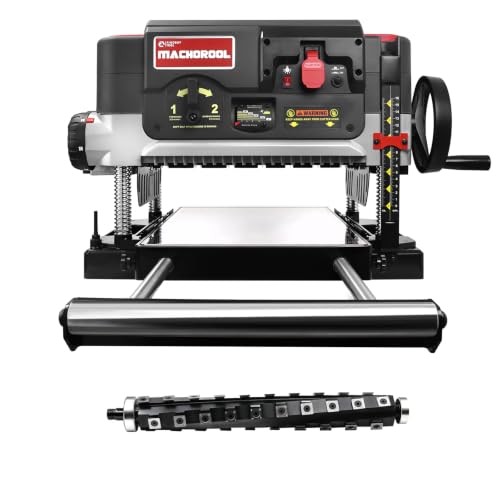
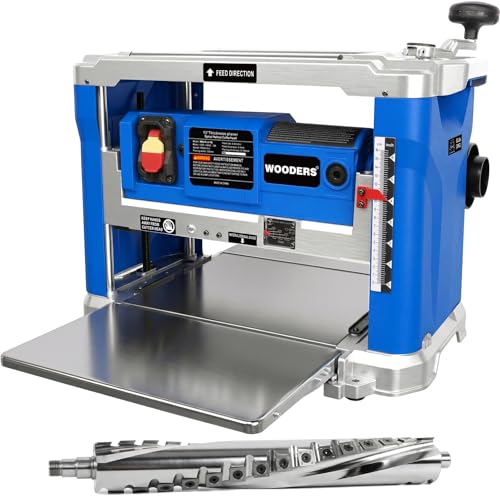

As an Amazon Associate we earn from qualifying purchases at no extra cost to you. Ratings are shown as listed on Amazon.
Best helical-head benchtop thickness planers at a glance
| Planer | Cutting width | Maximum depth | Depth per pass | Cutterhead | Approx. weight | Best fit |
|---|---|---|---|---|---|---|
| Cutech 40700H | 12.5 in | 6 in | 1/8 in | Spiral carbide inserts | About 70 lb | Smaller shops and occasional use |
| WEN PL1326 | 13 in | 6 in | 1/8 in | 26-blade helical carbide head | About 70 lb | Budget-conscious general woodworking |
| Grizzly G0940 | 13 in | 6 in | 1/8 in | Helical carbide insert head | About 80 lb | Frequent shop use and heavier stock |
| Typical 12.5-inch straight-knife planer | 12.5 in | 6 in | 1/8 in | Disposable or sharpenable knives | 60–75 lb | Lowest initial cost |
Dimensions and weights can vary slightly by production revision, so confirm the manufacturer’s current specification sheet before ordering. A benchtop planer also needs substantially more room than its body dimensions suggest: allow roughly 6 to 8 feet of clear length for long boards, plus space for dust hose routing and safe handling.
Best overall: WEN PL1326
The WEN PL1326 is the strongest all-purpose value among compact helical-head planers. Its 13-inch capacity handles most furniture parts, shelving, cabinet components, and rough-sawn boards used by home woodworkers. The 26 carbide cutters are arranged in a helical pattern, so the head engages the wood progressively rather than striking the entire board width with one long knife.
That arrangement generally produces less objectionable noise and leaves a more forgiving finish around knots and reversing grain than a conventional straight-knife head. It does not eliminate tear-out: grain direction, cut depth, feed rate, and moisture still matter. The practical advantage is that a damaged insert can be rotated or replaced individually instead of replacing or sharpening a full knife set.
The PL1326 is a good match for a user who planes a few boards each month and wants the extra width of a 13-inch machine without moving to a floor-standing planer. Its dust port should be connected to a capable extractor or shop vacuum. Without collection, chips accumulate quickly around the rollers and can interfere with board movement.
Best for a compact shop: Cutech 40700H
The Cutech 40700H gives up half an inch of capacity compared with a 13-inch planer, but that difference rarely affects ordinary table, shelf, and cabinet work. Its smaller footprint and relatively manageable weight make it easier to store on a mobile stand or lift onto a bench.
Choose it when available floor space is more important than maximum board width. A 12.5-inch planer can still process a 12-inch panel, but edge damage, snipe, and the need to leave a trimming margin make it sensible to reserve the full nominal width for occasional jobs rather than routine work.
The spiral insert head is particularly useful for people who work with figured hardwoods or reclaimed boards. Expect to rotate or replace inserts after contact with grit, staples, or hidden fasteners. Carbide inserts are durable, but they are not immune to abuse.
Best for frequent use: Grizzly G0940
The Grizzly G0940 is the more shop-oriented choice in this group. Its 13-inch capacity, helical carbide head, and heavier construction make it attractive for repeated dimensioning of hardwood and rough lumber. The additional mass can reduce movement during a cut, although a properly supported lighter planer can still perform well.
Its advantages are most meaningful when the planer is permanently mounted or used several times a week. For occasional work, the extra weight and higher general market price—often roughly $600 to $900 depending on configuration and promotions—may not provide enough benefit over a less expensive 13-inch model.
Helical head versus straight knives
A true helical or spiral cutterhead uses many small carbide inserts. Each insert normally has multiple usable edges, and individual cutters can be rotated when one corner becomes dull. This reduces maintenance disruption and makes localized damage less expensive to repair.
- Surface quality: Usually better on figured, interlocked, or knotty grain, though sanding may still be required.
- Noise: Often less harsh than a straight-knife head, but hearing protection remains necessary.
- Maintenance: More convenient when replacing individual inserts, but there are many screws and cutter positions to inspect.
- Consumable cost: Replacement inserts cost more than a simple knife change, but only damaged or dull inserts need attention.
- Cutting load: The machine still needs a strong motor and steady feed; a helical head does not turn a benchtop planer into a production machine.
Be careful with the terminology. Some listings call a head “spiral” when it uses long segmented knives rather than individual carbide inserts. If easy spot replacement is important, verify that the machine uses replaceable four-sided carbide cutters.
How the key specifications affect your choice
Cutting width
Thirteen inches is the useful sweet spot for a benchtop machine. It accommodates most boards used in small furniture and allows some margin for edge defects. A 12.5-inch model is rarely limiting unless you routinely flatten wide panels or need to dimension boards close to the machine’s maximum capacity.
Depth per pass
The common maximum is 1/8 inch, but that figure is best reserved for narrow, stable softwood or light finishing cuts. For rough hardwood, start at 1/32 to 1/16 inch per pass. A simple worked example shows why: removing 1/4 inch from a board at a 1/16-inch setting requires four passes per face, not two passes at the advertised maximum. The smaller cuts reduce motor strain, snipe, tear-out, and the chance of stalling the feed rollers.
Dust collection
Planers produce large, fast-moving chips. A 2.5-inch dust port can work with a strong shop vacuum for modest workloads, but a 4-inch hose connected to a dedicated dust collector is preferable for repeated use. Dust collection also improves cut consistency by preventing chips from being recut or trapped beneath the board.
Footprint and support
Measure the machine, then add the space needed for board travel. A planer that is 24 inches long may require more than 72 inches of unobstructed length when processing a six-foot board. Folding tables or a mobile cart help, but the support must remain level with the planer bed. If the infeed side is low, the board can dive into the cutterhead; if the outfeed side is low, the board can lift or develop snipe.
Decision matrix: which planer suits your shop?
| Your situation | Recommended direction | Reason |
|---|---|---|
| Limited storage and occasional projects | Cutech 40700H or similar 12.5-inch model | Smaller capacity is offset by easier storage and lower handling effort. |
| Beginner building furniture at home | WEN PL1326 or similar 13-inch model | Broad capacity and helical inserts without a floor-standing machine. |
| Several hours of planing each week | Grizzly G0940 or a heavier equivalent | Greater stability and a better fit for repeated hardwood work. |
| Mostly rough softwood and lowest budget | Compare helical models with a conventional planer | A straight-knife machine may cost less initially if finish quality is less critical. |
| Figured hardwood or reclaimed lumber | Helical insert head with spare cutters | Individual inserts are easier to replace after localized damage. |
Setup and ownership details that matter
- Inspect stock first. Remove nails, screws, stones, and loose bark. A single hidden fastener can damage multiple carbide inserts.
- Mark the high side. Take shallow passes until the board has a consistent face. Planing does not correct severe cup or twist as reliably as a jointer or sled.
- Use support tables. Keep long boards level with the bed to reduce snipe at the leading and trailing ends.
- Clean after use. Vacuum chips from the bed, rollers, cutterhead area, and dust port. Resin buildup can reduce feeding reliability.
- Rotate inserts methodically. Use a consistent pattern and the correct driver so screws are not damaged. Replace inserts with rounded edges, chips, or visible scoring.
- Check alignment. If boards emerge tapered or show repeated snipe, inspect table extensions, mounting surfaces, roller pressure, and cutterhead alignment before blaming the inserts.
For most woodworkers, the WEN PL1326 offers the best balance of width, price, and accessible helical-head maintenance. Pick the Cutech 40700H when storage is the overriding concern, and move to the Grizzly G0940 when the planer will see frequent hardwood work. Whichever model you choose, a rigid stand, effective dust collection, sharp inserts, and shallow passes will influence results more than a small difference in headline cutting capacity.