Key takeaways
- Choose among the best indoor TV antennas for cord cutters, from top-of-TV and window models to a DVR bundle, with range claims explained.
The UltraPro Hover is the best overall indoor TV antenna in this group for most cord cutters, because it sits on top of the TV, needs no tools, covers both VHF and UHF channels and does not depend on an amplifier that can overload a signal near a tower. An indoor TV antenna pulls free local broadcast channels such as ABC, CBS, NBC, Fox and PBS out of the air, so you can watch live news, sports and prime time without a cable or satellite subscription. If you live farther from your towers, an amplified or window-mounted model may reach more stations, and if you want to record shows, the Tablo DVR bundle is the one that adds that function.
Below are six options, from simple flat antennas to a combined antenna and recorder.
Quick List
- UltraPro Hover Digital TV Antenna – best for a no-fuss, top-of-TV setup
- Amplified Indoor HDTV Antenna with Detachable Amplifier – best for homes farther from broadcast towers
- Digital Indoor TV Antenna for Smart TV – best for a basic, low-profile local channels antenna
- Tablo 4th Gen 2-Tuner OTA DVR plus Antenna (Renewed) – runner-up and best for recording live TV without a subscription
- 2026 Digital TV Antenna with 360-Degree Reception – best for homes where towers sit in different directions
- ANTAN Indoor Window HDTV Antenna – best for window mounting with a long coaxial cable
Which One Is Right for You?
| If you… | Choose |
|---|---|
| want the simplest setup and live close to your towers | UltraPro Hover Digital TV Antenna |
| want to record shows and stream live TV to other screens | Tablo 4th Gen 2-Tuner OTA DVR plus Antenna |
| are far from towers and need a signal boost | Amplified Indoor HDTV Antenna |
| can place the antenna on a window and run a long cable to the TV | ANTAN Indoor Window HDTV Antenna |
| get stations from several directions | 2026 Digital TV Antenna with 360-Degree Reception |
| just want a basic antenna for a bedroom or kitchen TV | Digital Indoor TV Antenna for Smart TV |
Before you buy, look up your address on a reception map to see how far the nearest towers are and whether they broadcast on VHF, UHF or both. A tower within roughly 20 to 30 miles with a clear line of sight is well within indoor antenna territory, while a tower beyond 40 miles or behind hills may need an amplified model, a window position or an attic or outdoor antenna instead.
All 6 Picks in Detail
1. UltraPro Hover Digital TV Antenna – Best for a No-Fuss Top-of-TV Setup
As an Amazon Associate we earn from qualifying purchases at no extra cost to you.

The Hover’s selling point is its mount: it unfolds and rests on top of a flat-screen TV, so there is no wall drilling or window taping. The listing describes an indoor digital antenna for smart TVs that picks up local HD channels, supports 4K and 1080p HDTV, covers VHF and UHF and offers 360-degree reception. It suits apartments, dorm rooms and anyone who wants a clean setup near the television.
- Digital indoor antenna that rests on top of the TV
- VHF and UHF reception, per the listing name
- Retailer information describes a passive (non-amplified) design and a stated range of up to about 40 miles; treat that as a best-case claim
- 75-ohm coaxial connection, which is standard for TVs
- Supports 1080p and 4K broadcast formats, according to the listing
- Can be moved to a flat surface or fixed with mounting tape, per retailer information
Pros
- No tools or wiring beyond one coaxial cable
- Passive design cannot overload from a nearby tower
- Neat, TV-top placement
Cons
- TV-top height is often not the best spot for reception
- Range claim is a ceiling, not a guarantee
It also makes a good first antenna, since returning to a simple, passive design is easy if you later decide you need more reach. Compared with the amplified antenna, the Hover is simpler and avoids amplifier problems, while the amplified model is the better pick when towers are far away.
2. Amplified Indoor HDTV Antenna with Detachable Amplifier – Best for Homes Farther from Towers
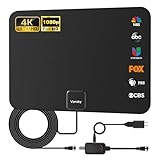
This antenna adds a signal amplifier and a long cable. The listing describes a digital amplified indoor HDTV antenna for 1080p VHF and UHF local channels with a detachable amplifier and a 16.5-foot coaxial cable. The detachable amplifier is the most useful feature, because you can leave it on when towers are far away and remove it when stations are strong or close, avoiding overload.
- Amplified design with a removable signal amplifier, per the listing name
- VHF and UHF coverage with 1080p HDTV support
- 16.5-foot coaxial cable, per the listing name
- Power for the amplifier typically comes over USB; confirm what is included
- Flat, lightweight panel that can be placed on a window or wall
Pros
- Amplifier can be turned off or removed when not needed
- Long cable allows window placement
- Suits weak-signal locations
Cons
- Brand and range details should be confirmed on the listing
- An amplifier can make some strong channels worse
The long cable also lets you try a window, a wall or a high shelf without moving the TV. Next to the Hover, this model gives you more control over signal strength at the cost of one more power connection.
3. Digital Indoor TV Antenna for Smart TV – Best for a Basic Low-Profile Antenna

The listing title for this antenna is short: a digital indoor TV antenna for smart TV, for local channels in 4K HD. It does not give range, cable length, amplifier or channel band details, so treat it as a basic flat or panel-style antenna and confirm the specifications on the product page. It suits a secondary TV in a bedroom, kitchen or office where you only want the local channels you can easily receive.
- Digital indoor antenna for local channels
- 4K and HD compatibility named in the listing name
- Amplifier, range and cable length not stated in the listing name; confirm on the listing
- Designed to work with smart TVs and standard coaxial inputs
- Low-profile body that can sit on a shelf or wall
Pros
- Simple, low-profile design
- Works for local channels within a short distance
- Good for a secondary TV
Cons
- Sparse listing details make comparison harder
- Range likely suits strong-signal areas only
Because the listing is so brief, check the return terms and plan to try it in a couple of locations when it arrives. Compared with the Hover, this one offers fewer published details, so the Hover is the safer pick if you want clear specs.
4. Tablo 4th Gen 2-Tuner OTA DVR plus Antenna (Renewed) – Best for Recording Live TV Without a Subscription

This product is not just an antenna, which is why it is a runner-up on a list of antennas. It is an over-the-air DVR with two tuners that comes bundled with an indoor antenna rated by the seller for about 35 miles. The listing describes it as a renewed unit, meaning refurbished, with no subscription required. It suits households that want to pause, rewind and record local broadcasts and watch them on several screens over Wi-Fi.
- Two tuners, so it can record one channel while you watch another, according to Tablo’s product information
- Bundled indoor antenna with a stated 35-mile range
- Records to onboard storage with roughly 50 or more hours of recording named in the listing; external USB drives can add capacity, per manufacturer information
- Streams to compatible smart TVs and streaming devices over your home network; needs a router and internet connection for setup
- No subscription fees named in the listing
- Renewed condition, so check what warranty applies
Pros
- Adds DVR features to free TV
- Two tuners handle overlapping shows
- Bundled antenna removes a purchase
Cons
- More complex than a plain antenna
- Requires a home network and a compatible streaming device or smart TV
Compared with a plain antenna such as the Hover, the Tablo is for people who want recording and multi-room viewing, and it adds setup steps that others avoid.
5. 2026 Digital TV Antenna with 360-Degree Reception – Best for Towers in Different Directions

This antenna’s listing emphasizes 360-degree long-range reception for local channels on smart TVs without cable, supporting 4K and 1080p. The cut-off title leaves out several specs, so confirm the amplifier, range and cable details on the product page. In practice, an omni-style design is helpful when different stations broadcast from different compass directions, because you do not have to rotate the antenna for each channel.
- 360-degree reception claimed in the listing name
- Designed for local channels on smart TVs without cable
- 4K and 1080p support named in the listing
- Amplifier, cable length and exact range not stated in the title; confirm on the listing
- Indoor use on a wall, window or shelf
Pros
- Helps when towers are spread out
- No aiming needed in many homes
- Works with smart TVs and standard inputs
Cons
- Omni designs can pick up more noise and multipath interference
- Details are thin in the title
It is worth confirming whether the cable is long enough to reach a window if the first shelf position gives poor results. Next to the ANTAN window model, this antenna is easier to place in a living room, while the ANTAN is better when you can mount high on a window.
6. ANTAN Indoor Window HDTV Antenna – Best for Window Mounting with a Long Cable

The ANTAN is a window-style antenna with a 16.5-foot coaxial cable, which gives you room to place it high on glass away from the TV. The listing claims a range of 35 to 45 miles and support for 8K, 4K and 1080p with UHF and VHF reception. Placing an antenna in a window usually helps because glass lets signals through and the position is higher and clearer than a shelf behind the TV.
- Window-mounted flat design, per the listing name
- Range claimed at 35 to 45 miles; treat as a best-case figure
- UHF and VHF reception named in the listing
- 16.5-foot coaxial cable, per the listing name
- Supports 1080p, 4K and 8K formats, as named in the listing; these are limited by what stations broadcast
Pros
- Window placement can improve reception
- Long cable adds flexibility
- Low profile is easy to hide
Cons
- Needs a usable window facing the right direction
- Adhesive mounting can leave marks if removed carelessly
For renters, check whether the adhesive or suction mount is allowed and how it peels off. Compared with the Hover, the ANTAN gains height and cable length but needs more setup.
Specs Compared
| Antenna | Type | Amplified? | Stated range | Bands | Cable |
|---|---|---|---|---|---|
| UltraPro Hover | Top-of-TV panel | No per retailer information | About 40 miles claimed | VHF and UHF | Confirm on listing |
| Amplified Indoor HDTV Antenna | Flat panel | Yes, detachable amplifier | Confirm on listing | VHF and UHF | 16.5 ft |
| Digital Indoor TV Antenna for Smart TV | Indoor panel | Confirm on listing | Confirm on listing | Confirm on listing | Confirm on listing |
| Tablo 4th Gen DVR plus Antenna (Renewed) | DVR with bundled antenna | Confirm on listing | 35 miles claimed | VHF and UHF per manufacturer | Confirm on listing |
| 2026 Digital TV Antenna, 360-Degree | Omni-style indoor | Confirm on listing | Confirm on listing | Confirm on listing | Confirm on listing |
| ANTAN Indoor Window HDTV Antenna | Window panel | Confirm on listing | 35 to 45 miles claimed | VHF and UHF | 16.5 ft |
How We Chose These
We began with the six listings supplied for this topic and gathered what each states about antenna type, amplification, cable length and range. We checked manufacturer and retailer information where available and used independent explainers on antenna range claims to set expectations. Our criteria were setup simplicity, clear specifications, coverage of both VHF and UHF, placement flexibility and honest range claims. Because advertised range is a marketing figure and not a certified rating, we treat every range number as a best-case claim. We list the Tablo as a runner-up because it is a recorder with an antenna, and we point out where listings omit details so you can confirm them before buying.
What to Look For
VHF and UHF coverage
US broadcast television uses two bands: VHF, roughly channels 2 through 13 and about 54 to 216 megahertz, and UHF, roughly 470 to 700 megahertz. Many stations broadcast on UHF, but several major networks still use VHF in some markets, so an antenna that handles both gives you the full set of stations. An antenna advertised only for UHF can miss channels in markets where a network transmits on VHF. Reception maps for your address list each station’s band, so check them before choosing.
Range claims and distance to the tower
Antenna range ratings are not certified or standardized, and claims of 100 miles or more are a red flag. Independent explainers suggest that about 30 miles is a realistic figure for indoor antennas, with up to 70 miles possible for large outdoor antennas under ideal flat-terrain conditions. Treat the printed number as a ceiling. Worked example: if your nearest tower is 25 miles away with trees and a hill in between, choose an antenna rated well above that distance, place it at a window and plan for a rescan, rather than expecting a 35-mile rating to guarantee a clean picture.
Amplified versus passive antennas
An amplifier boosts weak signals but also boosts noise, and it can overload the TV tuner if you live close to a tower. Amplifiers help most when you have a long cable run, a signal splitter or a distant tower. A passive antenna is quieter and simpler and is usually enough within about 20 to 25 miles of the broadcasters. A detachable amplifier gives you both options. If an amplified antenna makes some channels worse, remove the amplifier or move the antenna.
Placement, cable and rescanning
Height and window position matter more than most specifications. Try the antenna on a window facing the towers, as high as is practical, and keep it away from metal, large electronics and microwave ovens. After every move, run a channel scan on the TV and note the signal strength meter. Keep coaxial runs as short as possible, since longer or splitter-shared cables weaken the signal. As a rule of thumb, move the antenna a few feet and rescan until the number of channels stops improving.
ATSC 3.0, DVR and marketing terms
NextGen TV, known as ATSC 3.0, is a broadcast standard that depends on your TV’s tuner and not on the antenna. Any antenna that covers the right bands can receive it if the TV supports it, so “4K antenna” or “8K antenna” is a marketing label. A DVR such as the Tablo adds recording but requires a network and a compatible viewing device, so decide whether you want recording before buying one.
Interference, multipath and everyday noise
Indoor antennas pick up more than TV stations. Cell-signal boosters, LED bulbs, phone chargers, routers and large metal objects can all degrade a weak digital signal. Multipath, where the same signal arrives from several reflected directions, causes pixelation and dropouts that come and go as people walk through the room. If a channel breaks up, try rotating the antenna by a few inches, moving it away from the TV and router, and rescanning. Changing a position by only a foot can matter more than changing antennas, which is why a long cable that lets you experiment is so useful.
Trees, weather and seasons
Leaves absorb UHF signals, so reception that works in winter can weaken in a leafy summer, and heavy rain or snow can lower signal strength at long distances. Stations also change power levels and channels from time to time, so a rescan every few months is a good habit. If you suddenly lose a channel, a rescan is the first fix, and checking the station’s website for a frequency change is the second. These variations are one reason to leave margin when you read a range claim.
Antenna alone or antenna plus DVR?
A plain antenna costs less and works with any TV that has a digital tuner, but it only shows live broadcasts. A network DVR adds pausing, recording and viewing on phones or tablets around the house, which suits people who watch news or sports at different times. A DVR bundle also needs a router, a compatible viewing device and space for a recorder, so consider your home network before deciding. A renewed unit can reduce the cost but typically carries a shorter or different warranty than new equipment, so read the condition notes.
Questions
Do indoor TV antennas really work?
Yes, within reason. Indoor antennas can deliver strong local channels when you live within about 20 to 30 miles of the towers and have a reasonably clear path, but they struggle in hilly terrain or far from transmitters.
Is an amplified antenna better?
Not always. Amplifiers help in weak-signal areas or with long cables, but they can overload a tuner near a tower and make some channels worse. A detachable amplifier lets you try both.
Why am I missing some channels?
The cause is usually placement, distance or a band mismatch. Try a window, rescan channels, and check whether the missing stations broadcast on VHF or UHF.
Do I need a special antenna for 4K or NextGen TV?
No. Broadcast signals do not depend on antenna labels, and NextGen TV depends on your TV’s tuner. Choose an antenna for the bands and distance you need.
How do I find out which stations I can get?
Enter your address in the FCC’s digital TV reception map or a similar tower-lookup tool to see station distances and bands. Indoor results can vary, so treat the maps as a guide.
Can I use one antenna for several TVs?
You can with a splitter, but each split weakens the signal. A network tuner or DVR such as the Tablo streams live TV to several screens without splitting the coaxial signal.
How often should I rescan channels?
Rescan after moving the antenna, after a storm or when a favorite channel disappears. Many people also rescan every few months because stations occasionally change frequencies.
Will a window antenna work if my window faces away from the towers?
Often it still helps because signals pass through walls and reflect, but the signal is usually weaker. Try a window facing the towers first and move the antenna if channels are missing.
Update History
- October 20, 2026 – Initial publication; product set drawn from current catalog listings.
- Check the product page for current specifications and availability before buying.
Sources
- Manufacturer and retailer product pages and specification fields for UltraPro, Tablo and the other listed antennas
- Independent explainers on indoor antenna range claims, UHF and VHF bands and ATSC 3.0, including coverage from Engadget and Antennaland
- FCC digital TV reception map guidance