Our Top Picks
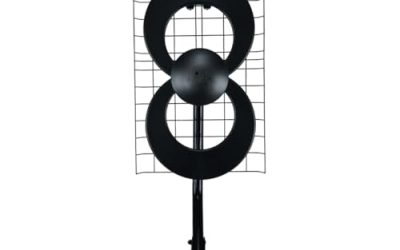
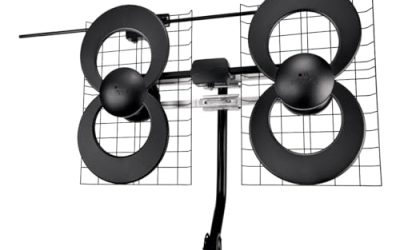
 Antennas Direct ClearStream 2V Indoor Outdoor TV Antenna18.50" H x 31.4" W x 6.5" D31.4 x 6.5 x 18 inches2 poundsCheck on Amazon

The best TV antennas for most households are the Mohu Gateway Plus for a simple amplified indoor setup, the ClearStream Eclipse for apartments close to the towers, the Antop HD Smart Bar AT-500SBS for longer indoor reach, and the Winegard Elite 7550 when you can mount an antenna outdoors. The right choice is set by three things: how far you live from the broadcast towers, whether anything blocks the path, and whether the antenna can go in a window, an attic or on a roof.
Free over-the-air television still delivers the major networks, local news, sports and often dozens of subchannels with no monthly fee, and broadcasts are typically uncompressed compared with streamed versions of the same programs. An antenna is the only hardware you need besides a TV with a built-in tuner. This guide compares eight antennas across the three installation classes (indoor, attic or indoor-outdoor, and outdoor), explains the numbers on the box, and includes a worked link-budget calculation so you can decide whether an amplifier will help or hurt.
Quick answer: pick by installation class
- Within about 25 miles of the towers, apartment or small house: ClearStream Eclipse or Channel Master FLATenna 35.
- Roughly 25 to 50 miles out, indoor only: Mohu Gateway Plus or Winegard FlatWave Amped FL5500A.
- Roughly 40 to 60 miles out, indoor or attic: Antop HD Smart Bar AT-500SBS or Antop AT-800SBS.
- Weak signal, wooded or hilly terrain, rooftop access: Winegard Elite 7550 or a similar outdoor antenna.
- Strong VHF channels in your market: an antenna with a reflector or loop design such as the ClearStream 2V.
How we chose these antennas
This is a research-based roundup built from manufacturer specification sheets, published range ratings and comparison guides, not from our own installation work. We favored antennas that cover both UHF and VHF, that are sold in the United States in 2026, and that fit a distinct use case so the list does not repeat the same product. We treated manufacturer range ratings as upper bounds and used them only to rank antennas against each other. Ratings of 70 to 85 miles describe ideal outdoor conditions with a clear path, so we do not suggest buying an indoor antenna on that number alone.
Selection criteria:
- Rated range and whether it is amplified.
- Band coverage: UHF channels for most stations, VHF-high channels 7 to 13 for markets that still broadcast there.
- Mounting flexibility: window, wall, tabletop, attic or mast.
- Cable length and connector quality.
- Compatibility with the newer ATSC 3.0 broadcasts, which need a compatible TV or tuner but not a special antenna.
Comparison table
| Model | Class | Rated range | Amplified | Form | Best for |
|---|---|---|---|---|---|
| Mohu Gateway Plus | Indoor | 60 miles | Yes | Indoor panel kit | Mid-distance indoor setups |
| ClearStream Eclipse | Indoor | 35 miles standard, 50 miles amplified version | Optional | Round, adhesive mount | Near-tower apartments |
| Channel Master FLATenna 35 | Indoor | 35 miles | No | Flat panel | Strong local signal |
| Winegard FlatWave Amped FL5500A | Indoor | 55 miles | Yes, USB powered | Thin flat panel | Long cable runs, window mounting |
| Antop HD Smart Bar AT-500SBS | Indoor | 80 miles | Yes, adjustable | Bar | Longer-reach indoor use |
| Antop AT-800SBS | Indoor or outdoor | 85 miles | Yes | Bar | Attic, balcony or eave mounting |
| ClearStream 2V | Indoor or attic | Mid-to-long range class | No | Reflector | Focused UHF and VHF reception without an amplifier |
| Winegard Elite 7550 | Outdoor | 70 miles | No | Rooftop antenna | Weak-signal rural homes |
Range figures are manufacturer ratings under open-air conditions. Walls, trees and terrain reduce them, so treat them as a ceiling, not a promise.
What the numbers on the box actually mean
Rated range
The mile figure is a line-of-sight rating at the transmitter, and it is not tied to a standard test. Two manufacturers can rate similar designs at 50 and 80 miles. Use range numbers to compare antennas within a brand and class, then rely on a reception map for your address.
UHF versus VHF
Most U.S. stations broadcast on UHF channels, but some networks remain on VHF-high channels 7 to 13. A compact flat antenna handles UHF well but can be weak on VHF because the elements are short. If a station you need sits on a VHF channel, choose a bar, loop or reflector design, or an outdoor antenna, rather than a small flat panel.
Amplified or passive
An amplifier adds gain to the signal on its way to the TV. It helps when the antenna sits far from the towers, when the cable run is long, or when the signal is split to several TVs. It hurts when you live close to the towers, because a strong signal can overload the tuner and cause pixelation. If your signal is strong, use the passive version or a unit whose gain can be switched off.
ATSC 3.0 and the 4K label
Antennas are not 4K or 8K devices. They catch radio signals. A modern antenna that covers the right frequencies works with newer ATSC 3.0 broadcasts if your TV or an external tuner supports the standard.
The eight antennas
Mohu Gateway Plus
Specs: Indoor · amplified · 60-mile rating · plug-in power for the amplifier.
Best for: A first antenna for households 20 to 45 miles from the towers that want a plug-in setup.
Skip if: You live within about 10 miles of the towers, where the amplifier may overload the tuner.
- Pros: Simple setup; the amplifier covers longer cable runs.
- Cons: Amplified designs require a power source; details of VHF performance were not confirmed, so check your channel list first.
ClearStream Eclipse
Specs: Indoor · 35-mile standard rating, 50-mile rating on the amplified version · round design with adhesive mount.
Best for: Apartments and condos in cities with strong nearby towers.
Skip if: The towers sit beyond about 35 miles or behind hills.
- Pros: Compact, easy to place high on a window or wall.
- Cons: Short range for the standard version; limited VHF strength for a compact design.
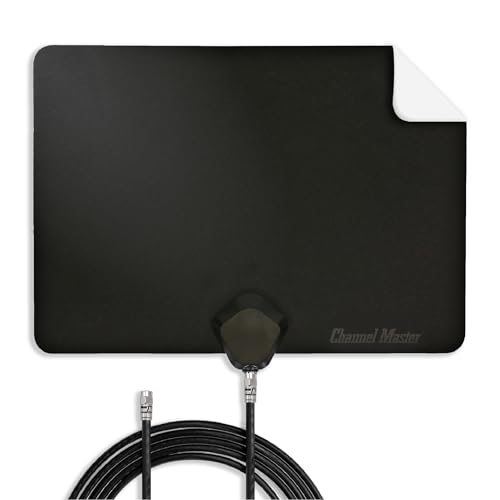
Channel Master FLATenna 35
Specs: Indoor · non-amplified · 35-mile rating · simple flat panel.
Best for: Strong-signal homes that want a passive, no-power antenna.
Skip if: You are far from the towers or need reach through multiple walls.
- Pros: No amplifier to overload; thin and inconspicuous.
- Cons: Limited range; placement is critical.
As an Amazon Associate we earn from qualifying purchases at no extra cost to you.
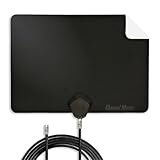
Winegard FlatWave Amped FL5500A
Specs: Indoor · amplified through USB power · 55-mile rating · thin flat panel with a long lead.
Best for: Window mounting with the TV across the room.
Skip if: You are very close to the towers.
- Pros: USB power can come from the TV; long cable helps reposition.
- Cons: Flat panels can miss weaker VHF channels.
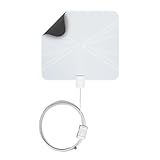
Antop HD Smart Bar AT-500SBS
Specs: Indoor · amplified with adjustable gain · 80-mile rating · bar design covering UHF and VHF.
Best for: Indoor installs farther from the towers where a standard panel falls short.
Skip if: You are close to the towers and cannot reduce amplifier gain below overload.
- Pros: Longer rated reach; adjustable amplification helps match local signal strength.
- Cons: Larger and less discreet than flat panels.
Antop AT-800SBS
Specs: Indoor or outdoor · amplified · 85-mile rating · bar design.
Best for: Attic, balcony or eave mounting where a full roof install is not possible.
Skip if: You only need a window-sized indoor antenna for a nearby station.
- Pros: Flexible placement class; long rated reach.
- Cons: Mounting hardware and a weatherproof routing of coax add work outdoors.

ClearStream 2V
Specs: Indoor or attic · non-amplified · reflector design covering UHF and VHF.
Best for: Viewers who want focused reception without relying on an amplifier.
Skip if: You need a flat, window-hugging profile.
- Pros: Directional gain from the reflector; no powered component to fail.
- Cons: Bulky; a numeric range rating was not confirmed in our sources, so we describe it by class.
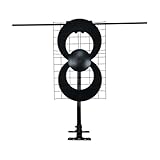
Winegard Elite 7550
Specs: Outdoor · 70-mile rating · rooftop mounting.
Best for: Rural or wooded homes that can mount an antenna on a mast.
Skip if: You rent, or cannot install a mast or ground the coax.
- Pros: Outdoor height beats any indoor placement on weak signals.
- Cons: Installation effort and grounding requirements.
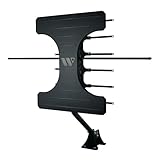
All fourteen antennas compared
This table merges the eight antennas from the main list with the six added above. Ranges are manufacturer ratings from current listings, shown only where one was available; treat every figure as a ceiling.
| Model | Class | Rated range | Band coverage | Best distance band |
|---|---|---|---|---|
| Mohu Gateway Plus | Indoor | 60 miles | UHF and VHF | 20 to 45 miles |
| ClearStream Eclipse | Indoor | 35 miles (standard) | UHF-leaning | Under 25 miles |
| Channel Master FLATenna 35 | Indoor | 35 miles | UHF-leaning | Under 25 miles |
| Winegard FlatWave Amped FL5500A | Indoor | 60 miles | UHF and VHF | 25 to 50 miles |
| Antop HD Smart Bar AT-500SBS | Indoor | Long-reach class | UHF and VHF | 40 to 60 miles |
| Antop AT-800SBS | Indoor or outdoor | 85 miles | UHF and VHF | 40 to 60 miles |
| ClearStream 2V | Indoor or attic | 60 miles plus | UHF and VHF | 30 to 55 miles |
| Winegard Elite 7550 | Outdoor | 70 miles plus | UHF and VHF | 45 to 70 miles |
| ClearStream 1MAX | Indoor or outdoor | 40 miles plus | UHF and VHF | 15 to 35 miles |
| Mohu Leaf Ultimate | Indoor | Not confirmed | UHF and VHF | 20 to 45 miles |
| Winegard FlatWave Amped Pro TH-3000 | Indoor | 60 miles | UHF and VHF | 25 to 50 miles |
| Antop Big Boy AT-400BV | Indoor or outdoor | 85 miles | UHF and VHF | 40 to 60 miles |
| ClearStream 4V | Outdoor | Long-reach class | UHF and VHF-high | 45 to 70 miles |
| Winegard Elite Pro BW-2000 | Outdoor | 70 miles plus | UHF and VHF | 50 miles and beyond |
How to choose: thresholds that settle the decision
- Distance under 15 miles: go passive, such as the FLATenna 35 or ClearStream 1MAX. An amplifier here is more likely to cause pixelation than fix it.
- 15 to 35 miles: a flat panel or a 1MAX-class antenna placed high in a window facing the towers; add an amplifier only if the cable run exceeds about 50 feet or you split to two or more TVs.
- 35 to 60 miles: a bar or large panel (AT-500SBS, AT-400BV) in an attic, or an outdoor antenna if trees or hills block the path.
- Beyond 60 miles or obstructed: outdoor on a mast, with a directional antenna aimed using a signal meter.
- VHF stations: if a station you need is on channels 7 to 13, pick a bar, loop, reflector or outdoor design with VHF-high elements rather than a small flat panel.
- Several TVs: each two-way split costs about 3.5 dB, so plan on amplification once you split more than once.
- Renters: check lease rules before drilling; indoor and window-mounted designs avoid the issue.
Before buying, enter your address in a reception map to see which stations are UHF or VHF and how strong each is. That one step prevents most wrong purchases.
Worked example: does an amplifier help?
A link budget is a simple tally of gains and losses between the antenna and your tuner. Here is a household with an antenna in a window, a 50-foot RG6 coaxial run, and one splitter feeding two TVs.
- Cable loss: RG6 loses roughly 5 to 6 dB per 100 feet at UHF frequencies, so 50 feet costs about 3 dB.
- Splitter loss: a two-way splitter costs about 3.5 dB per output.
- Total loss before the tuners: about 6.5 dB.
- Amplifier gain: a typical antenna amplifier adds around 15 to 20 dB.
- Net: roughly 8 to 13 dB better than the unamplified arrangement.
That is a good case for an amplifier: you are losing signal in the cable and the splitter, and the amplifier ahead of that loss recovers it. Now change one input. If the tower is 8 miles away and the signal is already strong, adding 15 to 20 dB of gain can push the signal above what the tuner can handle, and the picture breaks up. Rule of thumb: add gain when the total loss in your setup exceeds 6 dB or you are over 35 miles from the tower; keep it passive when you are within 15 miles with a short cable.
Decision matrix: distance, obstruction and mounting
| Distance to towers | Clear path | Hills, trees or dense buildings |
|---|---|---|
| Under 15 miles | Passive indoor panel (FLATenna 35, ClearStream Eclipse) | Amplified indoor panel in a window, gain set low |
| 15 to 35 miles | Indoor panel or bar, amplified only if the cable is long | Amplified bar in a window or attic (Antop AT-500SBS) |
| 35 to 60 miles | Amplified bar or attic-mounted antenna | Outdoor antenna on a mast (Winegard Elite 7550) |
| Beyond 60 miles | Outdoor antenna, ideally with a preamplifier | Outdoor antenna; check the reception map before buying anything |
Read the table by finding your distance row and then asking honestly whether the straight line to the towers crosses a ridge or a row of tall buildings. If it does, shift one column over in cost and effort: a nominally close tower behind a hill behaves like a distant one.
Interference and other causes of poor reception
If a clean setup still drops channels, look for local interference. Cellular LTE signals can overload an amplified antenna, and many antennas sold today include or accept a filter for that reason. Nearby LED bulbs, power adapters and routers can add noise when the antenna sits beside them. Multipath, where the signal bounces off buildings and arrives twice, causes pixelation that a stronger amplifier cannot fix; moving the antenna a foot or two often does. Each of these is a placement or filtering problem, not a reason to buy a larger rated-range number.
Placement decides more than the model
- Mount as high as you can, ideally in a window facing the towers.
- Keep the antenna away from metal, large appliances and wiring.
- Rescan channels every time you move the antenna by more than a few inches.
- Use a reception map from your address to find the direction and distance of the nearest towers.
Outdoor installation safety
Outdoor antennas must stay far from overhead power lines, and a ladder or mast that touches a line can be fatal. Keep at least 10 feet from any power line when installing, and use a grounded mast and coax ground block following local code. Do not install in wet or windy conditions, and hire a professional if the roof is steep or the run is near service wires.
Six more antennas worth comparing
The eight antennas above cover the common cases. These six add a compact indoor-outdoor option, a smarter indoor panel, two long-reach bar and panel designs, and two dedicated outdoor classes for weak-signal homes. Details come from manufacturer listings; where a figure could not be confirmed, the entry describes the class instead.
Antennas Direct ClearStream 1MAX
Specs: Indoor or outdoor · UHF and VHF · multi-directional · 40-mile-plus rating · passive
A small keyhole-style panel that can hang on a wall, sit in a window or go in an attic. It is passive, so there is no power supply to plug in and nothing that can overload a tuner near the towers. It is a reasonable step up from a thin flat panel when the stations sit 15 to 35 miles away and you want a design that can move outdoors later.
Best for: Suburban homes within about 35 miles of the towers that want one antenna for several mounting spots. Skip if: your stations are beyond 40 miles or sit behind hills.
Pros: No power needed; flexible mounting; handles UHF and VHF.
Cons: Modest reach; no gain control.
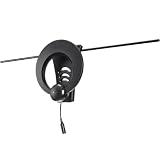
Mohu Leaf Ultimate
Specs: Indoor · amplified · ultra-thin panel · UHF and VHF · multi-directional
A thin amplified panel meant for window or wall mounting. The amplifier helps with a long cable run or a split to a second TV, and the panel form means it nearly disappears against glass. As with any amplified flat panel, switch the gain off or choose a passive model if you live close to the towers, since a strong signal can overload the tuner.
Best for: Mid-distance apartments and houses that want a low-profile amplified panel. Skip if: you sit within about 10 miles of the towers or need an outdoor install.
Pros: Slim profile; amplifier covers cable and splitter loss; multi-directional.
Cons: Needs a power source; flat designs can be weaker on distant VHF channels.

Winegard FlatWave Amped Pro TH-3000
Specs: Indoor · amplified · 60-mile rating · ultra-thin · built-in signal meter
This is the step-up flat panel in the FlatWave family. The built-in signal meter is the useful part: it lets you rotate the panel and move it between windows while watching a live strength reading instead of rescanning channels after every change. That removes much of the trial and error that makes indoor antennas frustrating.
Best for: Anyone who expects to experiment with placement. Skip if: you want a no-power passive setup for a strong local signal.
Pros: Signal meter speeds up placement; thin; amplified for longer cables.
Cons: Mid-range cost class; amplifier needs power.
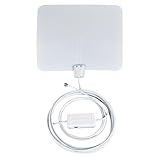
Antop Big Boy AT-400BV
Specs: Indoor or outdoor · amplified with Smartpass amplifier · 85-mile rating · UHF and VHF with enhancer rods
A larger flat panel with extendable VHF rods and a built-in filter against cellular interference. It occupies the same slot as the AT-800SBS but with a different panel layout, which makes it a good alternative when the AT-800SBS-style bar does not suit the mounting spot. Treat the rating as a best-case outdoor figure rather than an indoor promise.
Best for: Attic or eave mounting 35 to 60 miles from the towers. Skip if: you need something discreet for a small room.
Pros: Long rated reach; VHF rods help where networks use channels 7 to 13; interference filter.
Cons: Bulky; needs a power connection to the amplifier.

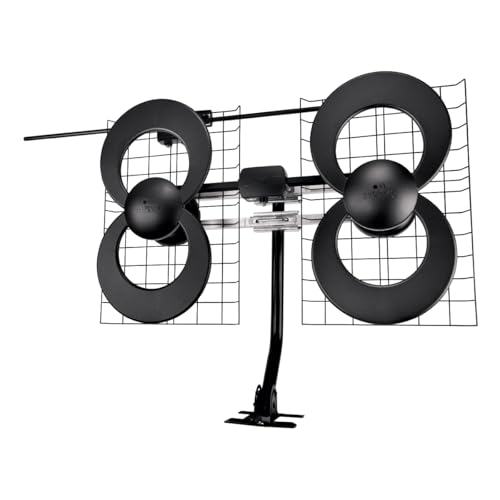
Antennas Direct ClearStream 4V
Specs: Outdoor · UHF and VHF-high · multi-directional · reflector and Hi-VHF elements · mast included
A larger outdoor antenna with reflectors and added VHF-high elements. It stays passive, which keeps the failure points to a minimum, and it targets the 50 to 70 mile band where an indoor antenna cannot compete. The size and mast work make it a project, not a quick swap.
Best for: Homes 40 to 70 miles from the towers with a clear roof or pole location. Skip if: you rent or cannot ground a mast.
Pros: Outdoor height and gain; no powered parts; VHF-high elements.
Cons: Large; installation and grounding required.

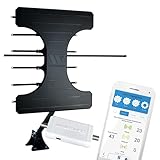
Winegard Elite Pro BW-2000
Specs: Outdoor · amplified directional · 70-mile-plus rating · TwinAmp · smart signal meter
A roof-class antenna in the same family as the Elite 7550, with an amplifier stage and a signal meter that makes aiming easier. It is meant for the weak-signal rural case: 50 miles or more, trees in the path, or a tower in one clear direction. Always check a reception map first, because an amplifier cannot repair a path that is blocked.
Best for: Rural homes aiming at towers in one direction. Skip if: your signals are strong and nearby; an outdoor amplified antenna would be overkill.
Pros: Directional gain for weak signals; amplified; aiming aid.
Cons: Premium cost class; needs a mast and grounded coax.
Frequently asked questions
What is the best TV antenna for most people?
For most homes, an amplified indoor antenna such as the Mohu Gateway Plus or the Winegard FlatWave Amped FL5500A is the easiest start. Your distance to the towers should decide, not the brand.
Do I need an amplified antenna?
Only if you are far from the towers, have a long cable run or feed several TVs. Near the towers an amplifier can overload the tuner and cause pixelation.
How far can a TV antenna reach?
Indoor antennas typically deliver reliable reception within roughly 30 to 40 miles. Outdoor antennas on a mast can reach farther, often 60 to 70 miles with a clear path.
Do I need a 4K antenna?
No. Antennas do not have a resolution. Any antenna that covers the right frequencies works with 4K-capable ATSC 3.0 broadcasts if your TV has a compatible tuner.
Why do channels pixelate when it rains or at certain times?
Weak signals, interference from LTE and weather can all reduce quality. Raising the antenna, reducing amplifier gain or using an outdoor model often fixes the problem.
Do I need to rescan channels after moving the antenna?
Yes. Run a new channel scan after every placement change, because the TV only lists channels it found during the last scan.
Can one antenna feed several TVs?
Yes, through a splitter, but each split cuts signal strength by about 3.5 dB for a two-way splitter. Use an amplified antenna or a distribution amplifier on larger setups.
Is it legal and free to watch over-the-air TV?
Yes. Broadcast stations transmit free to the public, so you pay only for the equipment, not for a subscription.
Final recommendation
Start with a reception map for your address, note the distance and direction of the towers, and choose from the class that matches. Under 25 miles, choose a passive indoor antenna such as the ClearStream Eclipse or FLATenna 35. At 25 to 50 miles, choose an amplified model such as the Mohu Gateway Plus. Beyond that, or with hills in the way, move to a bar design or an outdoor antenna such as the Winegard Elite 7550. Place it high, rescan, and adjust gain only when the numbers say you need it.
More from Amazon
Programs that pair well with the guide above. Offers and eligibility are set by Amazon and may change.
Free shipping on eligible items, Prime Video and more. Eligible new members can start with a free trial.
Start a Prime free trialAd-free music streaming. Eligible new subscribers can start with a free trial.
Try Music Unlimited freeA Prime membership for ages 18-24 with a trial period. Eligibility is set by Amazon.
See Prime for Young AdultsAudiobooks and podcasts to listen to on the go. Eligible new members can start with a free trial.
Try Audible freeAs an Amazon Associate we earn from qualifying purchases.