Key takeaways
- Compare five camera lens cleaning kits and tools: a full hard-case kit, a carbon lens pen, a rocket blower, pre-moistened wipes and a compact dry kit.
A streaming camera lens collects two kinds of dirt: dust that settles while the camera sits on its mount, and fingerprints from every focus check, filter swap and quick reposition between segments. Both show up on air as a soft haze that sharpening in software cannot fully hide. The five picks below cover the full job in different forms: a complete hard-case kit for the desk, a carbon pen for fingerprints, a large hand blower that should always be step one, sealed pre-moistened wipes for travel and shared gear, and a compact dry kit that lives in a camera bag. Every contents list and figure here is a maker figure from the manufacturer’s published listing or manual.
One honest note on method, because it decides which kit matters. Cleaning order does more for a coated lens than any single product: loose grit comes off with air first, a brush handles what air leaves behind, and fluid touches the glass only after both. A cloth dragged across a dusty lens is the most common way coatings pick up fine scratches, and no kit below can undo that. The kits differ mainly in how completely they cover those three steps and how well they keep their own tools clean between uses.
Disclosure: As an Amazon Associate, I earn from qualifying purchases.
How to Choose a Camera Lens Cleaning Kit
Work in order: air, brush, then fluid. Loose dust and grit must leave the surface before anything touches it. A hand blower clears most of it without contact, a soft brush lifts what remains in the crevices around the front element, and only then should a cloth, tissue or pen touch the glass. Any kit that leads with wipes and skips a blower is asking its owner to grind the first clean into the coating.
Put fluid on the cloth, never on the glass. Spraying cleaner straight onto a front element lets liquid pool at the rim and creep past the seal into the barrel. The safer pattern is a drop or two on a microfiber cloth or a lens tissue, then a gentle circular wipe from the center outward. It uses less fluid and leaves less residue to polish away.
Match the fluid to coated optics. Modern streaming lenses and filters carry delicate anti-reflective coatings, so the fluid in a kit should be one the maker lists as safe for coated lenses. The full kit below uses an alcohol-free, ammonia-free formula, which is the conservative choice for coated glass. Pre-moistened wipes are a different case: the sealed wipes here use an alcohol-based formula the maker positions for coated camera lenses, but the lens manufacturer’s own manual wins any disagreement, and glass the maker says to clean dry should stay dry.
Know what dry tools cannot do. A blower and a carbon pen handle dust and fresh fingerprints well. Dried water spots, salt spray and sticky residue need fluid, so a dry-only kit is a maintenance kit, not a complete one. Decide which problem you actually have before deciding that the smallest kit is enough.
A dirty cloth is an abrasive pad. Reusable microfiber only stays safe while it stays clean. Wash cloths separately from other laundry, skip fabric softener, which leaves a residue film, and store cloths sealed or inside the kit case rather than loose in a bag pocket. Sealed single-use wipes and tissues sidestep the problem entirely, which is their real advantage on location.
Skip canned air near lenses. Compressed-gas dusters can spit liquid propellant when tilted and their blast is hard to meter near a front element. A squeeze-bulb blower delivers a controlled puff with nothing in it but room air, which is why every kit here is built around one.
The 5 Best Camera Lens Cleaning Kits
1. Altura Photo Professional Cleaning Kit — The Full Kit in a Hard Case
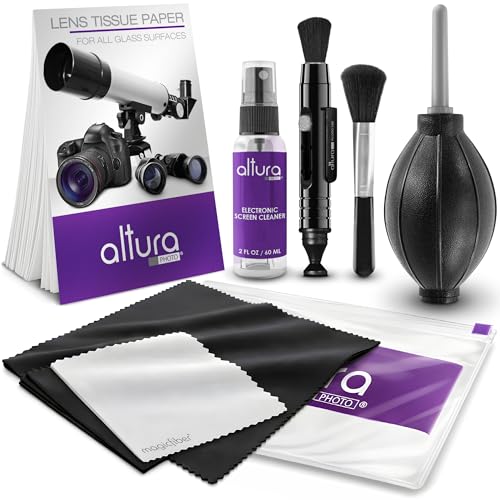
This is the complete desk kit: a 2 oz bottle of Altura Photo lens cleaner spray, an air blower, a cleaning brush, a double-sided lens pen, three MagicFiber microfiber cloths and 50 sheets of lens tissue, all packed in a hard case. The spray is listed by the maker as alcohol free, ammonia free and odor free, which suits coated front elements and filters, and the tissue count covers the disposable step of a wet clean for many sessions. The hard case is not a cosmetic extra. Brushes and cloths stored loose in a drawer or bag collect the same dust they are meant to remove, and a case that closes keeps the whole workflow clean between uses. For a streaming setup that lives in one room, this is the kit that covers air, brush and fluid steps without a second purchase.
Specs
- Contents: 2 oz lens cleaner spray, air blower, cleaning brush, double-sided lens pen
- Cloths and tissue: 3 MagicFiber microfiber cloths, 50 lens tissue sheets
- Fluid: Alcohol free, ammonia free and odor free, per the maker
- Storage: Hard carrying case
- Compatibility: DSLR and mirrorless lenses and filters, per the maker
- View on Amazon
2. LensPen NLP-1 — The Carbon Pen for Fingerprints

The NLP-1 is a single-purpose tool done properly. One end carries a retractable natural brush for loose dust; the other carries a 12 mm round carbon cleaning tip, slightly concave to match the curve of a front element. The carbon compound absorbs the oil in a fingerprint instead of smearing it across the glass the way a dry cloth tends to, and it needs no fluid at all. Twisting the cap back on refreshes the compound, and the maker rates a pen for up to 500 cleans. At 11 cm long it disappears into a pocket or a mount-side pouch, which is exactly where a streaming camera needs it: most lens dirt in a studio is a fingerprint left by a quick adjustment seconds before going live. The discipline still applies — brush or blow grit off first, because the tip is not a dust tool.
Specs
- Model: NLP-1
- Cleaning tip: 12 mm round carbon tip, non-liquid compound
- Brush: Retractable natural brush
- Length: 11 cm
- Maker figure: Up to 500 cleans per pen
- Use: Lenses, filters, viewfinders and other optics, per the maker
- View on Amazon
3. Giottos Rocket Air Blaster AA1900 — The Blower That Begins Every Clean

If only one tool from this page earns a permanent spot beside the camera, it is this one. The AA1900 is the large size of Giottos’s rocket-shaped blower: a natural rubber bulb with a one-way valve, so the bulb does not inhale dusty air and blow it back at the lens, and short fins that let it stand upright on a desk with the nozzle pointing up and away from surfaces. At 7.5 inches tall and 90 grams it moves a generous volume of air per squeeze, enough to clear a front element, a filter and the rear element during a lens swap. There is no propellant, no moisture and no contact, which makes it the safest first step before any cloth, pen or wipe touches glass. The trade-off is bulk: it takes real space in a slim bag, which is what the smaller kit below is for.
Specs
- Model: AA1900, large size
- Material: Natural rubber bulb
- Valve: One-way valve to keep intake dust out of the airstream
- Dimensions: 7.5 inches tall
- Weight: 90 grams
- Design: Stands upright on its fins, nozzle held off surfaces
- View on Amazon
4. ZEISS Pre-Moistened Lens Cleaning Wipes — Sealed Wipes for Travel and Shared Gear

A box of 250 individually wrapped wipes solves the one problem reusable cloths cannot: certainty that the surface touching the lens is clean. Each wipe is sealed at the factory, used once and thrown away, so a wipe pulled out at a venue, a borrowed desk or a shared studio camera carries nothing from the last clean. ZEISS positions the wipes for coated camera lenses, filters, screens and other optics, and the format suits streaming work away from home, where washing a cloth properly is not an option. Two honest limits belong with the format. The formula is alcohol based, so the lens maker’s own guidance governs — glass or coatings a manufacturer says to clean dry should stay dry. And a wipe begins drying the moment the packet opens, so one packet is one clean, not a session’s worth of glass.
Specs
- Count: 250 individually wrapped wipes
- Formula: Pre-moistened, 70% alcohol per the listing
- Model number: 740.000.00282
- Use: Camera lenses, filters, screens and optics, per the maker
- Format: Single use, sealed packets
- View on Amazon
5. K&F Concept 4-in-1 Camera Lens Cleaning Kit — The Compact Dry Kit for the Bag

K&F Concept’s 4-in-1 kit, model SKU0711, strips the workflow down to its dry essentials: a silicone air blower with a one-way intake and a soft nozzle, a 2-in-1 lens pen with a brush on one end and a carbon head on the other, and two microfiber cloths that arrive individually vacuum packed so they begin life genuinely clean. The whole kit measures 4.88 by 2.32 by 2.32 inches and weighs 3.17 ounces, small enough to live in the bag permanently rather than being packed on purpose. It is a maintenance kit and says so by its contents: with no fluid aboard, dried spots and sticky residue wait for a wet kit back home, and the carbon head is the only answer to fingerprints. For day-to-day dust and smudges on a camera that travels, that limit is a reasonable trade for the size.
Specs
- Model: SKU0711
- Contents: Silicone air blower, 2-in-1 lens cleaning pen, 2 microfiber cloths
- Blower: One-way air intake, soft nozzle
- Cloths: Individually vacuum packed, machine washable
- Dimensions: 4.88 x 2.32 x 2.32 inches
- Weight: 3.17 ounces
- View on Amazon
Comparison Table
| Pick | Main tools | Fluid included | Storage | Best role |
|---|---|---|---|---|
| Altura Photo Professional Kit | Blower, brush, pen, cloths, tissues | 2 oz spray, alcohol free | Hard case | Full desk kit |
| LensPen NLP-1 | Brush and carbon tip pen | None, dry carbon compound | Pocket size, capped | Fingerprints |
| Giottos Rocket Air Blaster AA1900 | Large hand blower | None | Stands upright | First step, every clean |
| ZEISS Pre-Moistened Wipes | 250 sealed wipes | In each wipe, alcohol based | Sealed packets | Travel and shared gear |
| K&F Concept 4-in-1 | Blower, pen, 2 cloths | None | Compact kit, no case | Bag-friendly dry kit |
FAQ
Can a microfiber cloth alone clean a camera lens?
Only on a lens that is already free of loose grit. A cloth on a dusty front element drags particles across the coating, so the safe sequence is blower first, then the cloth. On an otherwise clean lens, a cloth alone handles a fresh fingerprint fine, ideally with a drop of fluid on the cloth rather than on the glass.
Are pre-moistened wipes safe for coated lenses?
The wipes here are made for coated camera lenses according to their maker, and a fresh sealed wipe cannot carry grit from a previous clean. The formula is alcohol based, though, so the lens manufacturer’s manual is the final word: any glass or coating the maker says to clean dry should stay dry, and a wipe is never reused for a second lens.
How often should a streaming camera lens be cleaned?
Inspect before each session and clean only what is actually there. Dust that sits at the edge of the frame area may never show on air, while a fingerprint near the center will. Cleaning on a fixed schedule adds handling and risk without adding clarity, so a lens cap, a blower within reach and a quick look under a bright light beat a daily routine.
Can these kits clean a camera sensor as well?
That is a different job. Sensor cleaning uses swabs matched to the sensor’s width and a dedicated procedure, and it has its own kits. The blowers here can clear loose dust from a mirrorless sensor area with care, but lens tissues, pens and cloths should stay on lenses, filters and screens, where they belong.
Conclusion
The kit that matters is the one that enforces the right order: air first, brush second, fluid last, and never a dry wipe over grit. The Altura Photo kit covers all three steps in one hard case for a fixed streaming desk. The LensPen NLP-1 answers the fingerprint problem in a pocketable form, and the Giottos AA1900 should begin every clean whatever kit surrounds it. ZEISS wipes trade reusability for a guaranteed-clean surface on the road, and the K&F Concept 4-in-1 keeps the dry essentials in the bag at all times. Pick by where the camera works, and keep the tools as clean as the glass.
More from Amazon
Programs that pair well with the guide above. Offers and eligibility are set by Amazon and may change.
Free shipping on eligible items, Prime Video and more. Eligible new members can start with a free trial.
Start a Prime free trialAd-free music streaming. Eligible new subscribers can start with a free trial.
Try Music Unlimited freeA Prime membership for ages 18-24 with a trial period. Eligibility is set by Amazon.
See Prime for Young AdultsAudiobooks and podcasts to listen to on the go. Eligible new members can start with a free trial.
Try Audible freeAs an Amazon Associate we earn from qualifying purchases.