Key takeaways
- Bypass pruning shears: for shoots, leaves, and small branches. A narrow nose reaches into dense growth.
- Concave cutters: for removing branches close to the trunk while leaving a shallow, tidy depression that can heal over.
- Wire cutters: for removing training wire. Bonsai wire cutters have rounded or blunt jaws that reduce the chance of gouging bark.
- Root rake or root hook: for teasing compacted roots and separating soil during repotting.
- Tweezers: for removing weeds, dead needles, buds, and loose soil from tight spaces.
- Small knob cutter: useful for refining larger cuts, but usually unnecessary for a first tree.
- Jin pliers: useful for deadwood work and twisting wire, though they are not essential for ordinary pruning.
Best Bonsai Tool Sets for Beginners and Enthusiasts
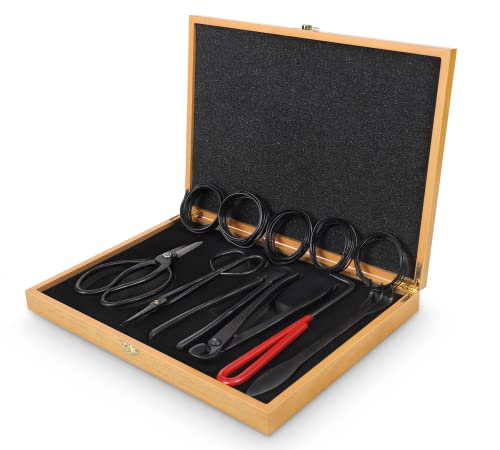
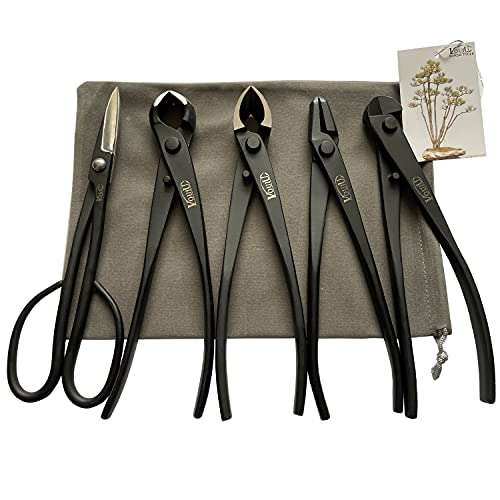
The best bonsai tool sets for most buyers are compact stainless-steel or carbon-steel kits with bypass shears, concave cutters, wire cutters, tweezers, and a case that protects cutting edges; beginners should prioritize clean, comfortable tools over large sets filled with duplicates.
A sensible starter budget in 2026 is about $35–$80 for a basic stainless-steel kit, $80–$180 for a better steel set from a specialist bonsai supplier, and $180 or more for Japanese-made tools such as selected Okatsune or Kaneshin pieces bought individually. A 20-piece case is not automatically better than a six-tool set: bonsai work depends more on edge geometry, jaw alignment, and rust resistance than on tool count.
Our top picks
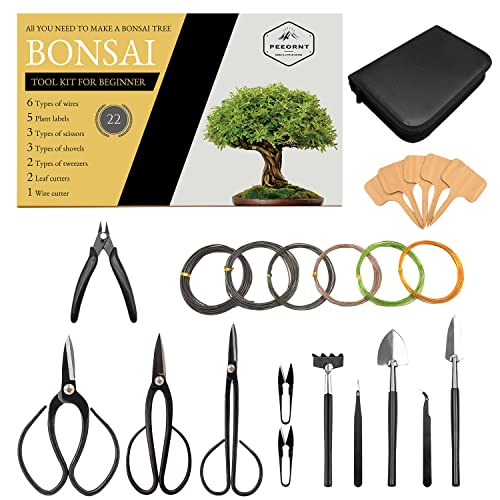

As an Amazon Associate we earn from qualifying purchases at no extra cost to you. Ratings are shown as listed on Amazon.
Quick picks by bonsai situation
| Situation | Best choice | Why it fits | Typical 2026 budget |
|---|---|---|---|
| First tree, occasional pruning | 6–8-piece stainless-steel starter set | Easy cleaning, low rust risk, and the essential tools without unnecessary duplicates | $35–$80 |
| Several trees, regular seasonal work | Specialist set with carbon-steel cutters and stainless accessories | Sharper cutting geometry and better leverage, while tweezers and wire tools remain easy to maintain | $80–$180 |
| Refined Japanese or conifer training | Individual Japanese tools from makers such as Kaneshin or Okatsune | More precise jaws, better balance, and tool sizes matched to branch diameter | $180–$450+ |
| Small apartment collection | Compact 5–7-piece case under 30 cm long | Stores neatly and avoids tools that are too large for finger-sized branches | $30–$100 |
| Heavy training and thicker branches | Separate long-handle branch cutter plus a smaller maintenance set | Longer handles provide leverage without forcing delicate pruning shears to do structural work | $100–$250+ |
What a useful bonsai tool set should include
A practical set should cover four jobs: foliage pruning, branch reduction, wiring, and root or soil work. The following tools are more useful than a case packed with several nearly identical pliers.
- Bypass pruning shears: for shoots, leaves, and small branches. A narrow nose reaches into dense growth.
- Concave cutters: for removing branches close to the trunk while leaving a shallow, tidy depression that can heal over.
- Wire cutters: for removing training wire. Bonsai wire cutters have rounded or blunt jaws that reduce the chance of gouging bark.
- Root rake or root hook: for teasing compacted roots and separating soil during repotting.
- Tweezers: for removing weeds, dead needles, buds, and loose soil from tight spaces.
- Small knob cutter: useful for refining larger cuts, but usually unnecessary for a first tree.
- Jin pliers: useful for deadwood work and twisting wire, though they are not essential for ordinary pruning.
Sets from specialist bonsai brands such as Joshua Roth and Ryuga commonly provide this sort of selection. Kaneshin is better known for higher-grade Japanese bonsai tools, while Okatsune is a respected Japanese maker of pruning tools. Brand names still need to be checked against the actual steel, finish, and intended size: a reputable manufacturer can offer both entry-level and professional tools.
Steel quality: stainless versus carbon steel
Stainless steel is the easier choice for beginners. It tolerates humid storage, occasional handling with damp hands, and imperfect cleaning better than untreated carbon steel. Its main drawbacks are that inexpensive stainless tools can be soft, lose their edge quickly, or develop play at the pivot.
Carbon steel can offer a very keen, easily sharpened edge and is common in high-quality Japanese pruning tools. It is not maintenance-free. Sap and moisture should be wiped away after every session, and a very light protective oil film is useful during storage. Surface discoloration is not always a structural problem, but active rust around the pivot or cutting edge eventually affects movement and accuracy.
| Tool characteristic | Budget stainless set | Better specialist set | Premium individual tool |
|---|---|---|---|
| Typical steel description | Unspecified or general stainless steel | Named stainless or carbon steel | Identified Japanese or high-carbon tool steel |
| Useful branch capacity | Usually up to 6–8 mm for pruning shears | About 8–12 mm, depending on tool size and wood | Often 10–15 mm for an appropriately sized cutter |
| Expected case length | 20–30 cm | 25–35 cm | Individual storage or 30–40 cm roll |
| Best maintenance level | Wipe and dry after use | Wipe, lubricate the pivot, and inspect edge alignment | Frequent cleaning, oiling, and occasional professional sharpening |
Capacity figures are working guidelines rather than permission to force a tool. A green, flexible shoot may cut easily at the upper end of a tool’s range, while hard, dry, or dead wood can damage the edge at a much smaller diameter. For structural cuts, use a branch cutter or saw designed for that job.
Case durability matters more than extra accessories
A case protects the cutting edges from contact with metal objects and keeps soil away from the pivot. Look for stitched or riveted pockets, a flap that covers the jaws, and enough space that tools are not rubbing against each other. A soft canvas roll is compact and breathable; a molded plastic case offers more impact protection but can trap moisture if tools are put away wet.
Cases often fail before the tools do. Thin elastic loops stretch, low-quality zippers corrode, and tightly packed pockets bend delicate tweezers. If a set includes more tools than there are secure pockets, expect to store some separately. For a balcony collection of three to five trees, a roll around 25–30 cm long is usually sufficient. Enthusiasts with long-handled cutters should choose a 35–40 cm case or a dedicated tool chest.
How to choose the right set without overspending
1. Count your trees and the work they need
One or two young trees require shears, tweezers, wire cutters, and perhaps a root rake. A collection containing mature branches, conifers, or frequent styling justifies concave cutters, jin pliers, and a stronger branch cutter.
2. Match tool size to branch size
For most indoor and balcony bonsai, a 180–210 mm pruning shear is easier to control than a large landscape pruner. If most branches are pencil-thick or smaller, a compact cutter gives better visibility and reduces accidental trunk or bud damage.
3. Inspect the cutting action
When possible, close the shears slowly. The blades should meet cleanly rather than slide past each other, and the handles should return without grinding. Uneven gaps at the tip indicate poor alignment. On concave cutters, the two halves should meet across the cutting surface, not only at one corner.
4. Buy missing specialist tools later
A good six-piece set plus one quality concave cutter is usually a better purchase than a 16-piece kit with blunt scissors, duplicate pliers, and a weak case. Add a knob cutter or branch saw only when your trees create a real need.
Ownership costs and maintenance
Suppose a $60 starter set lasts three years and you prune twice a month for nine active months each year. That is 54 sessions, or about $1.11 per session before replacement costs. If poor cleaning causes the shears to rust after one year, the same purchase effectively costs $3.33 per session. A two-minute cleanup is therefore more valuable than buying extra tools.
- Remove sap with a soft cloth after every use; do not leave residue on the blades overnight.
- Dry tools completely before placing them in the case.
- Apply one small drop of tool oil to the pivot and wipe away excess.
- Disinfect blades between trees when disease transmission is a concern, then dry and re-oil them.
- Do not cut wire with pruning shears; it creates nicks that make clean plant cuts difficult.
- Do not twist tools sideways while cutting. Side loading is a common cause of chipped edges and loose pivots.
- Sharpen only the intended bevel. Over-sharpening changes the cutting geometry and can make the blades bind.
Final verdict
For a beginner, choose a compact stainless-steel set with narrow bypass shears, concave cutters, wire cutters, tweezers, and a root tool in a stitched case. For frequent styling, upgrade the cutters first rather than buying a larger kit. Enthusiasts working with valuable mature trees should combine premium Japanese cutting tools with lower-cost accessories, because precision and edge retention matter most where a poor cut can permanently affect the tree.
The best bonsai tool sets are not the ones with the longest accessory list. They are the sets whose steel, jaw alignment, tool sizes, and storage match the diameter of your branches, the frequency of your work, and the time you are willing to spend cleaning them.