Key takeaways
- Keep the base clean: Grass, sand, and grit can collect where the bag meets the cart. Brush them away before storage so debris does not abrade the base or cart surface.
- Dry it before storing: Empty pockets and leave zippers open after a wet round. Storing a damp bag in a closed trunk encourages odor and can stress seams and coatings over time.
- Do not overload pockets: Heavy items can pull on seams and make a mounted bag unstable. Keep valuables and frequently used accessories in easy-to-reach pockets; put dense items low and close to the bag’s center.
- Mind the strap: Tighten the cart strap enough to prevent movement, but avoid crushing pocket contents or forcing the bag against a sharp edge.
Best Golf Cart Bags: Quick Picks by Use
The best golf cart bag for most golfers is a midweight, cart-specific model with a 14-way top, a dedicated putter well, and a pass-through strap channel that leaves its main pockets usable when the bag is secured. Choose a lighter 14-way bag if you lift it often, a compact 5- to 8-way bag if you carry clubs between rounds, or a waterproof model if you play through frequent rain.
Good options to compare include the Sun Mountain C-130 for cart-focused storage, the Bag Boy Chiller for a built-in cooler pocket, and the Motocaddy Dry-Series for weather protection. Exact specifications can vary by model year, so check the current listing before buying.
Our top picks

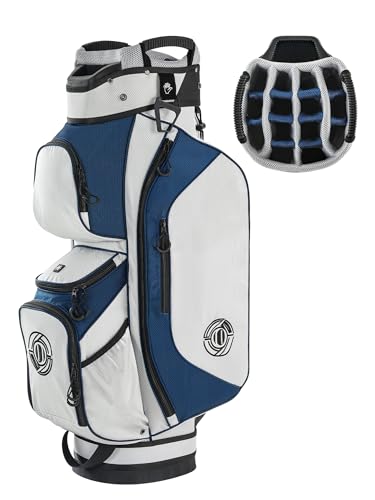


As an Amazon Associate we earn from qualifying purchases at no extra cost to you. Ratings are shown as listed on Amazon.
Golf Cart Bag Comparison
Weights and dimensions below are approximate published figures for commonly listed versions; color, size, and model-year updates can change them. Pocket counts are not directly comparable between brands, because some count small accessory sleeves separately.
| Bag | Club layout | Approx. weight | Storage and access | Best suited to |
|---|---|---|---|---|
| Sun Mountain C-130 | 14-way top; individual full-length dividers on many versions | About 6.6 lb | Cart-oriented pocket layout; pass-through strap channel on many versions | Golfers who keep the bag on a riding cart and want organized storage |
| Bag Boy Chiller | 14-way top on common versions | About 6.5 lb | Integrated cooler pocket; cart-compatible pocket arrangement | Players who want drinks and accessories close at hand |
| Motocaddy Dry-Series | 14-way top on common versions | About 5.7 lb | Waterproof construction and sealed pockets, depending on version | Frequent players in wet conditions |
| Titleist Players 4 StaDry | 4-way top | About 4.3 lb | Lightweight, waterproof stand-bag design; less cart-specific storage | Golfers who alternate between carrying and cart use |
These models serve different priorities rather than representing a single best-to-worst ranking. A stand bag can work on a cart, but its leg mechanism, pocket placement, and strap setup may be less convenient than a dedicated cart bag.
Choose by Your Golfing Situation
| Your situation | What to prioritize | Good direction |
|---|---|---|
| Bag stays on a riding cart most rounds | Cart strap channel, forward-facing pockets, stable base | A cart-specific 14-way model such as the Sun Mountain C-130 |
| You play or practice in frequent rain | Waterproof fabric, sealed seams and zippers, rain hood | A waterproof cart bag, or a stand bag with sealed pockets if carrying matters too |
| You walk some rounds or lift the bag in and out of a car | Low empty weight, comfortable handles, manageable pocket load | A lighter hybrid or stand bag; consider a smaller divider layout |
| You want drinks and extras within reach | Cooler access, rangefinder pocket, easy-open apparel pocket | A cart bag with dedicated storage, such as the Bag Boy Chiller |
| You use a push cart or an electric trolley | Base shape, strap placement, trolley compatibility | Check the bag and trolley maker’s fit guidance before purchase |
What Matters Once the Bag Is Mounted
Pocket access and strap routing
A cart strap can cover the ball pocket, apparel pocket, or valuables pocket if it crosses the wrong part of the bag. Look for a pass-through channel that lets the strap sit behind the pockets, and confirm that the pockets you use most face outward when the bag is mounted. If possible, compare a photo of the bag strapped to a cart—not only a product image of it standing upright.
Check where the cooler pocket opens, too. A side-mounted cooler may be easy to reach on a riding cart but awkward beside a push-cart frame. A magnetic valuables pocket is convenient, but the closure should remain secure when the bag tilts or the cart crosses rough ground.
Dividers: separation versus speed
A 14-way top gives each club its own opening, which can reduce shaft tangling and make it easier to spot a missing club. It does not guarantee that every divider runs the full length of the bag: shorter partitions can still let grips bunch together lower down. Full-length dividers matter most if you carry graphite-shafted clubs or find that grips catch when you pull clubs out.
A 5- or 6-way top has fewer openings to navigate and can be easier to use with a walking bag. The trade-off is more club-to-club contact. For a cart bag, the top layout is partly personal preference; pocket access, weight, and how cleanly clubs return to their slots may matter more than the number alone.
Weight, Cart Fit, and Weather Protection
Bag weight is only the starting point. A 6.5-pound empty bag loaded with balls, a rain jacket, drinks, and spare shoes can become cumbersome when lifting it into a trunk. If you regularly carry it, favor a lighter model and pack only what you need. If it stays on a powered cart, extra storage may be worth the added weight.
Before buying, check the bag’s base dimensions and how its strap sits against your specific riding cart, push cart, or trolley. Some carts have narrow cradles or fixed straps that interfere with pocket openings. A rotating or adjustable upper strap can help, but it is not a substitute for checking compatibility. For electric trolleys, consult the trolley maker’s bag-fit guidance: a bag that twists or shifts can make controls and pockets harder to reach.
“Water-resistant” and “waterproof” are not interchangeable. Water-resistant fabric can handle light showers, but seams and zippers may let water through during a long downpour. A waterproof bag generally uses sealed construction and water-resistant zippers; it still needs its rain hood, and small gaps can remain around openings. If rain is occasional, a rain hood and valuables pouch may be enough. If wet rounds are routine, prioritize sealed pockets and waterproof construction.
Ownership Details That Affect Longevity
- Keep the base clean: Grass, sand, and grit can collect where the bag meets the cart. Brush them away before storage so debris does not abrade the base or cart surface.
- Dry it before storing: Empty pockets and leave zippers open after a wet round. Storing a damp bag in a closed trunk encourages odor and can stress seams and coatings over time.
- Do not overload pockets: Heavy items can pull on seams and make a mounted bag unstable. Keep valuables and frequently used accessories in easy-to-reach pockets; put dense items low and close to the bag’s center.
- Mind the strap: Tighten the cart strap enough to prevent movement, but avoid crushing pocket contents or forcing the bag against a sharp edge.
The parts most exposed to wear are often the base, handles, zipper pulls, and strap-contact areas—not the divider count. A rain hood is also easy to misplace, so keep it in a dedicated pocket. If a zipper sticks, clear grit first rather than forcing it; repeated yanking can damage the teeth or stitching.
Bottom Line
For a bag that lives on a riding cart, start with cart-strap routing and pocket access, then choose the divider layout and storage you prefer. The Sun Mountain C-130 is a strong direction for organized cart use, the Bag Boy Chiller suits golfers who value accessible drink storage, and the Motocaddy Dry-Series is worth considering when wet-weather protection is a priority. If you carry regularly, put weight and comfortable handles ahead of maximum pocket count—and verify the exact model-year specifications and cart fit before buying.