Our Short List of 3

- 660 LED beads (330 daylight, 330 tungsten)
- Color temperature: 3200K-5600K
- CRI 96+ (maker figure)
- Metal frame with U bracket and barn doors

- Two panels with light stands included
- Color temperature: 3200K-5600K plus full RGB color
- CRI 97+ (maker figure)
- App control plus on-panel dials
- 660 LED beads, 50W output (maker figure)
- Color temperature: 3200K-5600K plus full RGB color
- CRI 97+ (maker figure)
- App control plus on-panel controls
All 4 Picks at a Glance
| Product | Specs | Action |
|---|---|---|
| 1. Neewer NL660 Bi-Color 660 LED Video Light |
| Check price on Amazon |
| 2. GVM 800D RGB LED Video Light 2-Pack |
| Check price on Amazon |
| 3. Neewer 660 PRO RGB LED Video Light |
| Check price on Amazon |
 4. RaLeno PLV-S192 13-Inch Edge-Lit Soft Light Panel |
| Check price on Amazon |
Key takeaways
- Compare the best fill lights for streaming by dimming range, panel size, diffusion, color temperature, and power options to balance your key light.
A single key light gives a stream its shape, but it also leaves one side of your face in shadow. On camera that shadow side can go muddy, especially in a dim room where the webcam is already struggling. A fill light is the second light that lifts those shadows without flattening the image. It is not a second key: it runs dimmer, sits on the opposite side, and exists to set the ratio between the bright side and the shadow side of your face.
This site already runs guides to key lights, ring lights, and background lights. This roundup covers the one role those guides leave open: LED panels bought specifically to fill. That changes what matters. Peak brightness matters less, because a fill that cannot dim low enough is just a second key fighting the first one. Softness matters more, because fill light wraps the shadow side and any harshness shows. Fine dimming steps, wide diffusion, and a color temperature range that matches your key light are the traits that decide the picks below.
Every brightness and color accuracy figure quoted here is a maker figure from the product listing, not a bench measurement, and no detailed research is claimed.
Disclosure: As an Amazon Associate, I earn from qualifying purchases.
How to Choose a Fill Light for Streaming
Dimming range beats peak output
Fill work happens at the low end of the dial. A panel that dims in coarse jumps, or stops at a still-bright minimum, forces you to move it farther away or angle it off your face, and both workarounds change the light’s character. Look for continuous dimming or fine percentage steps, and a minimum setting that is genuinely low. A powerful panel you run at a fifth of its output is a better fill than a weak panel running flat out, because the powerful one still has headroom for brighter rooms and larger setups.
Softness comes from size, diffusion, and distance
A small panel is a hard light source no matter what the marketing says. Hard fill carves a second set of shadows instead of softening the first. Larger panels, edge-lit designs, and snap-on diffusers spread the source so shadows open up gently. Distance works the same way in reverse: moving a panel closer makes it effectively larger and softer, which is why a modest panel placed just out of frame often fills better than a big one parked across the room.
Match the key light’s color temperature
Skin looks patchy when the bright side of a face is lit at one color temperature and the shadow side at another. A bi-color fill panel that spans roughly 3200K to 5600K can be dialed to the same Kelvin setting as your key light, and that match matters more than squeezing out extra output. Color accuracy figures such as CRI are quoted by makers under their own test conditions, so treat a high figure as a good sign rather than a promise, and prefer panels whose range covers the setting your key already uses.
Power decides where the panel can live
Fill panels often sit in awkward spots: on a shelf, clamped beside a monitor, or on a short stand behind a desk. Mains-powered panels are dependable for fixed setups but trail a cable to wherever they sit. Panels that also run on NP-F style batteries, or carry a built-in battery, can live in those awkward spots without a cable crossing the desk. USB-powered panels are the most limited of all, because a USB port supplies only a few watts; fine for a small panel close to your face, not enough for a full-size panel across the room.
Mounting and control
A fill panel you cannot aim stays in the box. A tilting bracket, a stand mount, or a hot shoe adapter for a desk tripod all work; what matters is that the panel holds its angle once set, since a slowly drooping fill changes your look mid-stream. Rear dials are fine on a fixed setup, while app control earns its keep when the panel sits somewhere you cannot reach without leaving your chair.
A note on RGB
Full-color panels can wash a background or add a colored edge when they are not filling. The scene modes bundled with them are decoration, though: buy an RGB panel for its white-light quality and dimming control first, and treat the colors as a bonus.
Comparison Table
| Product | Panel type | Color temperature | Dimming | Power options |
|---|---|---|---|---|
| Neewer NL660 | Full-size bi-color panel with barn doors | 3200K-5600K | Continuous dial | AC adapter, NP-F batteries (not included) |
| GVM 800D RGB 2-Pack | Two RGB panels with stands | 3200K-5600K plus RGB | App and on-panel control | AC adapters, battery plates |
| Neewer 660 PRO RGB | Full-size RGB panel with barn doors | 3200K-5600K plus RGB | App and on-panel control | AC adapter, NP-F batteries (not included) |
| RaLeno PLV-S192 | 13-inch edge-lit soft panel | 2500K-6500K | Stepless dial with LCD | Built-in 8000mAh battery, USB-C |
| VILTROX L116T | Slim compact bi-color panel | 3300K-5600K | 20-100% with LCD | NP-F battery or 12V DC (not included) |
1. Neewer NL660 Bi-Color 660 LED Video Light
- 660 LED beads (330 daylight, 330 tungsten)
- Color temperature: 3200K-5600K
- CRI 96+ (maker figure)
- Metal frame with U bracket and barn doors
The NL660 is the classic full-size studio panel: 660 LED beads in a metal frame, with a U bracket and four-leaf barn doors. As a fill, its best trick is control. The barn doors keep fill light off your background and green screen, and the big panel face is softer than any compact light at the same distance. Run it at low output a few feet from your shadow side and it opens shadows without announcing itself.
The limits are size and cabling: it needs a stand, and battery power costs extra on top of the panel. For a fixed streaming corner, though, it is the dependable fill the rest of this list is measured against.
2. GVM 800D RGB LED Video Light 2-Pack
- Two panels with light stands included
- Color temperature: 3200K-5600K plus full RGB color
- CRI 97+ (maker figure)
- App control plus on-panel dials
Most streamers adding a fill do not yet own a matched pair of panels, and this kit solves the whole setup at once: two 800D RGB panels, stands, and diffusers in one box. Use one as your key and the other as fill, and the matched color temperature and output curves make setting a ratio simple, because a given percentage means the same thing on both lights.
The honest caveat is that the RGB color and scene effects are doing no work in fill duty; you are paying for a matched two-light kit, and that is the real value. If you already own a key light you like, a single bi-color panel fills for less. If you are building the setup from nothing, the pair is the straightforward route.
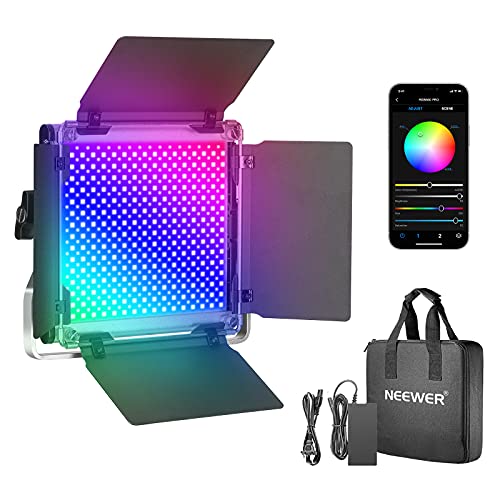
3. Neewer 660 PRO RGB LED Video Light
- 660 LED beads, 50W output (maker figure)
- Color temperature: 3200K-5600K plus full RGB color
- CRI 97+ (maker figure)
- App control plus on-panel controls
The 660 PRO RGB takes the NL660 formula and adds full-color output plus app control. For fill duty, the app is the feature that matters: the panel usually sits off to one side, sometimes behind a monitor, and adjusting its level from your chair keeps you in frame while you judge the result on your own preview. Its white-light output is strong enough that it can also step up as a key light when a setup changes.
Two cautions. This is a second Neewer 660-class panel in this roundup, included because app control and RGB output make it a genuinely different buy from the plainer NL660. And like its sibling, it is a stand-mounted studio panel, not a desk light.
4. RaLeno PLV-S192 13-Inch Edge-Lit Soft Light Panel
- 13-inch edge-lit panel, 19.5W
- Output: 650 lux at 1 m (maker figure)
- Color temperature: 2500K-6500K
- CRI 95+ (maker figure)
Fill light should be soft, and the PLV-S192 is built around exactly that. Its LEDs sit around the edge of a 13-inch panel and shine through a diffuser, so the whole face of the light glows evenly instead of showing a grid of bright points. The result is a gentle wash that opens shadows without creating a second hard shadow edge, even placed fairly close.
The built-in battery is the other half of its appeal: it can sit on a shelf or a short stand beside your desk with no cable at all. Its output ceiling is modest, which is a genuine limit as a key light but barely matters for fill, where modest output close to the face is the job description.
5. VILTROX L116T Super Slim LED Video Light Panel
The L116T is the smallest panel here, a slim 260-gram light that tucks beside a monitor or onto a desk tripod just out of frame. Small sources are harder light, and this one is no exception, so placement is the technique: keep it close, where its size relative to your face works in your favor, and its gentle output becomes an asset for filling a single face at a desk.
Specs
- Color temperature: 3300K-5600K
- CRI 95+ (maker figure)
- Output: 987 lumens (maker figure), 15W
- Brightness range: 20-100% with LCD display
- Dimensions: 192 x 128 x 25 mm, 260 g
- Power: NP-F style battery or 12V DC adapter, neither included with the base panel
- Hot shoe adapter included
- View on Amazon
The base listing sells the panel without a battery or power adapter, so budget for one of the two before it lights anything. Within that limit, it is the fill for desks where a full-size panel simply does not fit.
FAQ
How bright should a fill light be compared with the key light?
Start with the fill clearly dimmer than the key, then raise it until the shadow side of your face shows detail without looking flat. Most streamers land with the fill around a third to a half of the key light’s intensity at the face. If both sides read equally bright, the fill has become a second key and the image loses its depth.
Can one panel do both key and fill duty?
Not at the same time, because one light can only sit in one place and light comes from that direction. A single panel plus a white wall or a large pale surface opposite it can fake the combination, since the bounce acts as a weak fill. It works in small rooms, but the bounce is fixed in strength and color, so a dedicated second panel gives you control that bouncing cannot.
Does a fill light need to match the key light’s color temperature?
Yes, closely. When the key is set to 5600K and the fill sits at 3200K, the shadow side of your face turns orange while the bright side stays neutral, and no camera setting fixes both at once. Set both panels to the same Kelvin value, which is why a bi-color fill with a range that covers your key light’s setting is worth more than extra brightness.
Where should a fill light be placed?
On the opposite side of your face from the key light, close to the camera’s axis, and roughly at eye level. Keep it a little farther away or dimmed lower than the key so it lifts shadows instead of erasing them. If the fill starts casting its own visible shadow behind you, it is too strong or too far off to the side.
Conclusion
A fill light is the least glamorous purchase in a streaming setup and one of the most visible on camera, because it decides whether your face has depth or just a dark side. Choose by dimming control and softness first, match the color temperature to your key light, and pick the power option that fits where the panel has to live. The NL660 is the fixed-setup default, the GVM 800D pair builds a matched two-light rig in one box, the 660 PRO RGB adds app control and color, the RaLeno PLV-S192 brings battery-powered softness to a small desk, and the VILTROX L116T fills the tightest spaces.
More from Amazon
Programs that pair well with the guide above. Offers and eligibility are set by Amazon and may change.
Free shipping on eligible items, Prime Video and more. Eligible new members can start with a free trial.
Start a Prime free trialAd-free music streaming. Eligible new subscribers can start with a free trial.
Try Music Unlimited freeA Prime membership for ages 18-24 with a trial period. Eligibility is set by Amazon.
See Prime for Young AdultsAudiobooks and podcasts to listen to on the go. Eligible new members can start with a free trial.
Try Audible freeAs an Amazon Associate we earn from qualifying purchases.