Key takeaways
- Compare the best anti-static record brushes: carbon fiber brushes that lift dust and drain static before each play, plus a velvet pad kit for deeper work.
An anti-static record brush is the tool you reach for in the ten seconds before the needle drops. Held lightly on a spinning record, its fine fibers lift the loose dust sitting in the grooves, and because carbon fiber conducts, the fibers also give the static charge built up on the vinyl a path off the surface, through the brush and through your hand. It is worth being clear about the ceiling: a brush does not deep-clean a dirty record, it cannot pull out grime ground into the groove over years, and it does nothing at all for scratches. Deep cleaning belongs to wet methods and to the cleaning machines covered elsewhere on this site. Used before every play, a brush stops today’s dust from becoming part of the record.
Technique decides most of the result. The same brush that leaves a record quiet in one pair of hands will drag a line of dirt across it in another, because pressure and angle matter more than brand. The five brushes below cover the two families worth owning: four carbon fiber brushes for the daily dry sweep, and one velvet pad kit for records that need fluid. Every figure quoted is a maker’s figure.
Disclosure: As an Amazon Associate, I earn from qualifying purchases.
How to Choose an Anti-Static Record Brush
Start with the brush family. Carbon fiber brushes are the daily drivers. Thousands of hair-fine conductive fibers reach down into the groove, flick loose particles out, and drain static as they go. Velvet and fabric pads work differently: a wide pad contacts the surface all at once and traps what it picks up, which makes pads the better partner for cleaning fluid and filmed-over records. If you buy only one, buy the carbon fiber brush, because it is the one you will use before every play.
Follow the static path. Draining charge is a circuit, not a slogan. The fibers have to connect electrically to your hand, which is why the better designs use an uncoated metal finger grip, a metal chassis, or an internal conductive path through the handle. A brush held by an insulated grip may still sweep dust, but it gives the charge nowhere to go. A listing that explains the charge path is telling you something that matters.
Let technique do the work. Rest the fibers on the record while it spins and let the rotation carry the dust; two or three revolutions is plenty. Use the lightest touch that keeps the fiber tips in the groove, then angle the brush and sweep the dust line outward, off the edge. Never press down or scrub back and forth, and never dry-brush a visibly filthy record: it just herds the grit into a ridge and drags it across the surface. Wet cleaning comes first; the brush maintains the result afterwards.
Respect the pad’s upkeep. A velvet pad holds what it lifts, which is its strength and its weakness. A loaded pad stops trapping and starts pushing grit around, so pads need regular cleaning of their own and eventual replacement. Carbon fiber brushes shed their load more easily, especially designs with a self-cleaning lip or a handle that strips the fibers, but they still deserve a flick and a check before each session. Either type should span the full groove band of a 12-inch LP in one placement.
Comparison Table
| Product | Type | Working surface | Static path | Standout trait |
|---|---|---|---|---|
| AudioQuest Anti-Static Record Brush | Carbon fiber brush | Two rows of conductive carbon fibers | Uncoated metal finger grip | Self-cleaning lip under the handle |
| Boundless Audio Record Cleaner Brush | Carbon fiber brush | Dual-row carbon fiber bristles | Conductive path through the handle | Self-cleaning rotating handle, rounded corners |
| Fluance VB50 | Carbon fiber brush | Carbon fiber bristles | Conductive carbon fibers | Purpose-built brush from a turntable maker |
| Hudson Hi-Fi Vinyl Record Brush | Carbon fiber brush | Carbon fiber bristles | Metal chassis held in the hand | Chassis doubles as the grounding contact |
| Audio-Technica AT6012 Record Care Kit | Velvet pad kit | Sonic Broom velvet brush pad | Fluid formula addresses static | Pad, solution, and storage base in one kit |
AudioQuest Anti-Static Record Brush

AudioQuest’s brush is the reference design in this class. More than a million conductive carbon fibers stand in two rows, fine enough to enter the groove and soft enough not to mark it. The finger grip is uncoated metal on purpose: your fingers complete the circuit, so charge gathered by the fibers leaves through your hand instead of snapping back onto the record. Beneath the handle, a discreet lip strips dust off the fibers as you finish a pass, so dirt is not carried back on the next record.
A couple of turns under the lightest contact and an angled sweep toward the edge handles the daily job, with nothing to plug in or refill. Its limits are the class limits: it will not rescue a record that needs a wet clean, and it rewards a light hand far more than a firm one.
Specs:
– Type: Dry carbon fiber record brush
– Bristles: Conductive carbon fiber, two rows, more than one million fibers (maker figure)
– Handle: Uncoated metal finger grip
– Self-cleaning: Lip under the handle strips fibers
– Item weight: 2.4 oz (maker figure)
– Model: AQASRECORDBRUSH
See the AudioQuest Anti-Static Record Brush on Amazon
Boundless Audio Record Cleaner Brush
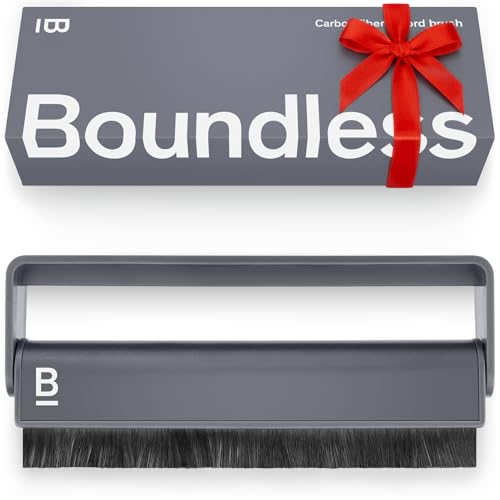
Boundless Audio builds its brush around the same dual-row idea, with extra-soft carbon fiber bristles and an internal design the maker describes as patented, intended to let static pass through the brush and discharge through the hand holding it. Two practical touches separate it from generic versions of this shape. The body corners are rounded, so a wandering hand is less likely to catch the record’s edge, and the handle works as the brush’s own cleaning tool: rotating it across the bristles frees collected debris, so each record starts with an empty brush.
The maker’s positioning is maintenance, not restoration, and that framing is accurate. This is a dry brush for records that are already fundamentally clean, used for a few seconds before each play to lift settled dust and bleed off charge. Nothing is consumed, and it suits collectors who like the classic pattern but want the self-cleaning handle.
Specs:
– Type: Dry carbon fiber record brush
– Bristles: Dual-row carbon fiber, extra-soft
– Static path: Internal conductive design discharging through the hand (maker description)
– Body: Rounded corners
– Self-cleaning: Rotating handle strips the bristles
– Fluids required: None
See the Boundless Audio Record Cleaner Brush on Amazon
Fluance VB50 Anti-Static Carbon Fiber Record Cleaning Brush

Fluance sells decks first, and the VB50 is its matching brush, a carbon fiber design meant to remove dust and neutralize static before playback. The pitch is the familiar one for this class, quieter surfaces because the groove reaches the stylus clean rather than coated.
Within this group, the VB50 is the pick for Fluance owners who want the accessory shelf to match the deck. Functionally it follows the shared rules of its family: light contact on a spinning record, a few revolutions, an outward sweep, and no pressure. It is a dry brush only, so a collection with genuinely grimy secondhand finds will still want a wet method in reserve, with the VB50 taking over upkeep once a record has been washed.
Specs:
– Type: Dry carbon fiber record brush
– Bristles: Carbon fiber, anti-static
– Model: VB50
– Maker: Fluance
– Fluids required: None
– Intended use: Dust and static removal before each play
See the Fluance VB50 on Amazon
Hudson Hi-Fi Vinyl Record Brush

Hudson Hi-Fi’s brush makes its grounding arrangement the headline: the carbon fiber bristles mount in a metal chassis, and you hold that chassis while you clean, so the charge the fibers pick up has a direct metal path into your hand. Hudson describes it as a patented anti-static design; the logic matches the AudioQuest grip, executed with the whole brush body instead of a finger strip.
That exposed-metal approach has one practical consequence: your grip is part of the tool. Hold the chassis with skin contact and the static path is complete; hold it loosely by a coated edge and you have an ordinary dust brush. Collectors in dry rooms, where records cling to sleeves, gain most from a design that treats grounding as the main event.
Specs:
– Type: Dry carbon fiber record brush
– Bristles: Carbon fiber
– Chassis: Metal, held in the hand as the grounding contact
– Static handling: Patented anti-static design (maker description)
– Fluids required: None
– Intended use: Dust removal and static discharge before play
See the Hudson Hi-Fi Vinyl Record Brush on Amazon
Audio-Technica AT6012 Record Care Kit

The AT6012 is the pad representative in this group, arriving as a small system rather than a bare brush. The centerpiece is the Sonic Broom brush pad, a velvet pad whose fibers are cut to reach into the grooves, backed by a reservoir that distributes fluid through the pad. The kit adds a 2 fl oz bottle of record care solution, a storage base, and adhesive tape to fix the base near the turntable. The maker’s formula is described as removing microdust, dissolving fingerprints, and eliminating static, making this the one pick aimed at records with more than loose dust on them.
The trade-offs are the pad trade-offs. The pad must itself be kept clean or it redeposits what it collected, the fluid is a consumable, and a wet pass is slower than a three-second dry sweep, so this kit complements a carbon fiber brush rather than replacing it. As a second tool, it covers the ground dry brushes cannot: fingerprints and film.
Specs:
– Type: Velvet pad record care kit
– Pad: Sonic Broom velvet brush pad with fluid reservoir
– Included: Record care solution 2 fl oz, storage base, double-sided adhesive tape
– Solution role: Removes microdust and fingerprints, addresses static (maker description)
– Model: AT6012
– Maker: Audio-Technica
See the Audio-Technica AT6012 Record Care Kit on Amazon
FAQ
Does a carbon fiber brush really remove static, or does it just move dust around?
It does both jobs at once, provided the brush is built with a conductive path. Carbon fibers are conductive, so charge on the record surface transfers into the fibers and, through a metal grip, chassis, or conductive handle, into your hand and away. A brush without that path sweeps dust but leaves the charge, and the charge pulls fresh dust back down. The effect is temporary, since handling and dry air rebuild static, so the brush comes out before every play.
Can a record brush fix a dirty or scratched record?
No. A brush removes loose surface dust and drains charge; that is the full extent of it. Dirt bonded to the groove, mold, and spilled residue need wet cleaning, with a pad and fluid or a cleaning machine. Scratches are physical damage to the groove wall and nothing reverses them. Brushing a filthy record before washing it can even work against you, so wash first and let the brush maintain the result.
How should an anti-static brush be used for the best result?
Set the record spinning, rest the fiber tips lightly in the grooves, and let the rotation do the work for two or three turns while the brush stays grounded through your hand. Then tilt the brush slightly and draw it outward so the collected dust line leaves over the record’s edge. Keep the touch light; pressing harder bends the fibers flat so they skate over the groove instead of entering it. Clean the brush itself regularly; a loaded brush redeposits dust.
When does a record need more than a dry brush?
When you can see or feel contamination: fingerprints, a dull film, dust that returns immediately after brushing, or a secondhand record with an unknown history. Those signs mean residue in the groove, not loose particles on top. A velvet pad with cleaning fluid, like the kit in this guide, handles the lighter cases, and a vacuum or ultrasonic machine handles the heavy ones. Once a record has been wet-cleaned and dried, the dry brush before each play is enough.
Conclusion
A record brush earns its place by being used constantly, so the best one is the one whose routine fits your habits. The AudioQuest is the reference carbon fiber design, the Boundless adds a self-cleaning handle and rounded corners, the Fluance VB50 suits owners of that maker’s decks, and the Hudson Hi-Fi puts its metal chassis and grounding path at the center of the design. Keep the AT6012 pad kit beside your dry brush, and the pair covers the honest range of the job: daily dust and static, plus the occasional record that needs fluid and a pad first.
More from Amazon
Programs that pair well with the guide above. Offers and eligibility are set by Amazon and may change.
Free shipping on eligible items, Prime Video and more. Eligible new members can start with a free trial.
Start a Prime free trialAd-free music streaming. Eligible new subscribers can start with a free trial.
Try Music Unlimited freeA Prime membership for ages 18-24 with a trial period. Eligibility is set by Amazon.
See Prime for Young AdultsAudiobooks and podcasts to listen to on the go. Eligible new members can start with a free trial.
Try Audible freeAs an Amazon Associate we earn from qualifying purchases.