Key takeaways
- Five turntable isolation feet compared by load window, material and height, from soft silicone pads to spring feet, with the sizing math that matters.
Every footstep in the room lands in the cartridge. A turntable on a stand over a wood floor turns the floor into a sounding board: footsteps thump through the speakers, a closing door nudges the stylus, and heavy bass passages blur because the deck shakes along with the furniture. Isolation feet are the smallest fix in the vinyl toolkit. They replace the deck’s own feet, or slip directly under them, and break the hard mechanical path between shelf and plinth.
Scope matters, so let us be plain: this guide covers feet only. It does not cover isolation platforms, the full boards a deck sits on, nor speaker spikes, cones or subwoofer pads, which solve different problems under different loads. The five picks work four different ways: soft silicone hemispheres, an engineered puck, machined aluminum, exposed springs, and a solid silicone block. Hudson Hi-Fi appears twice, with two genuinely different designs, stated openly rather than disguised. Every load figure quoted is a maker figure, and the sizing math in How to Choose matters more than any single pick.
Disclosure: As an Amazon Associate, I earn from qualifying purchases.
How to Choose Turntable Isolation Feet
Do the division before anything else. Isolation feet only work inside their load window. Divide your deck’s weight by the number of feet, usually four, and that per-foot figure has to land inside the window the maker publishes. Too light a deck barely compresses the material, so the foot behaves like solid rubber and passes vibration straight through. Too heavy a deck crushes the foot flat, bottoms it out, and arrives at the same result. The middle of the window is where the material flexes and absorbs. Weight is rarely spread evenly: the corner carrying the motor sits heavier than the others, and mixing a stiffer foot at the heavy corner with softer ones elsewhere is a legitimate setup, not a fudge.
Know which vibration you are fighting. Feet treat floor-borne vibration: footfalls, door slams, a washing machine two rooms away, traffic rumble coming up through the stand. They do nothing at all for airborne sound, the pressure waves from your speakers hitting the platter and lid directly. If your speakers share the turntable’s shelf or stand, that airborne and same-surface path is usually the bigger problem, and no foot will fix it. Move the speakers, or move the deck, first.
Soft and tall can work against your hands. A deck floating on tall, compliant feet rocks when you touch it, and that wobble shows up exactly when you cue a record or lift the dust cover. Listeners who hand-cue all day often do better with a lower, firmer foot that trades a little isolation for a steady deck. There is no virtue in maximum softness; there is virtue in a deck that stays put while breaking the vibration path underneath it.
Level is a separate job. Most isolation feet are a fixed height and are not adjustable, so a sloped shelf stays sloped after you fit them. A turntable needs to sit level for its bearing, tonearm geometry and anti-skate calibration to behave. Level the furniture first, with shims under the stand if needed, then add the feet, then confirm with a small bubble level on the platter. If the shelf cannot be leveled, keep the deck’s stock adjustable feet and solve the slope at the furniture instead.
Decide on adhesive, and protect the finish. Adhesive-backed pads stay where you place them, which suits light decks that get nudged. Loose feet and blocks are easier to reposition but can drift when the deck is bumped. One caution across materials: soft vinyl and some silicone compounds can leave rings on wood, lacquer and painted finishes over time. A thin card or felt disc between foot and shelf is cheap insurance, and several makers advise exactly that.
The 5 Best Turntable Isolation Feet
1. Hudson Hi-Fi 0.75-Inch Platinum Silicone Hemisphere Bumpers — the soft option for light decks

The smallest feet here are also the softest. Hudson Hi-Fi molds these hemispheres from platinum-cured silicone at 20 Duro on the Shore A scale, the softest compound in this roundup, and the 0.75-inch size carries a maker load window of 3 to 10 pounds per pad. Four pads therefore suit a deck of roughly 12 to 40 pounds, covering most belt-drive decks and compact direct drives. The hemisphere spreads load across a dome that flattens as weight rises, and the adhesive backing keeps each pad planted on the plinth or under the stock foot. Placement is forgiving, but the window is not: a deck under 12 pounds will barely dent them, and one over 40 pounds will squash them into washers. Sold in multi-packs, so one purchase can treat a phono stage as well.
Specs
- Maker: Hudson Hi-Fi
- Material: platinum-cured silicone, 20 Duro (maker figure)
- Diameter: 0.75 in
- Load window (maker figure): 3 to 10 lb per pad
- Mounting: adhesive backing
- Form: hemisphere bumper
2. IsoAcoustics ISO-PUCK mini — the engineered puck
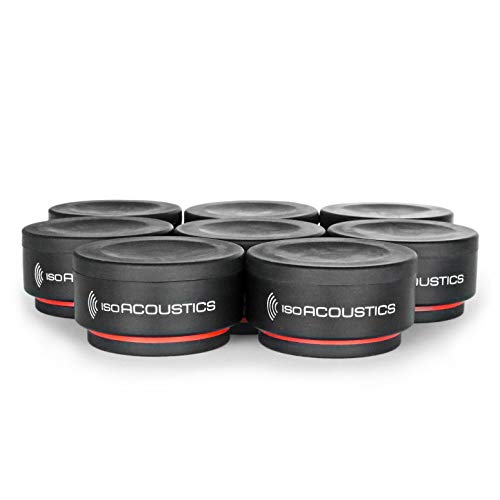
IsoAcoustics builds the ISO-PUCK mini as a two-part isolator rather than a lump of soft material: an upper flange forms a suction cup against the underside of the component, the lower section anchors to the shelf, and the patented isolator between them does the work. The maker figure is a maximum of 6 pounds per puck, and the eight-pack lets one box treat a deck and a phono stage together. At 1.7 inches across and under an inch tall, a mini raises the deck only slightly, keeping cueing stable. Four pucks put the working ceiling at 24 pounds, so this is a light-to-midweight solution; heavier decks belong on the larger pucks in the same family or a stiffer pick below. The suction-cup top means the pucks travel with the deck when you lift it, a small convenience loose pads cannot match.
Specs
- Maker: IsoAcoustics (model ISO-Puck mini)
- Pack count: 8 pucks
- Load limit (maker figure): up to 6 lb per puck
- Diameter: 1.7 in (44 mm)
- Height: about 0.9 in
- Mounting: suction-cup upper flange, no adhesive
3. Tertullus Aluminum Isolation Feet — the rigid, machined route

Tertullus takes the opposite philosophy from the silicone picks: a CNC-machined aluminum body, 58 mm across and 22 mm tall, with a removable non-slip rubber ring supplying grip at the contact faces. The thinking behind rigid metal feet is mass and a defined contact path rather than squash, and it works best on a solid, non-resonant surface such as a heavy wood console or a stone slab. On a thin, hollow stand the same rigidity can pass energy through instead of absorbing it, so the shelf decides whether this pick makes sense. One honest gap: the maker publishes no per-foot load window, so the division exercise from How to Choose cannot be run on them, and buyers with very light decks should treat the silicone and spring options as the more predictable route. The gold finish will divide opinion; the machining is the actual point.
Specs
- Maker: Tertullus
- Material: CNC-machined aluminum with rubber ring
- Diameter: 58 mm (2.28 in)
- Height: 22 mm
- Pack count: 4 feet
- Load window: not published by the maker
4. Preffair Spring Isolation Feet — isolation you can see working

Preffair puts the compliance in plain sight: each foot is an aluminum housing around a steel spring, so the deck floats on four springs and settles with a slow bounce when touched. The maker figure for the set is up to 88 pounds across four feet, about 22 pounds per foot, which reaches the heavy direct-drive decks and loaded vintage plinths that would crush the soft silicone picks flat. At 1.85 inches in diameter the footprint is modest, and the added height is the trade-off: a sprung deck sits noticeably higher and moves more when bumped, so cue gently while you learn its manners. Springs have a resonant frequency of their own, which is why the load window still applies; an under-loaded spring barely deflects and isolates little. Match the set to a deck heavy enough to work the springs and this is the strongest floor-borne isolation here.
Specs
- Maker: Preffair
- Material: aluminum housing, steel spring
- Diameter: 1.85 in
- Load capacity (maker figure): up to 88 lb per set of four
- Pack count: 4 feet
- Mounting: loose, sits under the deck’s feet or plinth
5. Hudson Hi-Fi Silicone Isolation Blocks — the firm middle ground

The second Hudson Hi-Fi design here is a different animal from the little hemispheres: a solid, glossy silicone block on a 1.2-inch base that stands upright on its own, with no adhesive, and carries a maker figure of up to 37.5 pounds per pad. That window covers the middle of the market, the decks too heavy for the softest pads, and the non-stick format lifts away cleanly when you rearrange the system. A bonus set of four silicone dots is included for use under spiked components. Two honest cautions: the glossy finish can creep on a very smooth shelf if the deck is knocked sideways, and a 1.2-inch base is a narrow perch, so tall, top-heavy gear feels less planted here than on the wide spring feet. For a mid-weight deck on a normal shelf, though, this is the tidy, reversible option.
Specs
- Maker: Hudson Hi-Fi
- Material: silicone block, non-adhesive
- Base width: 1.2 in
- Load limit (maker figure): up to 37.5 lb per pad
- Pack count: 4 blocks, plus 4 silicone dots
- Mounting: loose, weight-held
Comparison Table
| Product | Working principle | Load window per foot (maker figure) | Height added | Mounting |
|---|---|---|---|---|
| Hudson Hi-Fi 0.75-Inch Hemisphere Bumpers | Soft silicone dome | 3 to 10 lb | Low | Adhesive |
| IsoAcoustics ISO-PUCK mini | Two-part isolator puck | Up to 6 lb | About 0.9 in | Suction cup |
| Tertullus Aluminum Feet | Rigid machined metal | Not published | 22 mm | Loose, rubber ring |
| Preffair Spring Feet | Steel spring in aluminum housing | Up to 22 lb (88 lb per set) | Tallest here | Loose |
| Hudson Hi-Fi Silicone Blocks | Firm silicone block | Up to 37.5 lb | Medium | Loose |
FAQ
How do I work out which load window my turntable needs?
Weigh the deck, or take its weight from the maker’s specification sheet, and divide by the number of feet, usually four. That per-foot figure should sit inside the published window, ideally near its middle. A 24-pound deck puts 6 pounds on each foot, suiting the ISO-PUCK mini at its ceiling or the Hudson hemispheres mid-window. The motor corner carries more than its quarter share, so a deck near a window’s edge may want the next stiffness up at that corner.
Will isolation feet stop records skipping when people walk past?
That is precisely the job they exist for, because footsteps reach the deck as floor-borne vibration traveling up the stand, and a set matched to the deck’s weight absorbs most of it. If skips also happen when nobody is moving but the music is loud, suspect the airborne path instead: speakers sharing the deck’s surface, or a subwoofer nearby, excite the platter directly, and feet cannot help until that sharing stops.
Can I combine isolation feet with an isolation platform?
You can, but two compliant layers rarely add up to twice the isolation, and they often add up to a wobbly deck that is unpleasant to cue and easy to knock out of level. One well-matched layer, chosen by the load math, beats two soft layers working against each other. If you already own a platform, keep the stock feet or the firmest pick here on top of it rather than stacking soft on soft.
Do isolation feet level my turntable?
No. Nearly all isolation feet are a fixed height with no adjustment, so they preserve whatever slope the shelf already has. Level the stand first, using shims under the furniture if necessary, fit the feet second, and check the result with a bubble level on the platter. If a shelf cannot be brought level, adjustable stock feet or furniture glides are the honest fix, and isolation waits until the deck sits flat.
Conclusion
Isolation feet come with one non-negotiable rule: the load window decides everything. Weigh the deck, divide by four, and buy the foot whose maker window contains that number. Light decks belong on the soft Hudson hemispheres or the ISO-PUCK mini, heavy decks on the Preffair springs, mid-weight decks on the Hudson blocks, and the Tertullus feet suit rigid setups on solid furniture where their unpublished window is an acceptable unknown. Set them on a level surface, keep speakers off the deck’s shelf, and the footsteps stay in the room instead of in the recording.
More from Amazon
Programs that pair well with the guide above. Offers and eligibility are set by Amazon and may change.
Free shipping on eligible items, Prime Video and more. Eligible new members can start with a free trial.
Start a Prime free trialAd-free music streaming. Eligible new subscribers can start with a free trial.
Try Music Unlimited freeA Prime membership for ages 18-24 with a trial period. Eligibility is set by Amazon.
See Prime for Young AdultsAudiobooks and podcasts to listen to on the go. Eligible new members can start with a free trial.
Try Audible freeAs an Amazon Associate we earn from qualifying purchases.