Key takeaways
- Plan delivery: Cabinet saws commonly weigh 500–700 pounds. Arrange a pallet jack, engine hoist, lifting equipment, or several capable helpers before delivery.
- Install the base and table: Keep the machine on a stable, level floor. A slight twist in the base can affect table alignment.
- Fit the fence rails: Measure rail positions carefully and tighten hardware only after confirming the fence can travel across the intended range.
- Align the blade: Set the blade parallel to the miter slot. This is one of the most important accuracy and safety adjustments.
- Align the fence: Set the fence parallel or very slightly open at the back, according to the manufacturer’s instructions.
- Install safety equipment: Fit the riving knife, guard, anti-kickback pawls, and blade-brake components where supplied. Confirm that the guard lifts and returns freely.
- Test with scrap: Make a shallow cut, check the result with a reliable square, and listen for vibration before using expensive stock.
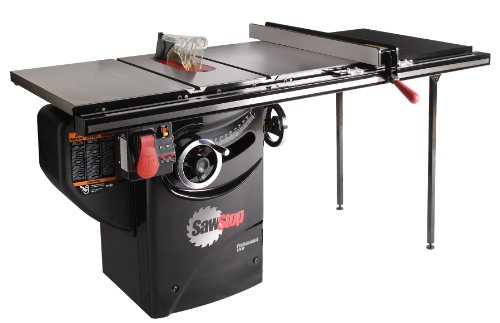
The best cabinet table saws combine a rigid cast-iron base, a dependable 3–5 hp motor, a fence that stays parallel under pressure, and dust collection strong enough for daily workshop use; for most serious woodworkers, the SawStop Professional Cabinet Saw is the safest all-around choice, while the Powermatic PM2000 is a premium alternative for maximum refinement.
Our top picks
As an Amazon Associate we earn from qualifying purchases at no extra cost to you. Ratings are shown as listed on Amazon.
Best cabinet table saws at a glance
| Model | Motor | Rip capacity | Blade size | Approx. weight | Best for |
|---|---|---|---|---|---|
| SawStop Professional Cabinet Saw | 3 hp, 240 V | 36 in or 52 in, depending on fence package | 10 in | About 515–635 lb | Safety-conscious general-purpose shops |
| Powermatic PM2000 | 3 hp, 230 V | 50 in | 10 in | About 660 lb | Premium accuracy and frequent use |
| Delta Unisaw | 3 hp, 230 V | 52 in | 10 in | About 600 lb | Large furniture and cabinet work |
| Grizzly G1023RL series | 3 hp, 240 V | 30 in or 50 in, depending on configuration | 10 in | About 530–650 lb | High capability at a lower market price |
Published specifications can vary by fence, extension table, voltage, and production revision, so confirm the exact configuration before ordering. The market range for a complete 3 hp cabinet saw is roughly $2,000 to $5,000, with premium packages and upgraded dust systems costing more.
Our top choices by workshop situation
Best overall: SawStop Professional Cabinet Saw
The SawStop Professional Cabinet Saw is the easiest recommendation when safety is a major buying criterion. Its electronic brake system is designed to stop the blade when it detects contact with conductive material. The system does not replace careful operating technique, but it adds a layer of protection that competing saws generally do not provide.
The 3 hp motor is suitable for hardwood, sheet goods, and repeated ripping with a sharp blade. Choose the 36-inch fence package if your shop is compact or most work involves manageable panels. The 52-inch version is better for full plywood sheets and wide cabinet components, but it requires considerably more clearance behind and beside the saw.
The main trade-offs are price and consumables. A brake cartridge and blade may need replacement after activation, and wet lumber or certain conductive materials can trigger the system. The enclosed cabinet supports effective dust collection, although a high-volume collector and well-sealed hose connections are still necessary.
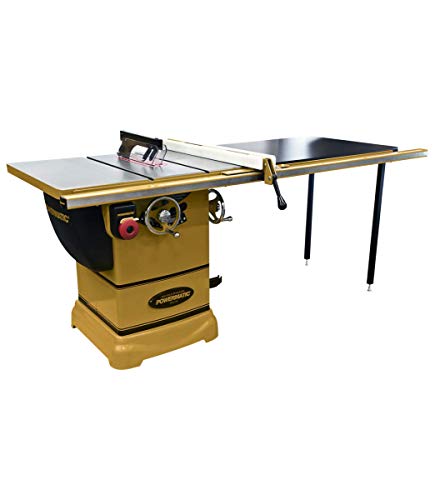
Best premium fence and adjustment system: Powermatic PM2000
The Powermatic PM2000 is aimed at woodworkers who value smooth adjustment, substantial construction, and a refined ownership experience. Its 3 hp motor provides the same basic power class as the other saws here, but the machine is distinguished by features such as an integrated dust collection design, large handwheels, a riving-knife system, and a robust 50-inch fence package.
It is a strong choice for a professional or highly active home shop that will make repeated long rips. The heavy cabinet and cast-iron table help it remain stable during difficult cuts. Its disadvantages are straightforward: it is expensive, heavy, and overkill for someone who makes only occasional crosscuts or small projects.
Best for maximum rip capacity: Delta Unisaw
The Delta Unisaw remains a sensible choice when the priority is a traditional, heavy-duty cabinet saw with a 52-inch rip system. Its 3 hp motor and large table support furniture parts, built-ins, and full-sheet processing when the surrounding shop has enough room.
Fence accuracy depends not only on the fence itself but also on installation and alignment. Once properly adjusted, a substantial T-square-style fence should lock firmly without shifting the far end. The Unisaw includes modern safety equipment such as a riving knife and blade guard, but it does not offer the same electronic blade-brake concept as SawStop. Buyers should also budget for a suitable dust collector and verify electrical requirements before delivery.
Best value-oriented cabinet saw: Grizzly G1023RL series
The Grizzly G1023RL family offers many of the features expected from a cabinet saw—3 hp power, a cast-iron table, enclosed base, riving knife, and large rip options—at a generally lower price than premium competitors. It is attractive for experienced woodworkers who are comfortable checking alignment, tuning the fence, and completing some assembly.
The value comes with practical responsibilities. Depending on the package, freight delivery, assembly, and initial calibration can require more time than with a more polished premium setup. It is a capable choice for a budget-conscious workshop, but less appealing if you want minimal setup work or electronic safety technology.
How the key buying criteria compare
Motor power and electrical requirements
A 3 hp cabinet saw is the normal sweet spot for a serious single-operator shop. It can rip thick hardwood more confidently than a typical 1.5–2 hp contractor saw and is less likely to bog down when the blade is sharp and the feed rate is reasonable. Most 3 hp models require a 240-volt circuit, commonly with a 20-amp breaker, though the exact electrical specification must come from the manufacturer.
A 5 hp saw makes sense for production environments, repeated thick-stock ripping, or a shop already equipped with suitable electrical service. It is not automatically more accurate, and it may increase installation cost. For ordinary cabinetmaking, fence alignment and blade quality usually matter more than moving from 3 hp to 5 hp.
Rip capacity and available space
A 30- or 36-inch fence handles most solid-wood work and many cabinet components. A 50- or 52-inch fence is preferable for breaking down full 4-by-8-foot sheets, but measure the complete footprint rather than the tabletop alone.
For example, if the saw table is 60 inches wide and the fence extends 52 inches to the right, the machine already occupies approximately 112 inches—9 feet 4 inches—before allowing room to stand, move material, or open a panel. Add at least 3 feet of comfortable working clearance on the infeed and outfeed sides, and a large-fence cabinet saw can require a work zone around 15 feet long.
Fence accuracy
A good fence should lock without visibly deflecting, remain parallel to the miter slot, and provide a reliable reference face for narrow and wide cuts. Look for a rigid steel or aluminum extrusion, a square front tube, and adjustment points that can be reached without dismantling the saw.
Do not assume a premium fence arrives perfectly aligned after freight shipping. Check the distance from the fence to the miter slot at both ends, then verify the blade-to-slot relationship. A fence that is slightly open at the rear can reduce binding risk, but excessive misalignment can affect cut accuracy.
Dust collection
Cabinet saws generally outperform open-base saws because their enclosed cabinets direct more chips toward a 4-inch dust port. A collector delivering approximately 800–1,200 cubic feet per minute at the machine is a practical target, although duct length, hose diameter, filters, and blast gates reduce real airflow.
Dust collection is not only about cleanliness. Chips trapped around the blade mechanism can interfere with elevation and tilt adjustments. Vacuum the cabinet periodically, inspect the hose for clogs, and seal obvious gaps with suitable foil tape or gasket material. Never rely on the dust collector to remove all airborne fine dust; use appropriate respiratory and workshop controls.
Assembly and setup: what to expect
- Plan delivery: Cabinet saws commonly weigh 500–700 pounds. Arrange a pallet jack, engine hoist, lifting equipment, or several capable helpers before delivery.
- Install the base and table: Keep the machine on a stable, level floor. A slight twist in the base can affect table alignment.
- Fit the fence rails: Measure rail positions carefully and tighten hardware only after confirming the fence can travel across the intended range.
- Align the blade: Set the blade parallel to the miter slot. This is one of the most important accuracy and safety adjustments.
- Align the fence: Set the fence parallel or very slightly open at the back, according to the manufacturer’s instructions.
- Install safety equipment: Fit the riving knife, guard, anti-kickback pawls, and blade-brake components where supplied. Confirm that the guard lifts and returns freely.
- Test with scrap: Make a shallow cut, check the result with a reliable square, and listen for vibration before using expensive stock.
Assembly time ranges from several hours for a straightforward package to a full day when the saw arrives with a large extension table, long fence rails, mobile base, and dust accessories. Paying for delivery into the workshop can be worthwhile because moving a cabinet saw down stairs or across uneven flooring creates avoidable risk.
Ownership costs and maintenance realities
The first items likely to wear are blades, throat plates, belts, fence faces, and dust-collection hoses—not the main motor. A quality general-purpose blade may cost roughly $60–$150, while specialty ripping or plywood blades can cost more. Keep a separate blade for rough construction lumber and inspect carbide teeth after cutting reclaimed wood.
Wax the cast-iron table periodically to reduce friction and prevent rust, but keep wax away from the drive belt and blade surfaces. Clean pitch from the blade and arbor, check belt tension, lubricate elevation and tilt mechanisms as specified, and remove dust from the cabinet. Avoid forcing a dull blade: excessive feed pressure creates heat, poorer cuts, and greater kickback potential.
Which cabinet saw should you buy?
- Choose the SawStop Professional Cabinet Saw if electronic blade-brake protection is your leading requirement and your budget supports the ongoing cartridge cost.
- Choose the Powermatic PM2000 if you want premium adjustment features, a 50-inch rip system, and expect frequent use.
- Choose the Delta Unisaw if you need a traditional heavy-duty machine with maximum rip capacity and have ample floor space.
- Choose a Grizzly G1023RL configuration if value matters most and you are prepared to perform careful assembly and calibration.
For most workshops, a properly aligned 3 hp cabinet saw with a 36-inch or 50-inch fence is a better investment than a larger motor paired with inadequate space, electrical service, or dust collection. Prioritize the safety system you will actually use, the fence capacity your projects require, and the setup time you can realistically accommodate.