Key takeaways
- Shared home or frequent authorized access: Consider a keypad safe with a separate backup key. It avoids relying on fingerprint recognition alone and makes it easier to set up access for more than one authorized adult.
- Bedside location where batteries are a concern: A mechanical push-button safe such as the Fort Knox PB1 removes electronic power as a failure point. It is heavier and usually costs more than a basic electronic lock.
- Travel or portability: A compact case such as the Vaultek LifePod 2.0 is easier to carry and stow. Portability is not a substitute for checking the laws that apply to transport and storage where you live.
- One handgun in a tight space: A low-profile safe may fit a drawer or shelf, but measure the gun and the space first. Exterior dimensions do not tell you how much room remains after the lid, foam, and locking mechanism are accounted for.
- Two handguns or a pistol with accessories: Move up to a roomier safe rather than relying on a manufacturer’s maximum capacity claim. A snug fit can obstruct access and leave no space for a spare magazine.
Best Handgun Safes: Choose by Access, Fit, and Mounting
The best handgun safe is the one that fits your firearm and intended storage location, opens reliably with a method you can use under stress, and can be secured against casual removal. For most buyers, a compact biometric-and-keypad model offers flexible access; a mechanical push-button safe avoids batteries; and a larger, heavier steel safe is better for storing more than one handgun or keeping valuables together.
Below are representative models with published dimensions and features to compare. Specifications can vary by model year and configuration, so confirm the exact version’s manual before buying—especially interior measurements, mounting hardware, and whether a stated capacity assumes small, unaccessorized pistols.
Our top picks


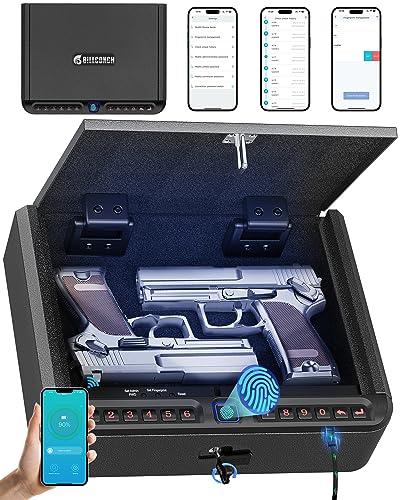
As an Amazon Associate we earn from qualifying purchases at no extra cost to you. Ratings are shown as listed on Amazon.
| Safe | Access method | Exterior dimensions (approx.) | Weight (approx.) | Notable fit or mounting consideration |
|---|---|---|---|---|
| Vaultek LifePod 2.0 | Keypad, backup key, and optional biometric configuration | 10.25 × 7 × 2 in. | 2.2 lb. | Portable, water-resistant case format; check the internal layout against your handgun and any mounted optic. |
| Fort Knox PB1 Handgun Safe | Mechanical push-button | 12.5 × 10.5 × 4.5 in. | About 21 lb. | Thick steel construction and a Simplex-style lock; its weight and shape suit a fixed bedside or drawer location. |
| SentrySafe QAP1BE | Biometric reader, keypad, and backup key | About 12 × 9.7 × 3.2 in. | About 12 lb. | Designed for one handgun; verify usable depth if the pistol has a tall optic or accessories. |
| Hornady RAPiD Safe 2700KP | Keypad, RFID access, and backup key | About 12 × 10.2 × 2.9 in. | About 11 lb. | RFID options can simplify routine access; confirm the exact model’s included mounting provisions and power requirements. |
Quick picks by storage situation
- Shared home or frequent authorized access: Consider a keypad safe with a separate backup key. It avoids relying on fingerprint recognition alone and makes it easier to set up access for more than one authorized adult.
- Bedside location where batteries are a concern: A mechanical push-button safe such as the Fort Knox PB1 removes electronic power as a failure point. It is heavier and usually costs more than a basic electronic lock.
- Travel or portability: A compact case such as the Vaultek LifePod 2.0 is easier to carry and stow. Portability is not a substitute for checking the laws that apply to transport and storage where you live.
- One handgun in a tight space: A low-profile safe may fit a drawer or shelf, but measure the gun and the space first. Exterior dimensions do not tell you how much room remains after the lid, foam, and locking mechanism are accounted for.
- Two handguns or a pistol with accessories: Move up to a roomier safe rather than relying on a manufacturer’s maximum capacity claim. A snug fit can obstruct access and leave no space for a spare magazine.
What matters more than the lock label
Access method and backup plan
Biometric locks can be quick, but performance depends on the reader, finger placement, and setup. Dry, wet, dirty, or worn fingerprints may not register consistently. Enroll more than one finger if the manufacturer permits it, follow its instructions, and test the reader repeatedly with the safe open. Keep the backup key accessible to authorized adults but secured so a child or visitor cannot use it.
Keypads are familiar and do not depend on fingerprint matching, but they need power. Learn how to respond to a low-battery warning, and check whether the safe has an external emergency power connection or requires the backup key when its batteries fail. Mechanical push-button locks need no batteries, though buttons and mechanisms still require care and a working combination. Keys, codes, and backup methods should not be left in an obvious place beside the safe.
Interior fit, not advertised capacity
Measure the handgun’s length, height, and width, including any optic, light, or other accessory you intend to leave attached. Then compare those figures with the safe’s usable interior dimensions—not only its exterior size. A pistol that technically fits may still be awkward to retrieve if foam presses on the trigger guard or the lid barely clears an optic. Leave room for your hand and, if needed, a magazine. Never store a loaded firearm in a way that lets the safe’s lining or other contents press on the trigger.
Mounting and construction
A light safe can be carried away if it is not secured. Look for manufacturer-provided mounting holes and install the unit into a solid surface using hardware appropriate to that surface. A screw suitable for wood may not suit concrete, and a drawer or furniture panel may be too thin to anchor securely. If you rent, check what installation is allowed before drilling.
Steel thickness, door design, hinge protection, and the quality of the locking mechanism all affect resistance to casual tampering, but a handgun safe should not be treated as a high-security vault. Check the maker’s stated construction details rather than inferring strength from weight alone. For a safe exposed to children, visitors, or a higher theft risk, consider a heavier model, discreet placement, and a properly secured installation.
How to choose in three steps
- Measure the location and firearm. Record available width, height, and depth, then measure the handgun with its intended accessories. Allow clearance for the lid and for retrieving the firearm.
- Choose the access method you can maintain. If you select an electronic lock, set a battery-check reminder and practice the backup procedure. If you choose a mechanical lock, make sure authorized users can operate it consistently.
- Plan the anchor before purchase. Decide whether the safe will be mounted to a bedside surface, shelf, or another suitable structure. Confirm the safe’s mounting pattern, included hardware, and the surface’s strength.
Ownership details buyers often overlook
Batteries are a recurring cost for electronic safes, and a fresh battery does not excuse skipping a function check. Test the primary entry method and backup access on a regular schedule, with the safe open during practice. Keep the lock and seams free of dust and debris; follow the manufacturer’s cleaning instructions, and avoid spraying lubricant into an electronic mechanism unless the manual specifically allows it.
Foam can compress or shift over time, especially if a tight-fitting pistol is repeatedly removed. Check that it has not moved into the trigger guard or interfered with closing. Store the safe in a dry location when possible, and follow the manufacturer’s guidance for moisture control. A compact safe may be convenient, but its small size can encourage overpacking—keep the interior clear enough that the firearm and lock operate as intended.
Bottom line
Choose a mechanical model if battery independence is your priority, an electronic safe with a well-practiced backup if you want flexible entry, and a portable case only when portability is part of the actual need. Before deciding, verify the internal dimensions, make a realistic mounting plan, and test access methods with the safe open. Secure storage also means controlling keys and codes, following local storage and transport laws, and keeping firearms inaccessible to children and unauthorized people.