
Key takeaways
- Cushioning: Skechers uses its ULTRA GO and Air-Cooled Memory Foam foams. Thicker stacks feel softer but can feel vague on uneven ground.
- Stability: Look for a firm heel counter, a wide base at the forefoot, and a midsole that doesn’t compress unevenly.
- Weight: Under about 9 oz per shoe feels light for travel; 10–12 oz feels more planted for standing shifts.
- Fit: Skechers runs generous. Many models are slip-on, and Relaxed Fit adds roughly a half-size of volume through the toe box.
- Outsole grip: Rubber with shallow flex grooves beats soft EVA-only bottoms on wet pavement.
Best Skechers Walking Shoes: Quick Comparison
The best Skechers walking shoe for most people is the Skechers GOwalk Arch Fit, because its removable Arch Fit insole, moderate stack of cushioning, and sub-10 oz build cover daily walks, travel days, and long retail or nursing shifts without giving up stability. If you need maximum softness for standing all day, the Skechers GOwalk Max is the plusher alternative; if you want the lightest possible pair for packing, the Skechers GOwalk Lite is the one to look at. The table below maps the main options by situation, then each pick gets its own breakdown.
| Pick | Best for | Key specs (per manufacturer) | Typical price |
|---|---|---|---|
| Skechers GOwalk Arch Fit | Best overall for daily walks and long shifts | Removable Arch Fit insole, ULTRA GO midsole, machine washable, approx. 8–10 oz per shoe | Roughly $70–$95 |
| Skechers GOwalk Max | Best for standing all day on hard floors | Thick ULTRA GO foam, slip-on knit upper, approx. 10–12 oz per shoe | Roughly $60–$85 |
| Skechers GOwalk Lite | Best for travel and packing light | Minimal knit upper, low-profile foam, approx. 5–7 oz per shoe | Roughly $55–$75 |
| Skechers Relaxed Fit: Expected – Avillo | Best for wide feet and all-day walking | Relaxed Fit last (extra room through toe box), Memory Foam insole, leather/textile upper | Roughly $70–$90 |
| Skechers GO RUN Consistent | Best for walkers who want a firmer, more stable ride | Air-Cooled Memory Foam insole, rubber outsole with flex grooves, approx. 8–9 oz per shoe | Roughly $65–$85 |
Prices above are typical US market ranges for 2026 and move with colorways and sales; treat them as a band, not a quote.
Our top picks
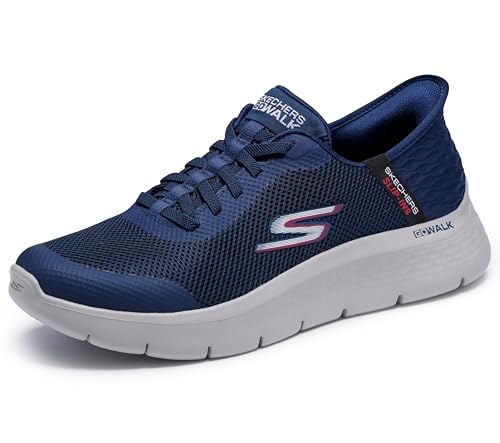


As an Amazon Associate we earn from qualifying purchases at no extra cost to you.
What Actually Matters for a Walking Shoe
Walking differs from running in ways that change what you should buy. A walker’s foot spends far longer in contact with the ground — a brisk half-hour walk is roughly 3,000 to 4,000 steps — and strikes heel-first with a pronounced roll-through rather than a midfoot landing. That means cushioning needs to absorb repeated low-impact loads without packing out, the heel counter needs to hold the foot steady during the roll, and the outsole needs a tread pattern that grips pavement, tile, and wet supermarket floors rather than aggressive lugs meant for trails.
The five attributes worth weighing are:
- Cushioning: Skechers uses its ULTRA GO and Air-Cooled Memory Foam foams. Thicker stacks feel softer but can feel vague on uneven ground.
- Stability: Look for a firm heel counter, a wide base at the forefoot, and a midsole that doesn’t compress unevenly.
- Weight: Under about 9 oz per shoe feels light for travel; 10–12 oz feels more planted for standing shifts.
- Fit: Skechers runs generous. Many models are slip-on, and Relaxed Fit adds roughly a half-size of volume through the toe box.
- Outsole grip: Rubber with shallow flex grooves beats soft EVA-only bottoms on wet pavement.
Best overall: Skechers GOwalk Arch Fit
Arch Fit is the model that best balances the five attributes. The removable insole is contoured under the arch and heel, which suits walkers who get tired feet after a couple of miles, and because it lifts out you can swap in a podiatrist-made orthotic without changing the shoe’s volume. The ULTRA GO midsole is firm enough to stay predictable on pavement but still soft under a long shift, and the knit upper is machine washable on a cold, gentle cycle — a genuine advantage given how much a walking shoe sweats.
Who it suits: commuters, nurses, retail and hospitality staff, and anyone walking 3–8 miles a day who wants one pair to do everything.
Main trade-off: the insole is the part that wears first, typically flattening somewhere between 300 and 500 miles of walking. Replacements are inexpensive, and rotating two pairs extends the midsole life noticeably.
Best for standing all day: Skechers GOwalk Max
The GOwalk Max is the plush end of the range. It uses a thicker slab of ULTRA GO foam and a simple slip-on knit upper, so there is almost nothing to break in. On hard floors — hospital corridors, warehouse aisles, shop floors — the extra foam takes the edge off heel strike in a way the lighter models don’t.
Who it suits: people whose day is more standing than walking, and walkers who prefer a soft, sock-like feel.
Main trade-off: a taller, softer stack gives up some ground feel and lateral stability, and knit-only slip-ons offer less side support than a laced shoe. If you roll your ankles easily, this is not the pick.
Best for travel: Skechers GOwalk Lite
At roughly 5–7 oz per shoe per the spec sheet, the GOwalk Lite is about as light as a functional walking shoe gets. That matters when you’re carrying a bag through an airport or walking 12,000 steps through a new city. The upper packs flat and the low-profile foam still handles pavement and terminal floors fine.
Who it suits: travelers, light daily walkers, and anyone who wants a second pair in a carry-on.
Main trade-off: less cushioning and a thinner outsole mean it’s the wrong choice for 10-mile days on rough ground, and the lighter foam compresses faster under heavy or very frequent use.
Best for wide feet: Skechers Relaxed Fit – Avillo
Relaxed Fit is Skechers’ wider last, adding room through the toe box and instep. The Avillo is a lace-up walking shoe with a Memory Foam insole and a leather-and-textile upper that looks dressier than the knit GOwalk line, which makes it a reasonable choice for people who need one shoe for both walking and a business-casual workplace.
Who it suits: walkers with bunions, wide forefeet, or high insteps who find knit slip-ons too tight across the top.
Main trade-off: heavier and stiffer than the GOwalk models, so it needs a short break-in period and won’t pack as small.
Best for a firmer, more stable ride: Skechers GO RUN Consistent
Despite the running name, the Consistent is a sensible walking shoe for people who dislike squishy foam. It uses an Air-Cooled Memory Foam insole over a firmer midsole, with a rubber outsole and flex grooves that give a clear heel-to-toe roll. Walkers who supinate or who want more feedback from the ground tend to prefer this firmer feel.
Who it suits: faster walkers, treadmill users, and anyone transitioning from a traditional walking shoe.
Main trade-off: less plush than GOwalk Max, and the more structured upper fits snugger, so size up if you’re between sizes.
How to Choose: Sizing, Weight, and Cost Per Mile
Three numbers do most of the decision work.
1. Sizing: leave 8–10 mm at the toe
Walkers’ feet lengthen and spread under load. Measure your foot in the afternoon — feet swell through the day — and pick a size giving roughly the width of your thumbnail (about 8–10 mm, or ⅓ inch) between your longest toe and the front of the shoe when standing. Skechers generally runs about half a size generous, so if you’re normally a US 10, a 10 is usually right and a 10.5 only if you’re between sizes. Wide or high-volume feet should start with a Relaxed Fit model.
2. Weight: match it to the job
A useful rule of thumb: pick under 8 oz per shoe if the shoe spends most of its life in a bag or on a plane; 8–10 oz for mixed daily walking; 10–12 oz if the shoe is really a standing shoe for a hard floor. Each 2 oz you add is roughly a 3–5% increase in the energy cost of a walk, which is negligible for a mile and noticeable over ten.
3. Cost per mile: the ownership calculation
Worked example. A GOwalk Arch Fit at about $80 that lasts 500 miles costs roughly 16 cents per mile. A $60 pair that wears out at 300 miles costs 20 cents per mile. The cheaper shoe is more expensive to own — and that assumes a replacement insole costs you nothing. If you add a $15 insole at the 400-mile mark, the Arch Fit math becomes ($80 + $15) ÷ 800 total miles with a second insole life, or roughly 12 cents per mile. Rotating two pairs spreads the load and typically pushes each pair’s midsole life up by about 20%, which flattens the cost curve further.
4. What wears first, and how to slow it down
- The insole compresses first, usually around 300–500 miles. Replace it, don’t replace the shoe.
- The midsole foam packs out next; you’ll feel it as a flat, dead feeling under the heel even though the shoe looks fine.
- The outsole heel edge wears fastest in heel-strikers — check the outer heel corner after 200 miles.
- Knit uppers fray at the flex point over the toes; washing them in a mesh bag on cold and air-drying (never a hot dryer) prevents most of that damage.
Common mistakes: buying walking shoes in the morning before feet swell, wearing brand-new shoes for a long shift instead of breaking them in over two or three short walks, and washing knit shoes in a hot cycle, which can warp the midsole glue.
Frequently Asked Questions
Are Skechers good for walking all day?
Yes, particularly the cushioning-focused GOwalk models. The GOwalk Max and GOwalk Arch Fit both use ULTRA GO foam and generous insoles designed for sustained time on foot, and they’re commonly chosen by people in nursing, retail, and hospitality. The trade-off is that softer stacks offer less lateral stability, so if you need firm support, look at a laced model like the GOwalk Arch Fit or the firmer GO RUN Consistent.
How long do Skechers walking shoes last?
Expect roughly 300–500 miles of walking before the insole and midsole feel noticeably flat, which for someone walking three miles a day works out to about four to six months. The upper often still looks new at that point — foam and insole wear is what retires the shoe. Replacing the removable insole can extend usable life, and rotating two pairs typically adds around 20% to each pair’s mileage.
Do Skechers walking shoes run true to size?
They generally run about half a size generous, so most people take their normal size. Measure in the afternoon and leave 8–10 mm between your longest toe and the front of the shoe while standing. If you have a wide forefoot or high instep, start with a Relaxed Fit model, which adds volume through the toe box, or size up half a size in a knit slip-on.
Can I put orthotics in Skechers GOwalk shoes?
In the GOwalk Arch Fit, yes — the Arch Fit insole is removable, and the shoe’s volume usually accommodates a slim aftermarket orthotic once the stock insole is out. Other GOwalk models vary; if the insole isn’t removable, adding an orthotic on top of it will make the shoe too tight. For prescription orthotics, ask the clinician who made them to check the fit.
Are Skechers walking shoes machine washable?
Many GOwalk knit models are, but only on a cold, gentle cycle with the shoes in a mesh laundry bag, and only air-dried. Never put them in a hot dryer — heat can warp the midsole and weaken the adhesive. Leather-trimmed models like the Relaxed Fit Avillo should be spot-cleaned instead, since water and detergent can dry out and crack the leather.
What’s the best Skechers walking shoe for travel?
The GOwalk Lite, at roughly 5–7 oz per shoe, is the easiest to pack and light enough for long airport walks. It gives up cushioning compared with the GOwalk Arch Fit, so it’s a better fit for city sightseeing and short daily walks than for ten-mile days on rough ground. If you want one pair for both travel and everyday walking, the Arch Fit is the more versatile compromise.
If you have foot pain, plantar issues, or a diagnosed condition, treat this as general information only and check with a podiatrist or other qualified professional before choosing a shoe.



