Key takeaways
- Cooking area: roughly 850 square inches across the main and upper racks (mid-size class)
- Connectivity: WiFi and Bluetooth; app-based temperature monitoring and adjustment
- Controller: LCD digital control panel with set-temperature readout
- Flame broiler: sliding-plate design for direct-flame searing over the fire pot
- Hopper: standard Navigator-class hopper (roughly 20 lb capacity class)
- Fuel: wood pellets, all common flavor varieties
Top 3 Picks
The best premium pellet grill with WiFi temperature control for most shoppers is the recteq DualFire 1200, because its twin cooking chambers let you run two completely different temperatures from one app-controlled unit — searing steaks on one side at high heat while a pork shoulder smokes low and slow on the other. If your budget is the deciding factor, the Pit Boss 850 Navigator Series delivers WiFi and Bluetooth control, a flame broiler for direct grilling, and an LCD controller at the most accessible price tier in this roundup. For buyers who want maximum cooking surface and flagship-grade build in a conventional single-chamber design, the Traeger Woodridge Elite is the premium pick, with 970 square inches of space and full WiFi connectivity.
Quick Comparison
| Product | Best For | Key Specs | Price Tier |
|---|---|---|---|
| Pit Boss 850 Navigator Series | Budget buyers who want app control and direct-flame grilling | ~850 sq in; WiFi + Bluetooth; LCD digital controller; flame broiler; (~20 lb hopper class) | Budget |
| recteq Patio Legend 600 | Small-space cooks who still want pro-grade temp stability | ~600 sq in; WiFi + app; PID-style controller; compact patio footprint | Mid-range |
| Pit Boss 1600 Navigator Series | Large-family and party cooking with touchscreen control | ~1,600 sq in; WiFi + Bluetooth; touchscreen; flame broiler; (~30+ lb hopper class) | Premium |
| Pit Boss 1300 Navigator Series | Big-capacity cooking at a mid-range price | ~1,300 sq in; WiFi + Bluetooth; touchscreen; flame broiler; (~30 lb hopper class) | Mid-range |
| Hungrill Universal WiFi PID Controller Kit | Upgrading an older pellet grill to app control | Universal-fit WiFi PID controller; grill RTD probe included; retrofit kit (no chamber) | Budget |
| Traeger Pro 780 | First-time Traeger owners who want proven app ecosystem | 780 sq in; WiFi; Pro controller series; (~18–20 lb hopper class) | Mid-range |
| Traeger Woodridge Elite | Premium single-chamber flagship cooking surface | 970 sq in; WiFi; premium build; (~20+ lb hopper class) | Premium |
| recteq DualFire 1200 | Two-zone cooking: sear and smoke at the same time | Dual chambers (~1,200 sq in combined class); WiFi + app; hot-and-fast plus low-and-slow zones | Premium |
| Traeger Westwood XL | Mid-range buyers wanting modern conveniences and 820+ sq in | 823 sq in; WiFi; mid-tier controller and build; (~20 lb hopper class) | Mid-range |
| Z GRILLS 600D2 | Budget entry into 8-in-1 cooking | 572 sq in; 8-in-1 cooking modes; (small hopper class) | Budget |
| KingChii Electric Pellet Grill | Apartment and balcony cooks with tight space | 456 sq in; PID temperature control; side shelf; (compact hopper class) | Budget |
| GRILLA Silverbac 2.0 | Serious smokers prioritizing hopper size and stainless build | 692 sq in; WiFi controller; 33 lb hopper; stainless components | Premium |
How We Chose
The products in this roundup were selected by evaluating published manufacturer specifications, category standards, and the features buyers most commonly prioritize when shopping for a premium pellet grill with WiFi temperature control. We looked first at temperature-control hardware: whether a grill uses a PID-style controller with an RTD probe for tight temperature holds, and how the WiFi and app layer supports remote monitoring and adjustment. Second, we assessed cooking capacity measured in square inches of primary grilling surface, since this is the single spec that most determines how well a grill fits a household’s cooking volume. Third, we examined hopper size, because a larger hopper translates directly into longer unattended cooks on brisket and pork butt.
Beyond raw specs, we weighed practical ownership factors: cleanup design, including ash management and drip systems; weather durability of the body, lid, and internal components; smoke performance and the range of temperatures the controller can hold; and upgrade path, meaning whether a grill can be brought up to modern WiFi control later rather than replaced entirely. Price tiers reflect general market positioning rather than fixed figures, since listings fluctuate. No product in this article was tested or benchmarked firsthand; every claim is based on published specifications and established facts about the brands and the pellet grill category.
1. Pit Boss 850 Navigator Series – Best for Budget Buyers Who Want App Control
As an Amazon Associate we earn from qualifying purchases at no extra cost to you.

The Pit Boss 850 Navigator Series is the grill to pick if you want modern WiFi temperature control and the ability to cook over direct flame, without stepping up into premium pricing. It sits near the top of the budget tier while including features — Bluetooth plus WiFi connectivity, an LCD digital controller, and a flame broiler — that were flagship-only a few years ago. For a household cooking for four to six people a few times a week, it covers nearly everything a pellet grill is asked to do.
Key Specs
- Cooking area: roughly 850 square inches across the main and upper racks (mid-size class)
- Connectivity: WiFi and Bluetooth; app-based temperature monitoring and adjustment
- Controller: LCD digital control panel with set-temperature readout
- Flame broiler: sliding-plate design for direct-flame searing over the fire pot
- Hopper: standard Navigator-class hopper (roughly 20 lb capacity class)
- Fuel: wood pellets, all common flavor varieties
Strengths
The core appeal here is feature density at the entry price tier. The WiFi and Bluetooth pairing means you can watch pit temperature from inside the house and adjust the set point without walking outside — the single most useful “premium” feature in the category. The flame broiler sliding plate is genuinely functional: slide it open and you get direct radiant heat for burgers, steak, and chicken thighs; slide it closed and you have a conventional indirect smoker. That gives the 850 a wider cooking range than grills costing meaningfully more. The LCD controller keeps the interface simple, and the Navigator line’s shared design language means parts like probes and covers are easy to find.
Pros
- WiFi and Bluetooth control at the most accessible price tier in this list
- Flame broiler adds true direct-heat searing
- 850 sq in is enough for a family cookout without dominating a patio
- Simple LCD interface is easy for new pellet grill owners
- Strong accessory and parts ecosystem from a well-known brand
Cons
- Smaller hopper than the 1300 and 1600 models, so long brisket cooks may need a refill
- Build materials and insulation are budget-class, so cold-weather performance trails premium units
- Temperature stability is good but not as tight as PID-driven premium grills
- No dual-zone cooking — one temperature at a time
How it compares
Against the Pit Boss 1300 Navigator, the 850 gives up roughly 450 square inches of cooking space and a touchscreen in exchange for a much friendlier price. If you routinely cook for more than six people, the 1300 is the better long-term buy; if your cooks are typically two racks of ribs and a tray of vegetables, the 850 is the smarter spend. Against the Z GRILLS 600D2, the 850 wins on connectivity and searing versatility, though the 600D2 has its own multi-mode appeal for smaller budgets.
2. recteq Patio Legend 600 – Best for Small Spaces With Pro-Grade Stability

recteq built its reputation on temperature control, and the Patio Legend 600 is the compact expression of that philosophy: a roughly 600-square-inch WiFi pellet grill designed for patios, balconies, and courtyards where space is tight but cooking quality is not negotiable. It suits the cook who has owned a cheap pellet grill, been frustrated by temperature swings, and wants tighter holds in a smaller footprint.
Key Specs
- Cooking area: about 600 square inches (compact class)
- Connectivity: WiFi with app connectivity for remote monitoring
- Controller: recteq PID-style controller with RTD temperature sensing
- Build: stainless-leaning construction typical of recteq’s lineup
- Footprint: patio-friendly dimensions with a smaller hopper to match
Strengths
The Patio Legend’s headline advantage is controller quality. recteq’s controllers are engineered around tight temperature holds, which matters enormously in practice: a grill that holds within a narrow band produces more consistent brisket, more even bakes, and fewer overnight babysitting sessions. The 600 square inches are efficiently arranged — enough for a packer brisket on the main grate or several racks of ribs across two levels. The WiFi app layer keeps you informed without hovering, and the compact chassis fits spaces where a 1,300-square-inch grill simply will not.
Pros
- Excellent temperature stability for its class
- Compact footprint suits small patios and balconies
- WiFi app monitoring and control
- Durable build quality typical of the brand
- Efficient pellet consumption at low-and-slow temperatures
Cons
- 600 sq in limits large-party cooking
- Smaller hopper shortens unattended runtime compared with 30 lb-plus hoppers
- Only one cooking zone, so no simultaneous sear-and-smoke
- Mid-range pricing for a relatively modest cooking surface
How it compares
The nearest alternative is the Traeger Pro 780, which offers about 180 more square inches for a similar mid-range outlay. The trade-off is philosophical: the Pro 780 gives you more space and Traeger’s app ecosystem, while the Patio Legend 600 gives you recteq’s temperature discipline in a smaller package. If patio space is the binding constraint, the recteq wins; if you regularly feed a crowd, the Pro 780’s extra area matters more.
3. Pit Boss 1600 Navigator Series – Best for Large-Scale Entertaining

The Pit Boss 1600 Navigator Series is the largest grill in this roundup, with roughly 1,600 square inches of cooking area, WiFi and Bluetooth connectivity, and a touchscreen controller. It is aimed squarely at the cook who hosts: graduation parties, game days, holiday turkeys, and multiple proteins at once. If you have ever wished you could smoke a brisket and grill forty burgers on the same machine without juggling, this is the category to shop in.
Key Specs
- Cooking area: approximately 1,600 square inches across multiple racks (large class)
- Connectivity: WiFi and Bluetooth with app-based control
- Controller: touchscreen digital control panel
- Flame broiler: sliding plate for direct-flame searing
- Hopper: large Navigator-class hopper (30 lb-plus class) for long cooks
- Fuel: wood pellets
Strengths
Capacity is the entire story, and it is a meaningful one. At roughly 1,600 square inches, the 1600 can hold multiple full racks of ribs plus sides simultaneously, which changes how you plan a cookout. The touchscreen controller is the most modern interface in the Navigator line, and WiFi plus Bluetooth means you can monitor and adjust from anywhere in the house. The large hopper supports genuinely long unattended cooks — an overnight brisket or an all-day pork butt without constant refilling. The flame broiler again provides direct-heat capability, so the 1600 is not purely a low-and-slow machine.
Pros
- Enormous cooking surface for parties and large families
- Touchscreen interface is fast and intuitive
- Large hopper supports very long cooks
- WiFi and Bluetooth control
- Flame broiler adds searing versatility
Cons
- Consumes substantial patio space and is heavy to move
- Uses more pellets per session simply because of its size
- Still a single-zone cooker despite its scale
- Premium pricing for the capacity
How it compares
Compared with the Pit Boss 1300 Navigator, the 1600 buys roughly 300 extra square inches and the same touchscreen experience for a step up in price. The 1300 is the more sensible pick for households of four to eight; the 1600 only justifies itself if you regularly cook for fifteen or more. Against the Traeger Woodridge Elite, which offers 970 square inches in a more premium build, the Pit Boss 1600 trades refinement for raw capacity — you get far more room for the money, but a less polished overall package.
4. Pit Boss 1300 Navigator Series – Best Mid-Range Balance of Space and Price

The Pit Boss 1300 Navigator Series hits the sweet spot that most buyers eventually settle on: roughly 1,300 square inches of cooking area, a touchscreen controller, WiFi and Bluetooth connectivity, and a flame broiler, all at mid-range pricing. It suits the household that entertains regularly but not constantly — the family that does a big Sunday cook and hosts friends once or twice a month.
Key Specs
- Cooking area: approximately 1,300 square inches (large-mid class)
- Connectivity: WiFi and Bluetooth with app control
- Controller: touchscreen digital panel
- Flame broiler: sliding-plate direct searing
- Hopper: large hopper (30 lb class) for extended cooks
- Fuel: wood pellets
Strengths
The 1300 is essentially the 1600 with the volume turned down to a price more buyers can justify. You keep the touchscreen interface, the WiFi and Bluetooth stack, the flame broiler, and a large hopper — everything that makes the Navigator line compelling — while giving up about 300 square inches you may never actually use. In practical terms, 1,300 square inches still fits four to six racks of ribs, multiple chickens, or a full brisket plus sides. The large hopper means overnight cooks are realistic without refilling, and the touchscreen keeps temperature changes quick when you are juggling multiple dishes.
Pros
- Excellent capacity-per-price ratio
- Touchscreen control with WiFi and Bluetooth
- Large hopper supports all-night cooks
- Flame broiler for direct-heat searing
- More patio-friendly than the 1600
Cons
- Single-zone cooking only
- Still a large, heavy unit to reposition
- Budget-to-mid build materials compared with premium stainless grills
- Temperature stability is adequate but not recteq- or GRILLA-tight
How it compares
Against the Pit Boss 850, the 1300 costs more but roughly doubles usable capacity and adds the touchscreen — a worthwhile upgrade if your cooks have outgrown a mid-size grill. Against the Traeger Westwood XL at 823 square inches, the 1300 offers significantly more room for a similar mid-range outlay, though it lacks Traeger’s ecosystem polish. Buyers who value app refinement over raw space should weigh the Westwood seriously.
5. Hungrill Universal WiFi PID Controller Kit – Best for Upgrading an Existing Grill
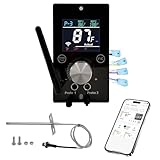
The Hungrill Universal WiFi PID Controller Kit is the odd item in this roundup, and deliberately so: it is not a grill but a retrofit kit that brings WiFi PID temperature control and an RTD grill probe to an existing pellet grill. It suits the owner of an older or budget pellet grill whose mechanical controller drifts, overshoots, or lacks any remote monitoring — someone who wants modern temperature control without buying a whole new cooker.
Key Specs
- Type: universal-fit WiFi PID controller retrofit kit
- Included: grill RTD temperature probe
- Control method: PID algorithm for tighter temperature holds than basic controllers
- Connectivity: WiFi for app-based monitoring and adjustment
- Compatibility: universal design intended for a broad range of pellet grills
Strengths
The economics here are compelling. A PID controller is the single biggest determinant of how well a pellet grill holds temperature; upgrading a serviceable grill’s controller can transform its performance for a fraction of the cost of a new unit. PID logic anticipates temperature changes rather than simply reacting to them, which reduces the overshoot-and-recover cycling that plagues basic controllers — the practical result being steadier cooks, less pellet waste, and more predictable results. Adding WiFi on top means you can monitor from indoors, which is the feature most owners miss most when they lack it. The included RTD probe replaces the original sensor, addressing one of the parts that degrades first on aging grills.
Pros
- Dramatically cheaper than replacing a functioning grill
- PID control improves temperature stability significantly
- Adds WiFi app monitoring to grills that never had it
- Includes a fresh RTD probe, a common failure point
- Extends the useful life of equipment you already own
Cons
- Requires DIY installation and comfort with wiring
- Universal fit means some grills need adaptation
- Does not improve hopper size, cooking area, or build quality
- If the grill body is rusted or the auger is failing, a new grill is the better investment
How it compares
Against buying the Pit Boss 850, the Hungrill kit is the frugal path: you keep your existing chamber and gain PID control and WiFi for far less money. But it only makes sense if your grill’s body, auger, and fire pot are in good condition. If you are fighting rust, a worn auger motor, or a failing igniter, put the kit money toward a complete grill instead — the 850 or the Z GRILLS 600D2 will serve you better.
6. Traeger Pro 780 – Best for First-Time Traeger Owners

The Traeger Pro 780 is the classic mid-range Traeger: 780 square inches of cooking area, WiFi connectivity, and the Pro-series controller that has made Traeger the default name in pellet grilling. It suits the buyer who wants a proven, widely supported grill from the brand that essentially created the category, in a size that fits a normal backyard.
Key Specs
- Cooking area: 780 square inches
- Connectivity: WiFi with Traeger app control and recipe integration
- Controller: Pro-series digital controller
- Hopper: roughly 18–20 lb class
- Fuel: Traeger wood pellets and compatible varieties
Strengths
Traeger’s greatest asset is its ecosystem. The app is mature, the pellet flavor range is the broadest in the industry, and the community of recipes, accessories, and troubleshooting knowledge is unmatched. For a first pellet grill, that support network matters: when something goes wrong at 7 p.m. on a Saturday, you will find an answer. The Pro 780’s 780 square inches handle most family cooking, from weeknight chicken to weekend brisket, and the WiFi controller lets you monitor and adjust remotely. The Pro-series controller is a meaningful step above entry-level controllers in temperature consistency.
Pros
- Mature, well-supported WiFi app with integrated recipes
- Broadest pellet flavor availability of any brand
- 780 sq in fits most family cooking needs
- Huge community and accessory ecosystem
- Proven reliability record in the category
Cons
- Modest hopper capacity limits very long cooks
- Only one cooking zone
- Temperature stability is good but recteq and GRILLA generally edge it out
- Mid-range price for mid-size capacity
How it compares
The direct competitor is the recteq Patio Legend 600. The Traeger gives you 180 more square inches and a richer app ecosystem; the recteq gives you tighter temperature control in a smaller footprint. Buyers who prioritize recipes and pellets should choose the Traeger; buyers who prioritize pit stability should choose the recteq. Against the Traeger Westwood XL, the Pro 780 is the more conservative choice — less capacity, but a long-established platform with proven parts availability.
7. Traeger Woodridge Elite – Best Premium Single-Chamber Flagship

The Traeger Woodridge Elite is the premium single-chamber pick in this roundup, offering 970 square inches of cooking area with WiFi connectivity and Traeger’s modern build and control refinements. It suits the buyer who wants one excellent grill, maximum cooking surface in a conventional layout, and the reassurance of the Traeger ecosystem — without moving into dual-chamber complexity.
Key Specs
- Cooking area: 970 square inches
- Connectivity: WiFi with Traeger app control
- Controller: modern Traeger control system with app integration
- Hopper: large hopper class (20 lb-plus)
- Build: premium materials and finish relative to the Pro line
Strengths
At 970 square inches, the Woodridge Elite offers nearly 200 square inches more than the Pro 780 — enough to fit a full brisket plus multiple sides, or several racks of ribs with room to spare. The premium build typically means better lid sealing, sturdier legs and shelving, and improved heat retention, all of which pay off in colder weather and in consistency across the grate. Traeger’s WiFi app integration remains the category benchmark for recipe guidance and remote monitoring, and the Woodridge platform represents the current generation of the company’s design thinking rather than a legacy layout.
Pros
- 970 sq in of cooking space in a single-chamber design
- Premium build quality and heat retention
- Best-in-class app ecosystem with WiFi control
- Broad pellet and accessory availability
- Straightforward operation for cooks who want one zone
Cons
- Premium price tier
- No dual-zone capability despite the flagship positioning
- Large footprint requires dedicated patio space
- Hopper, while large, is not in the 30 lb-plus class of some competitors
How it compares
Against the recteq DualFire 1200, the Woodridge Elite gives you more conventional single-zone simplicity and the Traeger app, while the DualFire gives you two independent chambers and the ability to sear and smoke simultaneously — a genuine capability difference rather than a spec-sheet one. Against its own sibling the Traeger Westwood XL, the Woodridge Elite is the upgrade: more space, better build, newer platform. Buyers deciding between the two should let capacity and budget settle it.
8. recteq DualFire 1200 – Best for Two-Zone Sear and Smoke Cooking

The recteq DualFire 1200 is the most conceptually interesting grill here: a WiFi pellet smoker with two independent cooking chambers, one for hot-and-fast searing and one for low-and-slow smoking. It suits the cook who wants steak-night capability and brisket-night capability from the same machine, without compromise and without juggling a separate gas grill.
Key Specs
- Cooking area: approximately 1,200 square inches combined across two chambers (dual-zone class)
- Configuration: dual independent chambers — hot-and-fast plus low-and-slow
- Connectivity: WiFi with app connectivity
- Controller: recteq PID-style control per zone
- Power: electric pellet ignition and feed
- Build: recteq stainless-leaning construction
Strengths
The dual-chamber design solves the pellet grill’s oldest limitation. Conventional pellet grills top out well below the searing temperatures a gas or charcoal grill reaches, which is why so many owners keep a second grill. The DualFire sidesteps that entirely: run one chamber wide open for direct high-heat searing and the other at 225°F for a long smoke, simultaneously. Combined with recteq’s controller reputation, you get tight temperature discipline in both zones. For anyone who has been running two grills and resenting the patio space, this is the consolidation play. The WiFi app layer keeps both zones monitorable from indoors.
Pros
- True two-zone cooking — sear and smoke at once
- recteq-grade temperature stability in each chamber
- WiFi app control across both zones
- Replaces a separate gas or charcoal searing grill
- Roughly 1,200 sq in combined capacity
Cons
- Premium price tier and premium pellet consumption
- More complex machine means more to clean and maintain
- Heavy and large — not a grill you wheel out for every cook
- Overkill for buyers who only ever smoke low and slow
How it compares
Against the Traeger Woodridge Elite, the DualFire trades the single-chamber simplicity and Traeger app ecosystem for genuine two-zone capability. If you have ever wanted a steak seared at high heat while a chicken smokes beside it, the DualFire is the only grill in this list that delivers it. Against the GRILLA Silverbac 2.0, the DualFire offers dual zones where GRILLA offers a large hopper and stainless build — different priorities, similarly premium positioning.
9. Traeger Westwood XL – Best Mid-Range Upgrade With Modern Conveniences

The Traeger Westwood XL occupies the mid-range tier with 823 square inches of cooking space and WiFi connectivity, sitting between the Pro 780 and the Woodridge Elite in Traeger’s current lineup. It suits buyers who want the newer Traeger platform and a bit more room than the Pro series offers, without paying flagship prices.
Key Specs
- Cooking area: 823 square inches
- Connectivity: WiFi with Traeger app control
- Controller: current-generation Traeger mid-tier control system
- Hopper: roughly 20 lb class
- Build: modern Westwood platform with updated design
Strengths
The Westwood XL’s advantage over the Pro 780 is straightforward: about 43 more square inches, a newer platform, and typically improved conveniences such as better shelving and a more contemporary control layout. It retains full Traeger app integration, which remains the most feature-rich in the category for guided cooks and remote monitoring. For the buyer who wants a Traeger but finds the Woodridge Elite more than they need to spend, the Westwood XL is the rational middle step.
Pros
- 823 sq in is a comfortable size for most households
- Newer Traeger platform with updated design
- Full WiFi app and recipe ecosystem
- Mid-range price tier
- Wide pellet and accessory availability
Cons
- Single-zone cooking only
- Hopper is solid but not in the large-runtime class
- Premium build materials reserved for the Woodridge Elite
- Capacity is modest next to the Pit Boss 1300 for similar money
How it compares
Against the Traeger Pro 780, the Westwood XL is the newer, slightly larger sibling — worth the step up if you want the current platform. Against the Pit Boss 1300 Navigator, the Westwood gives up roughly 475 square inches and a touchscreen in exchange for Traeger’s ecosystem and a more refined feel. Capacity-focused buyers should take the Pit Boss; ecosystem-focused buyers should take the Westwood.
10. Z GRILLS 600D2 – Best Budget Entry Into 8-in-1 Cooking

The Z GRILLS 600D2 is a budget-tier pellet grill with 572 square inches of cooking area and an 8-in-1 cooking design that covers smoking, grilling, baking, roasting, braising, barbecuing, char-grilling, and searing modes. It suits first-time pellet grill buyers and anyone testing whether pellet cooking fits their routine before committing serious money.
Key Specs
- Cooking area: 572 square inches
- Cooking modes: 8-in-1 (smoke, grill, bake, roast, braise, barbecue, char-grill, sear)
- Controller: digital temperature control
- Hopper: small-to-mid class
- Fuel: wood pellets
Strengths
For the money, the 600D2’s strongest card is versatility. The 8-in-1 mode set means a single budget unit can bake a pizza, roast a chicken, and smoke a rack of ribs, which is remarkable at the entry tier. At 572 square inches, it fits a family meal comfortably — two racks of ribs, a spatchcocked chicken, or a tray of vegetables with room to spare. For a buyer who is not yet sure how much they will use a pellet grill, the low entry cost reduces the risk of the experiment considerably.
Pros
- Very accessible budget-tier pricing
- 8-in-1 mode versatility
- 572 sq in is competent for family cooking
- Simple operation suits beginners
- Small footprint
Cons
- No WiFi or app connectivity
- Small hopper limits long unattended cooks
- Temperature stability is basic compared with PID-equipped grills
- Build and weather durability are entry-level
How it compares
Against the KingChii Electric Pellet Grill, the Z GRILLS offers 116 more square inches and the 8-in-1 mode set, while the KingChii counters with PID temperature control and a side shelf. Against the Pit Boss 850, the Z GRILLS saves money but gives up WiFi, Bluetooth, the flame broiler, and roughly 280 square inches. If connectivity matters to you at all, the 850 is worth the stretch.
11. KingChii Electric Wood Pellet Grill – Best for Balconies and Tight Spaces

The KingChii Electric Wood Pellet Grill is the smallest unit here at 456 square inches, with PID temperature control and a side shelf. It suits apartment dwellers, balcony cooks, and anyone whose outdoor space cannot accommodate a full-size grill but who still wants real pellet smoke.
Key Specs
- Cooking area: 456 square inches (compact class)
- Controller: PID temperature control
- Features: side shelf for prep and tool staging
- Hopper: compact class
- Fuel: wood pellets
Strengths
The standout spec is the PID controller, which is unusual at this size and price. PID logic gives the KingChii steadier temperature holds than a basic controller would, which is exactly what a small grill needs: on a compact chamber, temperature swings are amplified, so control quality matters more, not less. The side shelf is a genuinely useful addition on a small grill where counter space is often absent. At 456 square inches, it still fits a chicken, a couple of steaks, or a small rack of ribs — enough for one or two people cooking regularly.
Pros
- PID temperature control at a budget price
- Very compact footprint for balconies and small patios
- Side shelf adds practical workspace
- Low entry cost
- Real wood-pellet smoke flavor in a small package
Cons
- No WiFi or app connectivity
- 456 sq in is limiting for more than two or three diners
- Compact hopper means frequent refills on long cooks
- Not suited to large-party cooking
How it compares
Against the Z GRILLS 600D2, the KingChii trades 116 square inches and the 8-in-1 mode set for PID control and a smaller footprint. If space is the constraint, the KingChii wins on control quality; if capacity is the constraint, the Z GRILLS wins. Neither offers WiFi, so buyers who need app control should look at the Pit Boss 850 or recteq Patio Legend 600 instead.
12. GRILLA Silverbac 2.0 – Best for Hopper Capacity and Stainless Build

The GRILLA Silverbac 2.0 combines 692 square inches of cooking space with a 33-pound hopper, a WiFi controller, and stainless steel construction. It suits the serious smoker who runs long cooks regularly and wants a grill built to last with minimal pellet refilling.
Key Specs
- Cooking area: 692 square inches
- Hopper: 33 lb — the largest in this roundup
- Connectivity: WiFi controller with app-based monitoring
- Build: stainless steel components for weather durability
- Fuel: wood pellets
Strengths
The 33-pound hopper is the headline, and it is a spec that translates directly into lifestyle. A hopper that size supports overnight brisket cooks and all-day sessions without refilling, which is precisely the scenario where cheap grills fail. The stainless construction addresses the category’s most common long-term problem: rust. Pellet grills live outdoors, and the components that fail first — the lid, the fire pot area, the shelves — are exactly where stainless pays off. The WiFi controller keeps temperature monitorable from indoors, and 692 square inches is a smart middle size that handles family cooking and moderate entertaining without excessive footprint.
Pros
- 33 lb hopper — longest unattended runtime here
- Stainless steel build for weather durability
- WiFi controller with app monitoring
- 692 sq in balances capacity and footprint
- Premium components aimed at long-term ownership
Cons
- Premium price tier
- Single cooking zone
- Smaller cooking area than the Pit Boss 1300 or 1600 for similar or less money
- Less mainstream brand support than Traeger or Pit Boss
How it compares
Against the recteq Patio Legend 600, the Silverbac 2.0 offers about 92 more square inches, a much larger hopper, and stainless construction for a step up in price — a fair trade for buyers who cook overnight. Against the Pit Boss 1300, the Silverbac gives up roughly 600 square inches of capacity but wins decisively on hopper size and weather durability. It is the grill for the buyer who values longevity and unattended runtime over sheer cooking surface.
How to Choose
Choosing among WiFi pellet grills comes down to seven variables, and getting them in the right order for your situation prevents the most common and expensive mistake: buying too much grill or too little capacity for how you actually cook.
Temperature Accuracy and Controller Type
This is the spec that most affects results and the one listings explain least clearly. Basic controllers run on simple on-off logic: the auger feeds pellets until the pit hits the set temperature, then stops until it drops below, producing a sawtooth temperature curve with swings that can reach 25–50°F in either direction. PID controllers anticipate rather than react, modulating pellet feed to hold temperatures in a much narrower band — often within 10–15°F. For low-and-slow brisket and pork butt, where a 25°F swing changes cook time and moisture loss meaningfully, PID control is worth real money. Grills here with PID-style control include the recteq models, the GRILLA Silverbac 2.0, and the KingChii. The Hungrill kit exists precisely to add PID control to grills that lack it.
WiFi and App Controls
WiFi control has three practical functions: remote temperature monitoring, remote set-point adjustment, and alerts. Monitoring matters most — knowing your pit is holding temperature without walking outside every twenty minutes is the difference between an enjoyable cook and a chore. Alerts that warn you of a flame-out or temperature drop can save a brisket. Set-point adjustment is convenience rather than necessity. Bluetooth-only connectivity limits range to roughly 30 feet, so WiFi is the feature to insist on. Every grill in this roundup except the Z GRILLS 600D2 and the KingChii offers WiFi; the retrofit kit adds it to grills that lack it.
Cooking Capacity — Sizing It Honestly
Square inches are the most over-purchased spec in the category. A useful rule of thumb: allow roughly 70–100 square inches per person for a mixed cook, less for dense proteins. That means a household of four needs about 400 square inches for a normal dinner and 600–700 for a modest gathering. Here is how the sizes map to situations:
- Under 500 sq in (KingChii 456): one to three people, frequent small cooks
- 500–700 sq in (Z GRILLS 572, recteq Patio Legend 600, GRILLA 692): families of three to five, occasional guests
- 700–900 sq in (Traeger Pro 780, Traeger Westwood XL 823, Pit Boss 850): families of four to six, regular weekend entertaining
- 900–1,000 sq in (Traeger Woodridge Elite 970): large families and regular hosts
- 1,200 sq in and up (recteq DualFire 1200, Pit Boss 1300, Pit Boss 1600): frequent large gatherings or multi-protein cooks
Buy one size smaller than your ego suggests and one size larger than your weekly routine suggests. The weekly routine will win.
Smoke Performance and Temperature Range
Smoke quality depends on how the grill manages low-temperature burns. The “smoke” setting on most controllers, typically around 180–225°F, produces the cleanest blue smoke; above 275°F, combustion becomes too complete to generate much smoke flavor. If smoke intensity matters to you, look for grills with a dedicated low smoke mode and consider a smoke tube accessory, which works on any grill regardless of controller. Sear capability is the other end of the range: most pellet grills top out around 450–500°F, which is fine for grill marks but short of true steakhouse searing. Only the flame-broiler models, the Pit Boss Navigator grills, and the dual-zone recteq DualFire genuinely address direct high-heat cooking.
Hopper Size and Unattended Runtime
Hopper capacity converts directly into how long you can walk away. Pellets burn at roughly 1 to 2 pounds per hour at 225°F on most mid-size grills, and higher at grilling temperatures. A useful working calculation: an 18-pound hopper at 1.5 lb/hour gives about 12 hours of runtime — enough for a brisket but with little margin. A 33-pound hopper on the GRILLA Silverbac 2.0 at the same burn rate yields roughly 22 hours, comfortably covering any overnight cook. If you plan to smoke overnight on a 20-pound hopper, top it off before bed and expect to check it once.
Cleanup Design
Cleanup is where pellet grill ownership becomes work, and designs vary enormously. At minimum, a grill needs an accessible ash clean-out, a removable drip tray or grease management system, and a fire pot you can reach without disassembling the unit. The failure modes are predictable: ash accumulates in the fire pot and causes flame-outs, grease builds in the drain and causes flare-ups, and the temperature probe gets coated in residue and reads inaccurately. A grill that makes these three tasks easy will get used more. When evaluating any unit, look for how the grease drain and ash system are accessed — the difference between a five-minute weekly task and a thirty-minute one compounds over years.
Weather Durability
Pellet grills live outside, and the parts that fail first are the ones in contact with heat, moisture, and ash. Expect the internal RTD temperature probe to be the first component to degrade, followed by the igniter, then the auger motor, and finally rust at the fire pot and lid seams. Stainless steel construction, as on the GRILLA Silverbac 2.0 and recteq models, materially extends the lid and exterior life. Regardless of build, a fitted cover is the highest-value accessory you can buy. In humid or coastal climates, budget for replacing a probe every year or two; it is inexpensive and restores accuracy.
Upgrade Path
Finally, think about how a grill ages with you. A budget grill with a failing controller can be revived with a kit like the Hungrill Universal WiFi PID Controller, which turns an old grill into a WiFi-controlled one for a fraction of replacement cost — viable as long as the body, auger, and fire pot remain sound. Beyond that, the upgrade path runs through capacity: many owners start at 500–600 square inches and move to 800–1,300 within a few years as their cooking ambitions grow. If you suspect that will be you, buying the mid-size grill now rather than the small one often costs less over five years than trading up later.
Frequently Asked Questions
Do premium pellet grills with WiFi actually hold temperature better than cheaper ones?
WiFi itself has nothing to do with temperature stability — it is the controller type that matters. What often happens is that premium grills pair WiFi with PID controllers, while budget grills pair basic controllers with no connectivity. So the correlation is real but the cause is the controller, not the app. If tight temperature holds matter to you, look specifically for PID control, which you can find even at budget prices on grills like the KingChii.
How much cooking area do I really need?
For a household of four cooking dinner regularly, 500–700 square inches is comfortable, and 700–900 square inches covers entertaining. The 1,300 and 1,600 square inch grills in this roundup are genuinely for people who host large groups several times a year. Buying oversized costs you patio space, pellets, and cleanup effort on every single cook, not just the big ones.
Can I use a pellet grill for high-heat searing?
Most pellet grills max out around 450–500°F, which produces decent grill marks but not steakhouse-level crust. Two approaches solve this: flame broiler designs like those in the Pit Boss Navigator line, which slide a plate open to expose direct flame, and dual-chamber designs like the recteq DualFire 1200, which dedicate one chamber to high-heat cooking. Without one of these features, most owners keep a separate gas or charcoal grill for searing.
How long can I leave a pellet grill unattended?
That depends on hopper size and burn rate. At 225°F, most mid-size pellet grills consume roughly 1 to 2 pounds of pellets per hour. An 18–20 pound hopper therefore gives about 10–13 hours of runtime, and a 33-pound hopper like the GRILLA Silverbac 2.0 gives roughly 18–22 hours. Overnight cooks are realistic on most grills in this list if you fill the hopper first, but WiFi alerts are valuable insurance against a flame-out.
What wears out first on a pellet grill?
The temperature probe (RTD) is typically the first casualty, because it sits inside the chamber and accumulates residue, causing it to read inaccurately over time. The igniter and auger motor follow. Rust at the fire pot and lid seams is the longer-term concern, which is why stainless construction helps. Probes are inexpensive and usually user-replaceable, so an aging grill that reads temperature oddly is often a cheap fix rather than a replacement decision.
Is a retrofit WiFi PID controller worth it instead of a new grill?
Yes, if your grill’s body, auger, and fire pot are in good condition. A kit like the Hungrill Universal WiFi PID Controller adds both PID stability and WiFi monitoring for a fraction of the cost of a new unit, and it includes a replacement RTD probe. If your grill is rusting through or the auger is failing, though, put that money toward a new grill — the controller is not the problem at that point.
Do I need Bluetooth as well as WiFi?
Not really. Bluetooth is useful as a local backup when WiFi drops, and several grills here offer both, but WiFi is the feature that lets you monitor from inside the house or across town. If a grill offers only Bluetooth, expect roughly a 30-foot range, which defeats most of the purpose of remote monitoring.
How much maintenance does a pellet grill require?
Plan on a light cleanup after every cook — brushing the grates and clearing the drip tray — and a deeper session every few cooks: vacuuming ash from the fire pot and chamber, checking the grease drain, and wiping down the temperature probe. Skipping the ash removal is the most common mistake and the leading cause of flame-outs and uneven temperatures. Total time is modest, but consistency matters more than intensity.
Closing Recommendation by Situation
If you are buying your first pellet grill and want WiFi control without overspending, the Pit Boss 850 Navigator Series is the safest starting point — app control, flame broiler searing, and enough space for a family at the budget tier. If space is tight, choose the KingChii Electric Pellet Grill for its compact footprint and PID control, or the recteq Patio Legend 600 if you want tighter temperature discipline and WiFi in a slightly larger compact package. If you host regularly, the Pit Boss 1300 Navigator is the best balance of capacity and price, and the Pit Boss 1600 Navigator only makes sense if you genuinely cook for crowds. If you want one premium grill for everything, the recteq DualFire 1200 is the most capable machine here, thanks to its dual chambers, while the Traeger Woodridge Elite is the best conventional single-chamber flagship for buyers invested in the Traeger ecosystem. Finally, if you already own a working grill with a drifting controller, the Hungrill Universal WiFi PID Controller Kit is the cheapest route to modern temperature control — provided the rest of the grill is sound.