Key takeaways
- Full-size bench-top router table with a work surface designed for long stock support
- Adjustable fence with locking mechanism for repeatable positioning
- Accepts standard router motors and aftermarket router lifts
- Miter slot for crosscut sleds, miter gauges, and featherboards
- Portable format — can be clamped to a workbench or set on a stand
- Compatible with the Kreg Precision Router Table Fence (PRS1015) as an upgrade path
The Short Answer
If you want the best router table setup for precision woodworking without building your own cabinet, the Kreg PRS2100 Bench Top Router Table paired with the Kreg Precision Router Table Fence (PRS1015) is the most reliable starting point for most woodworkers, because the fence adjustability and tabletop flatness are designed to work together as a system. If you already own a table and only need the lift mechanism, the JessEm Rout-R-Lift 3.5XT is the most sensible mid-range upgrade for 3-1/2 inch motors. If precision on a tight budget is the goal, the Bosch RA1141 with a set of Comfylichi setup blocks gets you accurate repeat cuts for a fraction of the cost of a full premium system. This guide compares fence adjustability, tabletop flatness, miter-slot alignment, insert fit, and vibration control — the five variables that actually determine whether your repeated cuts come out identical every time.
Top 3 Picks
Best Overall: Kreg PRS2100 Bench Top Router Table
The PRS2100 combines a full-size work surface with a fence system that adjusts quickly and holds position reliably, which is the single biggest factor in repeatable cuts. It fits standard router motors, accepts aftermarket lifts, and its tabletop is designed to stay flat under load. For most small shops, it is the best balance of footprint, rigidity, and price tier.
Best Budget: Bosch RA1141 Portable Jobsite Router Table
The RA1141 uses a laminated MDF top with a 2-1/2 in. vacuum hose port, and it is the cheapest way to get a genuinely usable table with a miter slot and fence. It is not as rigid as a cast or phenolic top, but with careful setup it produces accurate cuts for trim work, small moldings, and edge profiles.
Best Premium: O’SKOOL Router Table System with Micro Adjust Fence (RTS026)
The O’SKOOL RTS026 adds a micro-adjust fence, which lets you dial in fence position in fractions of a millimeter rather than tapping the fence and hoping. That single feature is what separates “close enough” from “identical every time,” and it is why this is the pick for furniture-grade work and repeat production runs.
Quick Comparison
| Product | Best For | Key Specs | Price Tier |
|---|---|---|---|
| Kreg PRS2100 Bench Top Router Table | Best overall bench-top system | Full-size work surface, adjustable fence, accepts lifts, portable | Mid-range |
| Bosch RA1141 Jobsite Router Table | Budget entry with miter slot | 26 in. x 16-1/2 in. laminated MDF top, 2-1/2 in. vacuum port | Budget |
| O’SKOOL Router Table System RTS026 | Micro-adjust fence precision | Micro-adjust fence, system table, insert plate included | Premium |
| Bosch RA1181 Benchtop Router Table | Aluminum-top durability | 27 in. x 18 in. aluminum top, 2-1/2 in. vacuum port | Mid-range |
| Kreg Precision Router Lift PRS5000 | Above-table bit changes | Precision lift, above-table adjustment, fits standard plates | Premium |
| Kreg Precision Router Table Fence PRS1015 | Fence upgrade for existing tables | Precision fence, dual locking, T-track compatible | Mid-range |
| JessEm Rout-R-Lift 3.5XT | Mid-range lift for 3-1/2 in. motors | Lift system for 3-1/2 in. motors, above-table adjust | Mid-range |
| SpeTool Router Lift System | Heavy-duty aluminum lift kit | Aluminum lift, insert ring set, heavy-duty construction | Premium |
| MUWOOD Router Lift | Budget lift + insert plate | Lift system with insert plate, precision adjustment | Budget |
| O’SKOOL Precision Aluminum Router Lift Kit | Lift for 3.5 in. motors | Aluminum lift kit, for 3.5 in. router motors | Premium |
| Rockler Trim Router Table | Compact trim router work | Compact table, bit guard, adjustable | Budget |
| Comfylichi 14Pcs Setup Blocks | Setting bit and fence height | 14-piece setup block set, router and table saw use | Budget |
How We Chose
This roundup is built from published specifications, manufacturer documentation, and established category knowledge about how router tables behave in real shops — not from physical testing. The selection criteria were: (1) whether the product addresses one of the five precision variables directly (fence adjustability, tabletop flatness, miter-slot alignment, insert fit, or vibration control); (2) whether it fills a clear category role — full table, lift only, fence only, or accessory; (3) whether the price tier makes sense for the use case, so a hobbyist is not forced into a production-grade purchase and a production shop is not stuck with a hobby-grade table; and (4) upgrade path, meaning whether the product can be improved later or becomes a dead end. Products that duplicate another item’s role without adding a meaningful precision advantage were left out. The goal is a set of picks where each one is the best answer to a specific situation, and where the accessory items are treated as what they are: the small, cheap parts that quietly determine whether your “precision” table actually cuts accurately.
1. Kreg PRS2100 Bench Top Router Table – Best for Most Small Shops
As an Amazon Associate we earn from qualifying purchases at no extra cost to you.

The PRS2100 is the pick for the woodworker who wants one purchase to solve the whole problem. It is a full-size bench-top table, meaning the work surface is large enough to support long stock and wide panels, but it is still portable enough to move onto a workbench and clamp down when needed. That combination — big enough to be accurate, small enough to store — is why it sits at the top of this list.
Who it suits: hobbyists and small-shop professionals who make cabinets, furniture parts, moldings, and trim, and who want a table they can set up once and trust. It also suits someone upgrading from a homemade table because the fence and insert system are designed to work together rather than being a collection of mismatched parts.
Key specs
- Full-size bench-top router table with a work surface designed for long stock support
- Adjustable fence with locking mechanism for repeatable positioning
- Accepts standard router motors and aftermarket router lifts
- Miter slot for crosscut sleds, miter gauges, and featherboards
- Portable format — can be clamped to a workbench or set on a stand
- Compatible with the Kreg Precision Router Table Fence (PRS1015) as an upgrade path
Strengths. The main advantage is system coherence. The fence adjustments are designed to be quick to set and to hold, which matters more than any single number on a spec sheet. A fence that moves 0.5 mm when you lean on it will ruin a repeat cut no matter how flat the top is. The PRS2100’s fence locks down solidly, and the table accepts a lift, which means the same table can grow with you — you can start with the stock insert and add a precision lift later without replacing the table.
Tabletop flatness on a bench-top table of this class is generally good out of the box and stays reasonably stable as long as you support it properly. The single most common mistake owners make is letting a bench-top table flex because it is sitting on an uneven surface. Put it on a flat bench, shim if needed, and check flatness with a straightedge across the opening before you ever make a cut.
Miter-slot alignment is the second most important thing to verify. A miter slot that is not parallel to the fence will cause binding on long cuts and inconsistent widths on crosscuts. Check it by running a miter gauge with a dial indicator or a simple feeler-gauge setup against the fence line, and adjust the table or fence as needed. This is a ten-minute job that saves hours of frustration.
Pros.
- Full-size work surface for real furniture and cabinet work
- Fence locks firmly and repeats well
- Upgrade path to a precision lift and premium fence
- Portable but not flimsy
- Strong ecosystem of compatible accessories
Cons.
- Needs a flat, solid bench to perform at its best
- Not a production machine — heavy daily use will show wear sooner than a cast-iron cabinet table
- Stock insert and fence are good but not as refined as the premium alternative below
How it compares. Against the O’SKOOL RTS026, the PRS2100 gives you a larger, more established platform but a less precise fence out of the box. If your work depends on dialing in fence position to a fraction of a millimeter — cutting identical tenons, dadoes, or tongue-and-groove across dozens of parts — the O’SKOOL’s micro-adjust fence is the better tool. If you want one table that does everything well and can be upgraded over time, the PRS2100 wins. Against the Bosch RA1181, the PRS2100 is the more serious woodworking platform, while the RA1181 is the more durable-surface option for someone whose priority is a top that will not dent.
2. Bosch RA1141 Portable Jobsite Router Table – Best Budget Entry

The RA1141 is the cheapest way into a router table that still has the features that matter: a miter slot, a fence, and a vacuum port. It is a 26 in. x 16-1/2 in. laminated MDF top with a 2-1/2 in. vacuum hose port, and it is aimed at jobsite and light-shop users who need a table that folds away and does not cost much.
Who it suits: trim carpenters, hobbyists just starting out, and anyone who needs an occasional table for edge profiles, roundovers, and small moldings. It also suits someone who wants to test whether they actually enjoy router table work before spending real money.
Key specs
- 26 in. x 16-1/2 in. laminated MDF tabletop
- 2-1/2 in. vacuum hose port for dust collection
- Miter slot and fence included
- Portable, lightweight construction
- Designed for standard trim and mid-size routers
Strengths. Value and portability. The laminated MDF top is flat when new, and for light cuts it holds accuracy well. The vacuum port is a genuine asset — dust and chips under the workpiece are a leading cause of inconsistent cuts, because chips between the stock and the table lift the work slightly and change the cut depth. Hooking up a shop vac to the 2-1/2 in. port measurably improves cut quality, and that is a real precision advantage at this price tier.
The limitation is the fence. On budget tables the fence is usually the weak link: it can be adjusted, but locking it down without shifting it takes practice. The fix is cheap and effective — set the fence, lock it, then check the distance to the bit with a setup block rather than trusting the scale. This is exactly where the Comfylichi setup blocks earn their place; they convert a wobbly fence into a repeatable one because you measure the actual gap, not the indicator.
MDF tops also need respect. They do not like water, they can sag if unsupported in the middle, and they can be damaged if you over-tighten the insert plate screws. Check the top for flatness with a straightedge before use, and store the table flat, not leaning against a wall, which is one of the most common ways a good budget table gets ruined.
Pros.
- Very affordable entry into real router table work
- Includes miter slot and fence
- 2-1/2 in. vacuum port improves dust control and cut consistency
- Light and portable
Cons.
- MDF top can sag or swell if not supported and kept dry
- Fence is the weak point — needs setup blocks to be reliable
- Not suitable for heavy, repeated production cuts
- Vibration control is basic compared to heavier tables
How it compares. Against the Bosch RA1181, the RA1141 trades an aluminum top for a laminated MDF top to save money and weight. If your shop is humid or you tend to bump the table, the RA1181’s aluminum surface is the more durable choice. If budget is the hard constraint and you can store the table properly, the RA1141 plus a set of setup blocks gets you 80% of the precision for a fraction of the cost. Against the Rockler Trim Router Table, the RA1141 handles larger routers and longer stock, while the Rockler is purpose-built for compact trim routers and small edge work.
3. O’SKOOL Router Table System with Micro Adjust Fence (RTS026) – Best for Repeatable Precision

The RTS026 is the precision-first pick. Its headline feature is a micro-adjust fence, which lets you move the fence in small, controlled increments instead of tapping it with a mallet and re-checking. For anyone cutting the same joint across twenty parts, that is not a luxury — it is the difference between parts that fit and parts that almost fit.
Who it suits: furniture makers, joinery-focused woodworkers, and anyone doing repeat production runs. It also suits the woodworker who has been fighting a fence that shifts every time it is locked and is ready to stop fighting it.
Key specs
- Router table system with micro-adjust fence
- Includes insert plate for router mounting
- Fence moves in fine increments and locks without shifting
- Designed for accurate repeat cuts and joint work
- Compatible with the O’SKOOL lift ecosystem
Strengths. The micro-adjust fence is the single most valuable precision feature money can buy on a router table. Here is why, in concrete terms: suppose you are cutting a 1/4 in. groove and your target is 1/4 in. exactly, but your first test cut comes out at 0.240 in. With a friction fence, you loosen, tap, tighten, and re-cut — and you may overshoot. With a micro-adjust fence, you turn a screw a known amount, watch the fence move a few thousandths, and re-cut. Repeated across a run of parts, that turns a frustrating process into a mechanical one.
Fence adjustability also matters for bit changes. Different bits have different diameters, and every change requires re-referencing the fence to the bit’s cutting edge. A fence that returns to a known position — or that can be dialed precisely — shortens setup and reduces error. This is the core of repeatable precision.
Pros.
- Micro-adjust fence is a genuine precision advantage
- System approach: table, fence, and insert designed together
- Excellent for joinery and repeat runs
- Works with O’SKOOL lift kits for above-table adjustment
Cons.
- Premium price tier
- Micro-adjust takes a little learning — you must remember to lock the coarse adjustment before fine-tuning
- Overkill if you only cut roundovers and edge profiles
How it compares. Against the Kreg PRS2100, the O’SKOOL RTS026 is the more precise fence but the less established platform for long-stock support; Kreg’s ecosystem of accessories is broader. Against the Kreg PRS1015 fence as a standalone upgrade, the RTS026 packages fence, table, and insert together, which removes compatibility guesswork — but if you already own a solid table, buying just the PRS1015 fence is far cheaper than replacing the whole system. Against the Bosch RA1181, the RTS026 wins decisively on fence precision and loses on price.
4. Bosch RA1181 Benchtop Router Table – Best Aluminum-Top Durability

The RA1181 is the durable-surface pick: a 27 in. x 18 in. aluminum top with a 2-1/2 in. vacuum hose port. Aluminum does not swell with humidity, does not delaminate, and tolerates the kind of bumps and scrapes a working shop delivers. If your shop is unheated, humid, or just busy, that matters.
Who it suits: shops with variable humidity, users who want a table that will not need replacing in three years, and woodworkers who want a larger top than the budget RA1141 offers.
Key specs
- 27 in. x 18 in. aluminum tabletop
- 2-1/2 in. vacuum hose port
- Miter slot and adjustable fence
- Benchtop format, portable
- Accepts standard router mounting
Strengths. Tabletop flatness stability over time is the core argument for aluminum. A laminated MDF top can be perfectly flat on day one and slightly dished a year later if it has absorbed moisture or been stored badly. Aluminum holds its shape. That directly serves precision, because a dished top changes the effective cutting depth as the workpiece moves across it.
The vacuum port is the same 2-1/2 in. format as the RA1141, so the dust-control benefit carries over: fewer chips under the work means more consistent depth of cut. And the larger 27 x 18 in. surface gives you more support for long stock than the 26 x 16-1/2 in. budget top, which reduces the tendency of long boards to tip or rock at the end of a cut.
Insert fit is the thing to check carefully on any aluminum top. The insert plate must sit flush — if it sits proud of the surface, stock catches on it; if it sits low, stock dips into the gap. On aluminum tables you can use thin shims or set screws to level the insert precisely, and you should, because a flush insert is a hard requirement for accurate work. Vibration control on a bench-top aluminum table is decent, but it depends on mass and clamping. Clamp the table down or bolt it to a stand; a table that walks is a table that cuts inconsistently.
Pros.
- Aluminum top resists moisture, warping, and damage
- Larger 27 x 18 in. surface for long-stock support
- 2-1/2 in. vacuum port for effective dust control
- Flatness stability over years of use
Cons.
- Mid-range price — more than the budget RA1141
- Aluminum can be noisy and transmits vibration more than a heavy cabinet table
- Fence is functional but not micro-adjustable
- Still needs proper clamping to control vibration
How it compares. Against the Bosch RA1141, the RA1181 is the better long-term investment: aluminum versus laminated MDF, larger surface, same vacuum feature. The RA1141 wins on price and weight. Against the Kreg PRS2100, the RA1181 has the more durable top but the less refined fence and insert system; Kreg is the better woodworking platform, Bosch is the better all-weather table. If your priority is “buy once, do not worry about the top again,” the RA1181 is the pick.
5. Kreg Precision Router Lift PRS5000 – Best Above-Table Adjustability

The PRS5000 is a lift, not a table. It replaces the insert plate in a compatible table and gives you above-table bit height adjustment — you raise and lower the bit with a crank or hex key from the top surface instead of reaching under the table. Anyone who has changed bit height by loosening a fixed base under a table knows why this matters.
Who it suits: woodworkers who already own a table and have decided the under-table adjustment is the bottleneck. Also suits anyone doing joinery where bit height must be set precisely and repeatedly.
Key specs
- Precision router lift with above-table height adjustment
- Fits standard router table insert openings (verify plate dimensions for your table)
- Accepts common router motor sizes via appropriate mounting
- Repeatable height setting with fine adjustment
- Locking mechanism to hold height under cut
Strengths. The value of a lift is not convenience alone — it is repeatability. When you set a bit height for a 3/8 in. deep rabbet, make the cut, then need to return to that exact height later, a graduated lift lets you do it. A fixed base with a wrench does not. For multi-step joinery, that repeatability prevents the small cumulative errors that make joints fit too tight or too loose.
Insert fit is the critical installation variable with any lift. The lift’s plate must sit flush in the table opening, and the opening must match the plate size. Measure the opening in your table diagonally in both directions before buying — a plate that is 1 mm too large or too small will either not seat or rock. Level the plate with set screws after installation, and re-check after a few sessions as the screws settle.
Vibration control improves with a lift because the mechanism adds mass and clamping at the center of the table, which is often the most resonant area. Combined with a solid table and proper support, a lift noticeably reduces the ringing that causes slightly ragged cuts.
Pros.
- Above-table bit height adjustment saves enormous setup time
- Repeatable height settings for joinery
- Adds mass and dampens vibration at the table center
- Upgrades an existing table without replacing it
Cons.
- Premium price tier for what looks like a single component
- Requires a compatible table opening — check dimensions first
- Installation and leveling take patience
- Only worthwhile if you actually adjust bit height often
How it compares. Against the JessEm Rout-R-Lift 3.5XT, the Kreg PRS5000 is the more broadly compatible ecosystem choice, while the JessEm is specifically aimed at 3-1/2 in. motors and is the better match if that is what you run. Against the MUWOOD lift, the Kreg is the premium, better-supported option; MUWOOD is the budget route that includes an insert plate and gets you above-table adjustment for much less. Against a bare insert plate, any lift is a large step up in repeatability.
6. Kreg Precision Router Table Fence (PRS1015) – Best Fence Upgrade
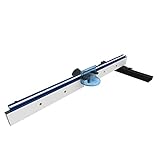
The PRS1015 is a standalone precision fence. If your table top is flat and your miter slot is true but your fence is the weak point, replacing the fence is the cheapest large precision gain available — far cheaper than a new table.
Who it suits: owners of budget or mid-range tables whose fence shifts, racks, or will not hold parallel to the miter slot. Also suits anyone building a custom table who wants a proven fence as the foundation.
Key specs
- Precision router table fence
- Dual locking for stability across the fence length
- Adjustable faces for different bit profiles
- T-track compatibility for featherboards, stops, and hold-downs
- Designed to hold position under load
Strengths. Fence adjustability is the variable that most often decides whether repeated cuts match, and a good fence solves it in three ways. First, it stays parallel to the miter slot when locked, so groove width stays constant along the length of the cut. Second, it does not creep under pressure, so you can feed stock firmly without the fence walking. Third, it supports accessories — a stop block on the fence turns it into a repeat-cutting jig, and a featherboard turns it into a safer, more consistent cut.
The practical test for any fence is simple: set it, lock it, and push hard against it from several points along its length while watching a dial indicator or feeler gauge against a known reference. A fence that moves more than a few thousandths is going to cost you accuracy. The PRS1015 is built to pass that test, which is why it is frequently the part people upgrade first.
Setup matters. Mount the fence square to the miter slot, not just square to the table edge — table edges are rarely perfectly square to the slot. Use a combination square against the slot, lock the fence, then verify with a test cut.
Pros.
- Large precision improvement for relatively modest cost
- Dual locking resists creep under feed pressure
- T-track opens up stops, featherboards, and hold-downs
- Works with many existing tables and custom builds
Cons.
- Not micro-adjustable — you still tap or nudge for fine settings
- Requires your existing table top and insert to already be sound
- Mounting may need drilling or adaptation on some tables
How it compares. Against the O’SKOOL RTS026’s integrated micro-adjust fence, the PRS1015 is less precise for dialing in a single setting but far cheaper and usable on a table you already own. Against a stock budget fence, it is a night-and-day improvement in rigidity and repeatability. If you want micro-adjustment without buying a whole new system, this fence plus a set of setup blocks is a practical middle path.
7. JessEm Rout-R-Lift 3.5XT – Best Mid-Range Lift for 3-1/2 in. Motors

The Rout-R-Lift 3.5XT is a lift system purpose-built for 3-1/2 in. router motors — the large, powerful motors used in serious table setups. If you run a 3-1/2 in. motor, the motor-to-lift fit is not a detail you want to improvise, and this is a purpose-made match.
Who it suits: woodworkers with a 3-1/2 in. motor who want above-table adjustment and repeatable height without moving to a full premium system. Also suits anyone upgrading a solid table whose current lift does not fit their motor well.
Key specs
- Lift system designed for 3-1/2 in. router motors
- Above-table height adjustment
- Fine height adjustment for joinery
- Locking mechanism to hold setting under cut
- Fits standard insert-plate openings (verify dimensions)
Strengths. Motor fit is the whole point. A 3-1/2 in. motor in a lift that grips it imperfectly will vibrate, and vibration is the enemy of clean cuts. A lift designed for that motor class clamps it properly, which reduces runout and improves cut surface quality — a direct precision benefit that no amount of fence tuning can compensate for. Above-table adjustment then makes bit height changes fast and repeatable, which is the second half of the precision equation.
Because the lift is a mid-range item rather than the top of the market, it is the sensible choice for someone who already owns a 3-1/2 in. motor and a usable table. You get the repeatability benefit at a lower cost than a premium system, and you keep your existing table.
Installation discipline is the same as any lift: measure the insert opening diagonally, confirm plate size, seat the plate flush, level with set screws, and re-check after the first few sessions. Then check that the bit is centered in the insert ring opening — an off-center bit means the ring will not support the work properly near the bit, which shows up as tearout on narrow cuts.
Pros.
- Purpose-built for 3-1/2 in. motors — better fit, less vibration
- Repeatable above-table height adjustment
- Mid-range price for a lift of this class
- Keeps your existing table in service
Cons.
- Only suits 3-1/2 in. motors, which limits who can use it
- Setup and leveling take time
- Not as broadly supported as the Kreg ecosystem for accessories
How it compares. Against the Kreg PRS5000, the JessEm is the better fit if you specifically run a 3-1/2 in. motor; the Kreg is the better choice for broader compatibility and accessory support. Against the SpeTool lift system, the JessEm is the more conservative, established pick; SpeTool competes on heavy-duty aluminum construction and included insert rings. Against the O’SKOOL Aluminum Lift Kit for 3.5 in. motors, both target the same motor class — O’SKOOL leans premium-aluminum, JessEm leans mid-range value.
8. SpeTool Router Lift System – Best Heavy-Duty Aluminum Construction

The SpeTool lift is a heavy-duty aluminum router lift kit with an insert ring set. It is aimed at woodworkers who want a rigid, aluminum-bodied lift and the flexibility of multiple insert rings for different bit sizes. Rings matter more than people expect: a ring with the smallest opening that clears your bit supports the workpiece closest to the cutter, which reduces tearout and chip-out.
Who it suits: woodworkers doing varied work with many different bit sizes, who want a rigid lift and a ring set included rather than purchased separately. Also suits anyone who wants more mass at the table center to fight vibration.
Key specs
- Heavy-duty aluminum router lift kit
- Insert ring set for multiple bit diameters
- Above-table height adjustment
- Aluminum construction for rigidity and corrosion resistance
- Designed for router table installation (verify opening dimensions)
Strengths. Aluminum construction means rigidity and stable dimensions. A rigid lift does not flex under cutting load, so bit height stays where you set it through the cut — which is exactly what “precision” means in practice. The included ring set is a real precision feature: using the correct ring for each bit keeps the gap between cutter and ring small, so narrow stock cannot dip into the opening, and the work stays supported right up to the cut line.
Vibration control benefits from mass and from tight fits. An aluminum lift clamps the motor firmly, and a well-seated plate in a flat table leaves fewer places for vibration to start. The remaining variable is the table and the bench under it; no lift can fix a table that is not clamped down.
Insert fit is the one thing to verify before buying. Measure your table’s insert opening and compare to the plate dimensions — this is the most common source of frustration with any lift purchase, and it is entirely avoidable with a tape measure and thirty seconds.
Pros.
- Rigid aluminum construction holds height under load
- Insert ring set included — better support near the cutter
- Above-table height adjustment
- Aluminum resists corrosion and dimensional change
Cons.
- Premium price tier
- Heavier than some alternatives, which is both a benefit and a handling issue
- Opening compatibility must be checked
- Aluminum transmits more noise than some composite plates
How it compares. Against the JessEm Rout-R-Lift 3.5XT, the SpeTool offers heavier-duty aluminum and an included ring set, while the JessEm is the more conservative, motor-specific option. Against the MUWOOD lift, the SpeTool is a substantial step up in construction and included accessories for a higher price. Against the Kreg PRS5000, the SpeTool competes on aluminum rigidity and rings; Kreg competes on ecosystem and support.
9. MUWOOD Router Lift – Best Budget Lift with Insert Plate

The MUWOOD lift is the budget route to above-table adjustment: a precision router table lift system with an insert plate included. For the woodworker who wants the repeatability of a lift but cannot justify a premium price, this is the entry point.
Who it suits: hobbyists with a solid table who want above-table height adjustment, and anyone building a first router table on a tight budget. It is also a reasonable spare or second-table lift for a shop that runs two setups.
Key specs
- Router lift with precision adjustment
- Includes router table insert plate
- Above-table height adjustment
- Budget price tier
- Designed for standard router table installation
Strengths. The included insert plate removes a purchase — with many premium lifts you buy the plate separately, so a budget lift that bundles it is better value than the headline price suggests. Above-table adjustment is the core benefit and it is fully present here: you can set depth from the top, which means faster bit changes and more repeatable settings than a fixed base.
At this price tier, expect to do a bit of tuning. Check that the plate seats flush, level it with shims or set screws, and verify that the lift mechanism holds height under load by making a test cut in scrap and measuring the result. If the height creeps, tighten the locking mechanism. These are normal steps for a budget lift and they take an hour, not a weekend.
Pairing a budget lift with a good fence is the smart allocation of money. Above-table adjustment plus a fence that locks square covers the two variables that most affect repeat cuts, and you can achieve both for a mid-range total if you use a budget lift and a mid-range fence.
Pros.
- Lowest-cost path to above-table height adjustment
- Insert plate included
- Repeatable height for joinery
- Good value for a first or second table
Cons.
- Build quality will not match premium lifts
- May need shimming and adjustment out of the box
- Less rigid under heavy cutting loads
- Fit and finish vary; check plate dimensions carefully
How it compares. Against the SpeTool lift, the MUWOOD trades construction quality and the included ring set for a much lower price — a fair trade for light and moderate use. Against the Kreg PRS5000, the MUWOOD is the budget alternative with more setup work required. Against a bare insert plate with no adjustment, the MUWOOD is a clear upgrade in repeatability at a modest cost.
10. O’SKOOL Precision Aluminum Router Lift Kit – Best Premium Lift for 3.5 in. Motors

The O’SKOOL aluminum lift kit is purpose-built for 3.5 in. router motors, the large-motor class that demands a properly matched lift. If you have committed to a 3.5 in. motor, matching it with a lift designed for that size is the correct precision decision.
Who it suits: woodworkers running 3.5 in. motors who want aluminum rigidity and a premium lift, and who are likely to pair it with the O’SKOOL micro-adjust fence for a matched system.
Key specs
- Precision aluminum router lift kit
- Designed for 3.5 in. router motors
- Above-table height adjustment
- Aluminum construction for rigidity
- Compatible with O’SKOOL table systems
Strengths. The combination of aluminum construction and a motor-specific fit gives you two precision advantages at once: rigidity under load and reduced vibration from a properly clamped motor. A large motor that is not clamped well will show up as chatter and a rougher cut surface, and no fence adjustment can fix that. This kit is designed to prevent the problem rather than compensate for it.
Because it shares the O’SKOOL ecosystem, pairing it with the RTS026 micro-adjust fence gives you a system where lift and fence are designed as companions. That matters for repeat work: setting bit height and fence position in coordinated increments makes multi-step joinery much more predictable.
As with every lift, the installation checks are non-negotiable. Measure the insert opening before purchase, seat the plate flush, level with set screws, verify the bit is centered in the ring, and re-check after the first few sessions. Then make a test cut and measure the result — never trust an indicator alone on a first setup.
Pros.
- Aluminum rigidity for stable bit height
- Purpose-built for 3.5 in. motors
- Pairs with O’SKOOL micro-adjust fence for a matched system
- Above-table adjustment for repeatability
Cons.
- Premium price tier
- Limited to 3.5 in. motor class
- Best value only if you also use the O’SKOOL fence or table
- Installation and leveling require care
How it compares. Against the JessEm Rout-R-Lift 3.5XT, the O’SKOOL is the more premium aluminum option and the better match if you want the full O’SKOOL system; JessEm is the mid-range value pick for the same motor class. Against the SpeTool lift, both emphasize aluminum construction, but O’SKOOL’s advantage is ecosystem integration rather than the lift alone. Against the MUWOOD lift, this is a different class of product entirely — more rigid, better matched, and considerably more expensive.
11. Rockler Trim Router Table – Best for Compact Trim Router Work

The Rockler Trim Router Table is a compact table with a bit guard, designed for trim routers rather than full-size motors. If most of your work is roundovers, chamfers, small edge profiles, and pattern routing with a compact router, a full-size table is overkill — and this fills the gap.
Who it suits: trim carpenters, hobbyists, and anyone doing light edge work who wants something small, quick to set up, and safe. It is also a good second table for a shop that already has a big setup and wants a quick option for small bits.
Key specs
- Compact table sized for trim routers
- Adjustable with integrated bit guard
- Small footprint, easy to store and set up
- Suited to small-diameter bits and light cuts
- Budget price tier
Strengths. The bit guard is a genuine safety feature and also a precision feature in a subtle way: a guard that keeps your hands controlled and consistent also keeps your feed rate consistent, and consistent feed rate produces cleaner, more uniform cuts. The compact format makes setup fast, which means you actually use it rather than avoiding a big table for a two-minute job.
On a table this size, the precision priorities shift. Tabletop flatness matters just as much on a small table — check it with a straightedge — but because the workpieces are small and light, vibration control is less of a battle. What matters most is that the bit is small enough for the router’s power and the table’s rigidity, and that the fence or guide is set square. On compact tables, a simple straightedge clamped as a guide is often more accurate than a flimsy fence, and it is a legitimate technique.
Miter-slot alignment is less critical here because trim work rarely involves crosscutting against a miter gauge. If your work is all edge profiles, spend your setup time on bit height and fence-to-bit distance instead.
Pros.
- Compact, inexpensive, and quick to set up
- Integrated bit guard for safer work
- Ideal for roundovers, chamfers, and light profiles
- Small storage footprint
Cons.
- Only suitable for trim routers, not full-size motors
- Small work surface limits long-stock support
- Not designed for joinery or heavy cuts
- Fence is basic — expect to use guides or setup blocks for precision
How it compares. Against the Bosch RA1141, the Rockler is smaller, cheaper, and limited to trim routers, while the Bosch handles larger routers and longer stock. Against the Kreg PRS2100, this is not a competitor at all — it is a different tool for a different job. If you already own a full-size table, the Rockler makes a handy companion; if you only do light edge work, it may be all you ever need.
12. Comfylichi 14Pcs Setup Blocks – Best Precision Accessory

The Comfylichi setup blocks are the least expensive item here and arguably the most important for precision. A 14-piece block set gives you physical references for setting bit height, fence distance, and blade height, so you measure the actual gap rather than trusting a scale or an indicator.
Who it suits: literally everyone with a router table. Beginners benefit most, because setup blocks remove the guesswork that causes most early frustration. Experienced woodworkers use them to speed up repeat setups.
Key specs
- 14-piece setup block set
- For router table and table saw setup
- Physical reference blocks for height and distance
- Budget price tier
- Compact storage
Strengths. Here is the concrete case. Suppose you need a 1/4 in. deep groove. You can lower the bit until the depth looks right and cut a test piece, or you can raise the bit until a 1/4 in. setup block just slides between the bit tip and the table, then make a test cut to confirm. The block method gets you there in one adjustment instead of several. Across a project with a dozen different settings, that saving is significant — and more importantly, it makes the settings reproducible, because you always reference the same block.
Setup blocks also solve the budget-table fence problem. On a fence without a micro-adjust, you can place a block between the fence and the bit’s cutting edge to set the distance, then lock the fence and confirm the gap. That converts an imprecise fence into a repeatable one, which is why a rug cheap block set can outperform an expensive fence that is set by eye.
The one thing to know: setup blocks are reference gauges, not cutting tools. Keep them clean, do not use them as push sticks, and store them so the faces do not get dinged. A burr on a block face turns a precise reference into an approximate one.
Pros.
- Extremely low cost for a large precision gain
- Makes bit height and fence distance repeatable
- Works on router tables and table saws
- Simple, durable, no calibration needed
Cons.
- Only as accurate as the blocks are made — check a few against calipers
- Requires a test cut to confirm, same as any method
- Can be lost or damaged if not stored carefully
How it compares. Against a fence upgrade like the Kreg PRS1015, setup blocks cost far less and solve a similar problem for anyone on a tight budget — but they do not fix a fence that physically shifts under load. The best result comes from combining them: a fence that locks solidly plus blocks to set it precisely. Against buying a dial indicator setup, blocks are cheaper and faster for most woodworking tolerances.
How to Choose
Precision on a router table comes down to five variables. Understand them and the buying decision becomes straightforward.
1. Fence adjustability
The fence controls the distance from the bit’s cutting edge to the work, which sets the width of a groove, the depth of a rabbet shoulder, and the fit of a joint. Two fence qualities matter: does it move in controlled increments, and does it stay put when locked? A micro-adjust fence lets you dial position in fractions of a millimeter. A non-micro-adjust fence relies on tapping and re-checking, which is fine for a one-off but slow and error-prone across a run of parts. If you cut the same joint on twenty pieces, micro-adjustment is worth real money. If you mostly cut roundovers and edge profiles, it is not. Decide which woodworker you are before paying for the feature.
2. Tabletop flatness
Flatness determines whether depth of cut stays constant as the workpiece crosses the table. A top that is dished by 0.5 mm in the middle will cut deeper in the middle of a board than at the ends. Check flatness with a straightedge laid across the table and a feeler gauge or flashlight behind it — you are looking for light gaps. Materials matter here: cast iron and aluminum are dimensionally stable; laminated MDF is flat when new but sensitive to moisture and poor storage; phenolic is stable and light. If your shop swings in humidity, prioritize a stable top material. If you store a table leaning against a wall, expect a laminated top to eventually bow — store it flat.
3. Miter-slot alignment
The miter slot must be parallel to the fence, and parallel to the direction of feed. If it is off, crosscuts bind and groove widths vary. Verify by running a miter gauge with a known-straight bar along the slot and checking against the fence line with a feeler gauge at both ends. Correct alignment on most tables is a matter of adjusting the table or fence mounting. Budget tables sometimes have slots that are not perfectly machined, in which case align your fence to the slot rather than to the table edge — the slot is what your sled actually rides in. For anyone doing joinery, this check is essential. For pure edge profiling, it matters less.
4. Insert fit
The insert plate must sit flush with the tabletop. Proud by a fraction of a millimeter and stock catches on the leading edge; low and stock drops into the gap. Either way, the workpiece rocks and the cut depth varies. Measure your table’s insert opening diagonally in both directions before buying any plate or lift, and confirm the plate dimensions match. After installation, level the plate with set screws or thin shims and re-check after the first several sessions, because screws settle. Also match the ring opening to the bit: use the smallest ring that clears the bit so the workpiece is supported close to the cutter. This reduces tearout and prevents narrow stock from tipping into the opening.
5. Vibration control
Vibration produces chatter, which produces a rough cut surface and inconsistent dimensions. Three things control it: mass, clamping, and fit. Heavy tables and heavy lifts damp vibration better than light ones. Clamping the table to a bench or bolting it to a stand stops the whole assembly from moving. Tight motor fit in a correctly sized lift eliminates the largest internal vibration source. Then verify your router’s runout — a bit that wobbles is a bit that cuts a wider groove than its nominal diameter — and check that the bit is properly seated and tightened in the collet. On any table, the cheapest vibration fix is simply clamping the table down and using sharp bits; dull bits force you to feed harder, which increases both vibration and burn.
Match the setup to your situation
| Your Situation | What to Prioritize | Recommended Path |
|---|---|---|
| Beginner, tight budget, occasional use | Working table + repeatable settings | Bosch RA1141 + Comfylichi setup blocks |
| Small shop, furniture and cabinets | Full platform + upgrade path | Kreg PRS2100, add PRS1015 fence or PRS5000 lift later |
| Humid or unheated shop | Stable top material | Bosch RA1181 aluminum top |
| Joinery and repeat production | Micro-adjust fence + repeatable lift | O’SKOOL RTS026 + O’SKOOL lift kit |
| Already own a table, fence is weak | Fence rigidity and repeatability | Kreg PRS1015, plus setup blocks for fine settings |
| Already own a table, no above-table adjust | Lift mechanism | JessEm 3.5XT (3-1/2 in. motor) or MUWOOD (budget) |
| Run a 3-1/2 in. motor, want premium | Matched motor-to-lift fit | O’SKOOL aluminum lift kit or SpeTool kit |
| Trim router only, light edge work | Compact size and safety | Rockler Trim Router Table |
Budget allocation
If you have a fixed budget, spend it in this order: first a table that is flat and can be clamped solidly; second a fence that locks square and does not creep; third a lift for above-table adjustment; fourth setup blocks and other reference gauges; fifth a dust collection hookup, because chips under the work are an underrated cause of inconsistent cuts. Many woodworkers invert this order and buy an expensive lift for a table with a wobbly fence, then wonder why their cuts still vary. The fence and the table flatness come first because they act on every single cut.
Materials and construction notes
Cast iron is the most stable tabletop material but is heavy and expensive; aluminum is nearly as stable, lighter, and resistant to moisture; phenolic is stable, light, and smooth but can chip if mishandled; laminated MDF is flat and inexpensive when new but must be kept dry and stored flat. For fences, extruded aluminum with locking cams is the standard for good reason — it is rigid and stays straight. For lifts, aluminum bodies are the norm at the higher tiers, and the mechanism quality (how much backlash, how smooth the adjustment) matters more than the material spec. For insert plates, look for flatness and a good set-screw leveling system; the plate is the interface between your lift and your table, and any slop there shows up in the cut.
Common mistakes that destroy precision
- Storing a laminated table leaning against a wall, which bows the top.
- Setting the fence by its scale instead of measuring the actual gap to the bit.
- Not clamping the table down, letting it move or resonate.
- Using the wrong insert ring, leaving a big gap around the bit.
- Skipping the test cut. Always confirm a setting with scrap before cutting good stock.
- Continuing to use a dull bit, which forces harder feeding and causes burn, chatter, and oversize cuts.
- Reaching under the table to adjust height while the router is plugged in.
- Over-tightening insert plate screws into an MDF top, stripping or dimpling the surface.
None of these require new equipment to fix. Most precision problems on a router table are setup problems, and the cheapest purchase in this roundup — setup blocks — addresses several of them at once.
Frequently Asked Questions
Do I need a router lift to get precision cuts?
No. A lift improves convenience and repeatability of bit height, which is genuinely valuable for multi-step joinery, but a fixed base with careful setup and a setup block can produce precise cuts. If your work involves frequent bit height changes or repeating the same setting across many parts, a lift pays for itself in time and consistency. If you mostly cut one profile at a time, a lift is optional.
Is a micro-adjust fence worth the extra cost?
It is worth it if you cut the same joint or groove repeatedly and need that dimension to be consistent across parts. For one-off decorative profiles, a standard fence plus setup blocks is sufficient. The rule is simple: if you count parts by the dozen rather than by the one, micro-adjustment is worth paying for.
Why does my groove get wider in the middle of the board?
This is almost always a tabletop flatness problem. If the top dips in the middle, the workpiece sinks slightly and the bit cuts deeper, which reads as a wider or deeper groove. Check with a straightedge across the table. If the top is dished, support it properly, store it flat, and consider a more dimensionally stable top material if the problem recurs.
How do I know what size insert plate my table needs?
Measure the opening in your table diagonally in both directions and compare those two numbers to the plate’s stated dimensions. Diagonal measurements matter because they reveal whether the opening is square. If the opening is not square, the plate will rock regardless of size, and you may need to shim it or reshape the opening.
Can I use a compact trim router in a full-size router table?
Physically you can adapt some, but it is a poor match. Trim routers have less power and smaller collets, so they limit you to small bits and light cuts, and they may not fit standard lift mounting patterns. A compact table like the Rockler is a better home for a trim router, and it costs less than adapting a big table to a small motor.
What causes chatter marks on router table cuts?
Chatter usually comes from vibration, which comes from four sources: a table that is not clamped down, a motor not held firmly in its lift or base, a dull or poorly seated bit, and feed rate that is too fast or too slow. Address them in order — clamp the table, check the motor fit, replace or reseat the bit, then slow down and feed steadily.
Should I buy a fence upgrade or a whole new table?
If your tabletop is genuinely flat and your insert sits flush, a fence upgrade is far cheaper and solves the most common precision problem. If the top is warped, the insert rocks, or the table cannot be clamped solidly, a new table is the better investment because a good fence cannot compensate for a bad platform.
How often should I check my table’s alignment?
Check fence-to-slot parallelism and insert plate flushness whenever you move the table, change the insert, or after heavy use. For a stationary setup, a quick check at the start of each project is enough. Many precision problems are discovered only after a bad cut, so a thirty-second check before starting saves the cost of ruined stock.
Which One Should You Buy?
If you are starting from nothing and want one purchase that covers most work, get the Kreg PRS2100 Bench Top Router Table and add the Kreg PRS1015 fence when you can — the table gives you a full-size platform, and the fence gives you the rigidity that makes repeat cuts reliable.
If your budget is tight, buy the Bosch RA1141 and a set of Comfylichi setup blocks. That combination costs little and produces accurate, repeatable cuts for edge work and light joinery, provided you store the table flat and clamp it down.
If you already own a solid table and the bottleneck is bit height adjustment, the JessEm Rout-R-Lift 3.5XT is the best mid-range lift for a 3-1/2 in. motor, while the MUWOOD lift is the sensible low-cost entry. If you want the best precision fence available in a complete system and your work involves repeated joinery, the O’SKOOL RTS026 with the matching O’SKOOL aluminum lift kit is the premium answer. And if all your work is light trim routing, skip the full-size tables entirely and get the compact Rockler Trim Router Table.
Whichever you choose, remember that precision on a router table is mostly about setup discipline: flat top, square fence, flush insert, clamped table, sharp bit, and a test cut before every new setting. The equipment sets the ceiling; the setup determines whether you reach it.