Key takeaways
- Five 1,500-watt space heaters compared: a ceramic tower, a vortex fan heater, an oil-filled radiator and a bladeless pick, plus safety checks that matter.
Every plug-in space heater in this roundup runs into the same wall: a standard household outlet circuit tops out at about 1,500 watts, so nearly every model here draws exactly that on high. Any heater claiming to warm a huge room fast is fighting physics, because 1,500 watts is 1,500 watts no matter what the box promises. What actually separates these five picks is how the heat leaves the unit, how quietly it works during a film or a call, and how seriously the safety hardware is built. A media room wants low fan noise, a bedroom wants a thermostat that holds a steady temperature without cycling clicks all night, and an office wants heat aimed at one desk rather than the whole floor.
This is the general space heater roundup: ceramic towers, a vortex fan heater, an oil-filled radiator and a bladeless fan heater. Infrared and quartz models are a different delivery method, and this site already covers them in its infrared heater guide, so none appear here and the slates do not overlap.
Disclosure: As an Amazon Associate, I earn from qualifying purchases.
How to Choose
Start with the wattage ceiling, not the coverage claim. Room-size figures on heater packaging assume a well-insulated room with standard ceilings and a closed door. In a drafty basement media room, treat any 1,500-watt heater as a zone warmer for the seating area rather than a whole-room furnace replacement. If a room needs more than one heater, it needs the heating system fixed, because two heaters on one circuit will trip the breaker.
Pick the heat delivery that matches the room. Ceramic fan heaters warm the air quickly and suit rooms people move around in. Vortex circulation models push warmed air across the room so the far sofa seat is not left cold. Oil-filled radiators are slow to warm up but silent, because there is no fan at all, and they keep radiating after the element cycles off. Bladeless fan heaters throw a focused jet of warm air and double as a cooling fan in summer.
Safety hardware is the product. Look for a tip-over switch that cuts power when the unit is knocked off level, overheat protection that shuts the element down if airflow is blocked, and a cool-touch housing where children or pets brush past. A heater without all three is not a bargain at any figure. Placement matters as much as hardware: keep three feet of clear space on every side, away from curtains, bedding and upholstered furniture.
Never use an extension cord. A space heater draws a full circuit’s worth of current for hours at a time. Extension cords, power strips and plug-in timers are not built for that sustained load and are a documented ignition path. Plug the heater directly into a wall outlet, every time, and treat a warm plug or outlet plate as a stop sign that means the outlet needs an electrician, not a different heater.
Match controls to the room. A digital thermostat with a readable set point beats vague low-medium-high dials in a bedroom, where overshoot wakes people up. A timer suits an office that should not run all weekend. Oscillation helps a tower share heat across a sofa; it does nothing in a single-desk setup, where a fixed, aimed unit is better.
The Picks
1. Lasko 751320 Ceramic Tower Heater

The Lasko 751320 is the long-running default in this class: a 23-inch ceramic tower with widespread oscillation, a remote control, an adjustable thermostat and a built-in timer. The tall cabinet throws heat across a wider arc than a cube heater, which suits a sofa row in a media room, and the elongated ceramic element warms up within moments of switch-on. Two heat settings plus a fan-only mode cover shoulder-season use, and the casing stays cool enough to move the unit by its handle shortly after shutdown. It is a dial-and-remote design rather than a precise digital thermostat, so bedroom users who want an exact set point should look at the Dreo below; for living spaces, the simple controls are a virtue, because there is nothing to misconfigure.
Specs
- Heat output: 1,500 W high, 900 W low, fan-only mode
- Heating method: ceramic element with fan
- Form factor: 23-inch oscillating tower
- Controls: remote control, adjustable thermostat, timer
- Safety: tip-over switch, overheat protection, cool-touch housing
- Listing: ETL
See the Lasko 751320 on Amazon
2. Dreo Atom One Space Heater (DR-HSH004-G)

The Dreo Atom One is the compact pick for bedrooms and desks, built around a digital thermostat that reads and holds a set temperature instead of swinging between too hot and too cold. It oscillates through 70 degrees, runs a 12-hour timer, and offers five modes including an eco mode that steps wattage down as the room approaches the target. Dreo tunes this line for low noise, which is the deciding factor in a bedroom or on a video call: the fan note sits under normal conversation rather than competing with it. The detachable filter is a small but real maintenance point, since a dust-clogged intake is what makes small fan heaters smell hot and trip their own overheat switches.
Specs
- Heat output: 1,500 W maximum, stepped settings down to 1,000 W
- Heating method: PTC ceramic element with fan
- Form factor: compact desktop and floor unit
- Controls: remote control, digital thermostat (41–95 °F), 12-hour timer, five modes
- Oscillation: 70 degrees
- Safety: tip-over switch, overheat protection
See the Dreo Atom One on Amazon
3. Vornado AVH2 Advanced Whole Room Heater

Vornado’s AVH2 takes the opposite approach to a tower: instead of blasting heat at the nearest seat, its vortex circulation keeps air moving around the whole room so the temperature evens out. The automatic climate control is the headline feature — the heater senses the room, adjusts output, and can run the fan continuously to smooth out the hot and cold cycling that makes basic heaters annoying during a long film. Two heat settings, a fan-only option and a 1-to-12-hour timer round out the controls. At just over four pounds it is the easiest pick here to move between a home office and a spare room, and the cool-touch exterior suits households where the heater sits at ankle height in a walkway.
Specs
- Heat output: 1,500 W high (12.5 A), 750 W low (6.25 A)
- Heating method: fan-forced vortex circulation
- Form factor: compact whole-room unit, about 4.4 lb
- Controls: automatic climate control, adjustable thermostat, 1–12-hour timer, fan-only mode
- Maker coverage figure: up to 250 sq. ft.
- Safety: tip-over protection, automatic safety shut-off, cool-touch exterior
See the Vornado AVH2 on Amazon
4. De’Longhi EW7707CM Oil-Filled Radiator
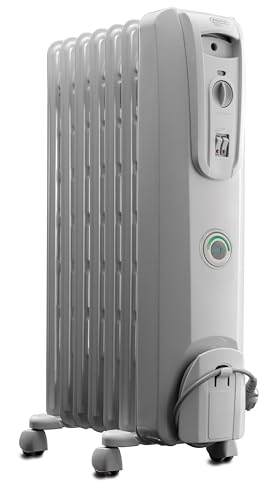
The oil radiator is the quiet-room answer. The EW7707CM heats a sealed column of oil, which then radiates warmth into the room with no fan, no airflow noise and no glowing element — the right profile for a bedroom, a nursery-adjacent space or a media room where fan hum competes with dialogue. Three power levels and an adjustable thermostat let it idle at low wattage once the room is warm, and the anti-freeze setting guards a cold spare room or cabin. The trade-offs are real: it is the slowest pick here to take the chill off a cold room, the heaviest to move despite its caster wheels, and the fins stay hot to the touch longer than a fan heater’s casing. What it returns is silence and the steadiest heat of the five.
Specs
- Heat output: 1,500 W maximum across three power levels
- Heating method: sealed oil-filled radiator, fanless
- Form factor: floor radiator on caster wheels
- Controls: adjustable thermostat, ComfortTemp setting, anti-freeze setting
- Safety: thermal cut-off, fully sealed oil system (never needs refilling)
See the De’Longhi EW7707CM on Amazon
5. Dyson Hot+Cool AM09 Jet Focus

The AM09 is the premium outlier: a bladeless tower that heats in winter and works as a cooling fan in summer, so it earns its floor space all year. Jet Focus control switches between a focused jet for one seat and a diffused mode for wider coverage, and the thermostat monitors the room and pauses heating at the target rather than overshooting. There are no fast-spinning blades and no visible heating element, the unit oscillates, and a sleep timer plus a magnetized remote that stores on the machine keep the bedside routine simple. It draws the same 1,500-watt ceiling as everything else here, so the extra outlay buys control, quiet delivery and year-round use — not extra heat. Confirm the current listing before ordering, since this is a long-running model line.
Specs
- Heat output: 1,500 W maximum
- Heating method: ceramic plates with Air Multiplier airflow, bladeless
- Form factor: tower fan heater, heating and cooling modes
- Controls: remote control, thermostat, Jet Focus focused and diffused modes, sleep timer
- Oscillation: yes
- Safety: automatic shut-off if tipped over, no visible heating elements
See the Dyson Hot+Cool AM09 on Amazon
Comparison Table
| Model | Type | Max output | Thermostat | Timer | Best room fit |
|---|---|---|---|---|---|
| Lasko 751320 | Ceramic tower | 1,500 W | Adjustable | Yes | Media room sofa row |
| Dreo Atom One DR-HSH004-G | PTC ceramic compact | 1,500 W | Digital, 41–95 °F | 12-hour | Bedroom, desk |
| Vornado AVH2 | Vortex fan heater | 1,500 W | Auto climate control | 1–12-hour | Whole small room |
| De’Longhi EW7707CM | Oil-filled radiator | 1,500 W | Adjustable dial | No | Quiet bedroom |
| Dyson Hot+Cool AM09 | Bladeless fan heater | 1,500 W | Digital thermostat | Sleep timer | Year-round single seat |
FAQ
Why does every space heater top out at 1,500 watts?
Because that is what a standard 120-volt household circuit can deliver continuously with a safety margin. Heater makers build to the outlet, not to the room, so a compact cube and a tall tower share the same ceiling. Differences in warmth come from how the heat is delivered and how well the room holds it, not from one unit secretly producing more energy than another.
Can a space heater warm a whole open-plan area on its own?
Realistically, no. A single 1,500-watt heater raises the temperature of one closed, average-sized room or one seating zone in a larger space. In an open-plan area it takes the edge off near where people sit, which is often the actual goal during a film or a workday, but it will not bring a large combined space to a uniform temperature.
Is it safe to leave a space heater running overnight?
Only with the full safety set — tip-over switch, overheat protection and a thermostat — and only with three feet of clearance from bedding and furniture, plugged straight into a wall outlet. The oil-filled radiator is the calmest overnight choice because it has no fan and no exposed element. Any heater that has been damaged, has a frayed cord, or trips its own protection repeatedly should be retired, not nursed along.
Can a space heater run on an extension cord or a power strip?
No. A heater pulls near-maximum current for hours, and cords and strips rated for lamps and chargers overheat under that load. This is one of the most common ways heaters cause fires. Plug directly into a wall outlet; if the outlet is in the wrong place, move the heater or have an outlet added — never bridge the gap with a cord.
Conclusion
Buy the delivery method first and the brand second. A ceramic tower like the Lasko 751320 covers a sofa row, the Dreo Atom One holds a bedroom temperature quietly and precisely, the Vornado AVH2 evens out a whole small room, the De’Longhi EW7707CM trades speed for complete silence, and the Dyson AM09 justifies itself only if the cooling mode will also be used all summer. Whichever one lands in the cart, the rules do not change: wall outlet only, three feet of clearance, and working tip-over and overheat protection — because with a product class capped at the same 1,500 watts, safety hardware and honest expectations are the whole purchase.
More from Amazon
Programs that pair well with the guide above. Offers and eligibility are set by Amazon and may change.
Free shipping on eligible items, Prime Video and more. Eligible new members can start with a free trial.
Start a Prime free trialAd-free music streaming. Eligible new subscribers can start with a free trial.
Try Music Unlimited freeA Prime membership for ages 18-24 with a trial period. Eligibility is set by Amazon.
See Prime for Young AdultsAudiobooks and podcasts to listen to on the go. Eligible new members can start with a free trial.
Try Audible freeAs an Amazon Associate we earn from qualifying purchases.