Key takeaways
- For outdoor use: at least 300 nits of brightness, a matte or low-glare screen, a 12V input, and a stand that resists tipping.
- For travel: under 5 pounds, a fold-flat stand, a protective sleeve, HDMI input, and charging from USB-C or a vehicle adapter.
- For family viewing: 14–24 inches, stereo speakers, a headphone jack or Bluetooth audio, and a viewing angle that does not heavily distort colors.
- For broadcasts: a current digital tuner appropriate to your region. In the United States, confirm support for ATSC 1.0; newer ATSC 3.0 reception is useful only where compatible broadcasts and equipment are available.
- For frequent charging: a battery indicator with a percentage rather than only three or four bars, since low-battery estimates can otherwise be difficult to interpret.
The best portable TVs for 2026 are compact battery-powered televisions with a built-in digital tuner, a stable stand, and enough battery capacity for your intended viewing time; choose an antenna model for off-grid use, a Wi-Fi model for streaming, or a hybrid if you travel between campsites, hotels, and rooms at home.
Our top picks
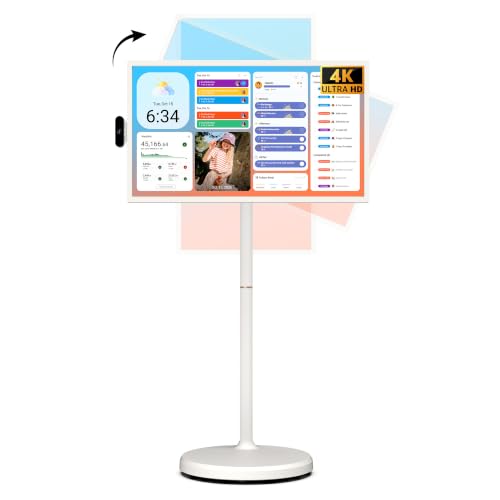


As an Amazon Associate we earn from qualifying purchases at no extra cost to you. Ratings are shown as listed on Amazon.
Best portable TVs by situation
| Situation | Best TV type | Useful target specifications | Why it fits |
|---|---|---|---|
| Camping without reliable internet | Battery TV with ATSC tuner | 9–14 inches, 4–8 hours of battery life, telescoping antenna, 12V input | Receives local broadcast channels without Wi-Fi or cellular data |
| Hotel or room-to-room streaming | Portable smart display or small TV with HDMI | 14–24 inches, Wi-Fi, HDMI, 5–9 lb | Provides a larger picture and works with a streaming stick or laptop |
| Tailgating, workshops, and short sessions | Compact rechargeable TV | 7–10 inches, 3–5 hours of battery life, under 3 lb | Easy to carry and adequate for news, sports, or background viewing |
| Emergency backup viewing | Digital TV with antenna and USB charging | 9–14 inches, USB-C or 12V charging, replaceable or power-bank-compatible battery | Can operate when home internet and mains power are unavailable |
| Frequent use in a kitchen or bedroom | Small mains-powered smart TV | 24–32 inches, 8–12 lb, wall-mount or tabletop stand | A larger screen usually gives better value when portability is occasional |
What makes a portable TV worth buying?
Battery life is more complicated than the advertised number
Manufacturers usually quote battery life at moderate brightness and lower speaker volume. Streaming over Wi-Fi, using maximum brightness outdoors, or connecting Bluetooth headphones can reduce runtime. A TV advertised for six hours may provide roughly four to five hours in bright outdoor conditions.
For camping, look for a model that accepts 12V DC power or USB-C input in addition to its internal battery. A 20,000 mAh power bank can often add useful runtime, but the result depends on voltage conversion and the TV’s power draw. As a practical estimate, a 20,000 mAh power bank contains about 74 watt-hours before conversion losses. If a television consumes 12 watts, allowing 15% loss gives approximately:
74 Wh × 0.85 ÷ 12 W = about 5.2 additional hours.
That is an estimate, not a guarantee. Some televisions do not accept power while operating, and some USB-C ports are for charging only.
Screen size affects portability quickly
A 7- to 10-inch screen is convenient for one viewer sitting nearby, but subtitles and sports scores can be difficult to read from several feet away. A 12- to 14-inch screen is a useful compromise for a picnic table, bedside table, or camper van. Screens from 19 to 24 inches are much more comfortable for two people, but they tend to weigh more, use more power, and need a larger protective case.
For room-to-room viewing, measure the storage space rather than just the diagonal screen size. A 14-inch television may be approximately 13 inches wide, while a 24-inch model can exceed 21 inches wide after accounting for its frame and feet.
Built-in stands are a major quality-of-life feature
The best portable TVs use a hinged rear kickstand or a wide, removable base. A narrow fold-out leg can work on a level desk but may tip on grass, a mattress, or an uneven counter. Check whether the stand supports both portrait and landscape placement, whether it locks when folded, and whether its hinge feels tight enough to hold the screen at different angles.
A VESA mounting pattern is useful in an RV or kitchen, but it does not replace a stable tabletop stand. If the TV will travel in a backpack, a protected fold-flat stand is preferable to a permanently protruding base.
Head-to-head: antenna TV versus streaming TV
Battery-powered antenna TVs
These include a built-in over-the-air tuner and usually ship with a small telescoping, magnetic, or flat antenna. They are the strongest choice for campsites, power outages, and locations with weak cellular service. They may also include USB media playback, HDMI input, composite video, and a 12V car adapter.
The limitation is reception. An indoor antenna may receive several channels in one town and none in another, especially in valleys, dense forests, or behind large buildings. Before a trip, check local broadcast coverage and scan for channels at the actual viewing location. Channel lists cannot be assumed to travel with the television.
Wi-Fi portable TVs and smart displays
Wi-Fi models are better for services such as Netflix, YouTube, or live-TV apps, provided the software supports the service and the location has usable internet. A phone hotspot can work, but high-definition video may use roughly 1.5 to 3 GB of data per hour depending on the service and video quality.
Many small “smart” televisions have slower processors, limited app stores, or older operating systems. HDMI input is therefore more important than the word “smart.” It lets you connect a current streaming device, laptop, game console, or phone adapter when the built-in software becomes outdated.
Hybrid models
A hybrid portable TV with both an antenna tuner and HDMI or Wi-Fi offers the most flexibility. It is usually the best overall choice for travelers who alternate between free local broadcasts and hotel or campsite internet. Make sure the TV can continue playing from its battery while connected to an external HDMI device; some models cannot supply enough power to run both efficiently.
Recommended portable-TV specifications
- For outdoor use: at least 300 nits of brightness, a matte or low-glare screen, a 12V input, and a stand that resists tipping.
- For travel: under 5 pounds, a fold-flat stand, a protective sleeve, HDMI input, and charging from USB-C or a vehicle adapter.
- For family viewing: 14–24 inches, stereo speakers, a headphone jack or Bluetooth audio, and a viewing angle that does not heavily distort colors.
- For broadcasts: a current digital tuner appropriate to your region. In the United States, confirm support for ATSC 1.0; newer ATSC 3.0 reception is useful only where compatible broadcasts and equipment are available.
- For frequent charging: a battery indicator with a percentage rather than only three or four bars, since low-battery estimates can otherwise be difficult to interpret.
Ownership realities: what wears out first
The battery is normally the first part to lose performance. Lithium-ion batteries gradually hold less charge, especially when stored fully charged in a hot car. For seasonal use, store the TV around half charged, keep it cool, and recharge it every few months. Do not leave it in direct sun or inside a sealed vehicle.
Small antennas are also easy to damage. Avoid carrying the television by its extended antenna, and replace a bent telescoping antenna rather than forcing it back into the housing. Keep the screen clean with a dry microfiber cloth or a cloth slightly dampened with water; household glass cleaner can damage coatings around the display.
Common mistakes include buying a Wi-Fi-only television for remote camping, assuming an antenna will work indoors everywhere, and choosing a screen that is too large for the available battery. Also check the supplied charger. A vehicle adapter may be included, while a suitable wall charger may not be.
How to choose in five steps
- Define the signal source. Choose an antenna first if internet access is uncertain. Choose Wi-Fi or HDMI first if your viewing comes from streaming services.
- Measure the viewing distance. If viewers will sit more than six feet away, favor at least 14 inches; for shared viewing, consider 19 inches or larger.
- Calculate the session length. Select a quoted battery life at least 25% longer than your typical session to allow for brightness, signal, and battery-age variation.
- Check the support and connections. A broad stand, HDMI, headphone output, and 12V or USB-C charging often matter more than a thin cabinet.
- Plan protection and storage. Include the antenna, remote, charger, and stand when measuring the travel case.
Are portable TVs better than a tablet?
A tablet is usually lighter and better for app-based streaming, while a portable TV is more convenient for free broadcast channels, physical inputs, and simple remote-controlled viewing. A tablet may also require a separate antenna tuner or internet connection. For camping and emergency use, a dedicated battery TV has fewer dependencies; for frequent hotel streaming, a tablet or small smart display may offer better software and battery efficiency.
Bottom line
For most travelers, the best portable TVs are 12- to 14-inch hybrid models with four to eight hours of realistic battery life, an ATSC tuner, HDMI input, USB-C or 12V charging, and a sturdy fold-out stand. Choose a smaller 7- to 10-inch antenna model when weight and emergency readiness matter most. Choose a 19- to 24-inch Wi-Fi or HDMI model when the TV will spend most of its time moving between rooms rather than traveling outdoors.