Key takeaways
- Protect and organize 7-inch singles with the best 45 RPM outer sleeves, inner sleeves and divider picks, sized for singles and nothing else at all.
A 45 lives a harder life than an LP. Most singles were sold in thin company sleeves — branded paper wrappers that were packaging, not protection — and decades later those wrappers are torn, split and shedding dust onto the vinyl they were meant to cover. An album arrives wearing a stiff jacket; a single arrives wearing a paper bag. That gap is what this guide fills: outer sleeves that act as the jacket the record never had, inner sleeves that guard the grooves, and dividers that keep a crate of singles findable.
Everything here is sized for 7-inch records only; 12-inch sleeves and dividers are a different shelf problem, covered in their own guides on this site, as are 45 adapters and storage boxes. The five picks below are sleeves, in both layers, while the divider guidance in How to Choose reflects the singles market as it is: sleeves are where makers compete, and dividers reward a clear head more than a long shortlist. Every dimension and material claim quoted is a maker figure.
Disclosure: As an Amazon Associate, I earn from qualifying purchases.
How to Choose 45 RPM Sleeves and Dividers
Two layers, two different jobs. An inner sleeve is the only thing that touches the playing surface, so its job is to be smooth, low in static and free of the grit that plain paper sheds. An outer sleeve never touches the grooves; its job is to take the shelf wear, finger grease and scuffs that would otherwise land on the company sleeve or picture sleeve underneath. Buying one layer and skipping the other leaves half the problem unsolved: a dirty paper inner grinds its own dust into the grooves at every slide, however good the outer sleeve is.
The company sleeve is not a jacket. Most 45s live in thin company sleeves that offer almost no protection: no stiffness, no sealed edge, no resistance to ring wear or corner knocks. An outer sleeve supplies all of that at once — it is the jacket the record never had. Keep the company sleeve for its label art and period charm, but file it inside an outer sleeve rather than asking it to do a structural job.
Picture sleeves get their own rule: sleeve the picture sleeve, never replace it. A picture sleeve is collectible and fragile, and much of its value sits in the printed card. Slip the record, in a fresh inner sleeve, behind the picture sleeve, then slide the whole package into an outer sleeve. The card stays visible and untouched by shelf friction, the record stays playable without handling the card, and nothing original is thrown away.
Materials decide how a sleeve ages. Outer sleeves are usually polypropylene or polyethylene: polypropylene runs clearer and stiffer, polyethylene softer and prone to hazing with age. Gauge matters too — a 2 mil outer flexes more and suits bulk filing, while a 3 mil outer holds a squarer shape in the crate and shrugs off corner knocks better. For inners, plain paper is the thing being replaced, not a candidate. The two constructions worth having are a rice paper layer sandwiched with polyethylene, pairing a soft contact face with a stable backing, and a triple-layer HDPE build, which leans on smoothness and anti-static behaviour. Anti-static claims are maker claims; treat them as design intent, not a measured promise.
Fit is a measurement, not a guess. A 7-inch sleeve should measure roughly 7.4 inches across the sheet. Too tight, and it curls the wrapper inside it and fights you at every filing; too loose, and the record slides until a corner finds the seam. Check the maker’s sheet dimensions against a record in its company sleeve before ordering in bulk; picture sleeve packages run thicker and want the roomier end of the range.
The center hole is a separate question. Singles come with two hole sizes — the large jukebox hole, near 1.5 inches across, and the small spindle hole on many non-US pressings — and sleeves fit both. No sleeve fixes a mismatch at the turntable: adapters and sleeve fit are separate questions, and adapters have their own guide on this site.
Dividers only help inside a system the owner actually maintains. A divider tab is a promise about how the collection is filed — by artist, by genre, by label — and it pays off only if records go back where the system says they belong, so buy dividers after choosing the system, not before. Look for a tab standing about half an inch proud of a sleeved record, stock stiff enough to stay upright in a half-full crate — heavy card around 30 mil, or polypropylene sheet — and tabs you can label yourself. Count sections, not records: a few hundred singles filed by artist may need only twenty dividers.
The 5 Best 45 RPM Sleeves and Dividers
1. BCW 45 RPM Record Sleeves — the bulk outer for a whole crate

BCW is the filing-supply name record shops buy by the case, and this is its standard 7-inch outer: a 2 mil polypropylene sleeve sold in hundreds. The sheet measures 7.37 by 7.6 inches on the maker’s figures, the extra length folding the opening closed against dust. At 2 mil it is the flexible option here, made for working through a large, ordinary collection where every single needs a jacket. It will not hold a crate corner as squarely as the 3 mil pick below, nor suit picture sleeves handled like prints. For the hundreds of company-sleeved singles in a typical inherited crate, it is the sensible default.
Specs
- Maker: BCW
- Type: outer sleeve
- Material: polypropylene, 2 mil (maker figure)
- Sheet size: 7.37 x 7.6 in (maker figure)
- Count: 100
- Model: 1-RSLV-45
- See it on Amazon
2. BIG FUDGE 7-Inch Outer Sleeves — the thicker, clearer jacket

Big Fudge builds its outer sleeve from 3 mil high-density polypropylene, half again as thick as the BCW sheet, and the difference is structural: the sleeve holds a square profile, resists corner dents, and reads clearer over picture sleeve art. The maker’s sheet size is 7.42 by 7.42 inches, a squarer cut suiting a record already in its company sleeve. This is the pick for the part of the collection that gets handled — the picture sleeves, the label variants, the singles you pull out to show people. Two picks here share this maker, one for each layer, because the 7-inch sleeve market is narrow. For bulk filing the thinner BCW above moves faster; for keepers, this is the jacket.
Specs
- Maker: BIG FUDGE
- Type: outer sleeve
- Material: high-density polypropylene, 3 mil (maker figure)
- Sheet size: 7.42 x 7.42 in (maker figure)
- Count: 50
- Model: BFOS
- See it on Amazon
3. Vinyl Styl 45 RPM Outer Sleeves — the record-store staple

Vinyl Styl sells into record shops, and its 45 outer sleeve is the plain, clear polypropylene wrapper that stores reach for at the counter. The pack holds 50, the model is VSP008, and the pitch is transparency: high-clarity film that lets a company sleeve’s label art read straight through, so a filed crate still shows you what it holds. The maker does not headline a gauge figure, so treat it as a midweight everyday outer rather than a rigid one, and pair it with a good inner. It is the middle path of the three outers here: clearer presentation than the bulk BCW, less armour than the Big Fudge.
Specs
- Maker: Vinyl Styl
- Type: outer sleeve
- Material: high-clarity polypropylene
- Count: 50
- Model: VSP008
- UPC: 711574724215
- See it on Amazon
4. BIG FUDGE Premium Inner Sleeves for 7-Inch — the rice paper layer

The inner sleeve is where protection is won or lost, and this one follows the construction that archival LP inners made standard: a rice paper layer held between polyethylene, so the face against the vinyl is soft and low-shedding while the backing keeps the sleeve from collapsing as it slides. The maker’s sheet size is 7.68 by 7.68 inches, generously cut, seating a record without a wrestle and sitting flat inside any of the outers above. The count is 25, pitched at the records that matter rather than the whole crate. Replacing a torn paper inner with this is the highest-value step in this guide: it removes the grit source that touches the grooves without changing how the single looks on the shelf.
Specs
- Maker: BIG FUDGE
- Type: inner sleeve
- Construction: rice paper with polyethylene layers (maker description)
- Sheet size: 7.68 x 7.68 in (maker figure)
- Count: 25
- Model: BFPIS7x25
- See it on Amazon
5. Spincare Audiophile Inner Sleeves for 7-Inch — the triple-layer HDPE option
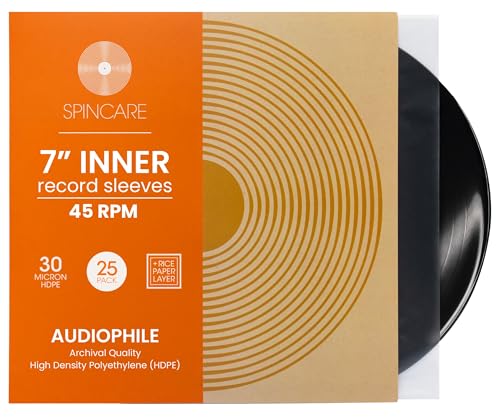
Spincare takes the other route to the same job: no paper at all, but three layers of HDPE film, built to be anti-static and smooth on both faces. The maker’s model name for the line is AUDIOPHILE-INNER-7-25, and the pack holds 25 sleeves. An all-film inner slides in and out with very little drag, which matters for singles played often: every extraction from a high-friction paper inner is a small scuffing event. Choose against the rice paper pick by habit: it feels more archival and handles stiffly, while this film is the lower-friction, wipe-clean option. Either replaces the original paper inner, which is the step that counts.
Specs
- Maker: Spincare
- Type: inner sleeve
- Construction: triple-layer HDPE, anti-static (maker claim)
- Count: 25
- Model: AUDIOPHILE-INNER-7-25
- See it on Amazon
Comparison Table
| Product | Layer | Material or construction | Count | Best for |
|---|---|---|---|---|
| BCW 45 RPM Record Sleeves | Outer | Polypropylene, 2 mil | 100 | Jacketing a whole crate at once |
| BIG FUDGE 7-Inch Outer Sleeves | Outer | High-density polypropylene, 3 mil | 50 | Picture sleeves and keepers |
| Vinyl Styl 45 RPM Outer Sleeves | Outer | High-clarity polypropylene | 50 | Clear view of company sleeve art |
| BIG FUDGE Premium Inner Sleeves | Inner | Rice paper with polyethylene | 25 | Replacing worn paper inners |
| Spincare Audiophile Inner Sleeves | Inner | Triple-layer HDPE | 25 | Low-friction filing for played singles |
FAQ
Do 45s really need outer sleeves if they already have company sleeves?
Yes, because a company sleeve is printed packaging rather than protection. It has no stiffness, no sealed edge and no resistance to the knocks and shelf friction that split seams and wear corners. An outer sleeve adds the missing structure while keeping the company sleeve visible and intact inside it. The pairing that works: company sleeve for the art, outer sleeve for the armour, fresh inner sleeve against the grooves.
How should I store a single that comes in a picture sleeve?
Sleeve the picture sleeve; never replace it. Put the record, in a new inner sleeve, behind the picture sleeve, and slide both into an outer sleeve. The printed card stays at the front, readable and untouched by shelf wear, while the record can be lifted out for play without flexing or handling the card. The card is the fragile, collectible part of the package, so the system asks no work of it.
Will these sleeves fit singles with the large jukebox center hole?
Yes. Sleeves are sized to the outside of the record, and a 7-inch disc measures the same across whether its center hole is the large jukebox opening or the small spindle hole. Hole size only matters at the turntable, where a large-hole single needs an adapter or a spindle insert to sit centred. That is a separate purchase entirely, with its own guide on this site.
How many dividers does a singles collection actually need?
Fewer than the pack sizes suggest, and only inside a filing system you will genuinely maintain. Count the sections you actually file by — letters, genres or labels — and buy one divider per section, plus a couple of spares. A few hundred singles filed by artist might need twenty dividers; filed loosely by genre, perhaps eight. Settle the system first and let it set the count.
Conclusion
Protecting a 45 collection is a layering exercise. Start with the inner sleeve: the Big Fudge rice paper build for an archival feel, or the Spincare triple-layer film for low-friction everyday play. Add the outer sleeve as the jacket the record never had: BCW in hundreds for a whole crate, Big Fudge in 3 mil for the keepers and picture sleeves, Vinyl Styl when clarity matters most. Then, and only then, divide the crate by a system you will actually keep. Together they turn a box of fragile paper-wrapped singles into a collection that can be handled, filed and played without wearing itself out.
More from Amazon
Programs that pair well with the guide above. Offers and eligibility are set by Amazon and may change.
Free shipping on eligible items, Prime Video and more. Eligible new members can start with a free trial.
Start a Prime free trialAd-free music streaming. Eligible new subscribers can start with a free trial.
Try Music Unlimited freeA Prime membership for ages 18-24 with a trial period. Eligibility is set by Amazon.
See Prime for Young AdultsAudiobooks and podcasts to listen to on the go. Eligible new members can start with a free trial.
Try Audible freeAs an Amazon Associate we earn from qualifying purchases.