Our Short List of 3
- https://www.amazon.com/dp/B0BCWNQPQ7
All 3 Picks at a Glance
| Product | Specs | Action |
|---|---|---|
| NEBULA Capsule 3 Laser by Anker |
| Check price on Amazon |
 XGIMI Halo+ (New) |
| Check price on Amazon |
 ViewSonic M1X |
| Check price on Amazon |
Our Top Picks
A lightweight projector earns its place in a bag only when the low weight does not force too many compromises elsewhere. The models in this guide all weigh under four pounds, and most weigh closer to two, yet they still manage native 1080p pictures on three of the four picks, built-in streaming on three of them, and batteries on three of them as well. That combination is what separates a genuinely useful travel projector from a novelty gadget: you can carry it in one hand, set it on a hotel nightstand or a camping table, and watch a film without hunting for a spare shelf, a long cable run, or a separate speaker.
As an Amazon Associate we earn from qualifying purchases.
Weight alone, though, is a poor way to shop. A projector that weighs two pounds but produces a dim picture will disappoint in any room that is not fully dark, while a slightly heavier model with two or three times the brightness can handle a shaded living room in the late afternoon. Battery life matters in the same way: a built-in battery only helps if it lasts through a full film, and a model with no battery at all can still travel well if it runs from a USB-C power bank you already own. This guide works through those trade-offs pick by pick, using the specifications each manufacturer publishes, so you can match the machine to the way you actually watch.
What “lightweight” should mean in a projector
For this guide, lightweight means a projector you can lift with one hand without thinking about it, which in practice puts the ceiling at about four pounds. Below that line, the differences still matter. A model near two pounds disappears into a carry-on or a daypack and adds less weight than a hardback book. A model near three and a half pounds is still easy to move from room to room, but you will notice it in a shoulder bag on a long walk, and it usually buys that extra heft with a brighter lamp and bigger speakers.
It also helps to think about what the weight is made of. In a portable projector, the battery is often the single heaviest component, followed by the speaker enclosure and the cooling system the light engine needs. A laser or LED light source keeps both heat and size down compared with a traditional lamp, which is why every pick here uses a solid-state light source. None of these machines needs a lamp replacement during normal ownership, and none of them needs a warm-up or cool-down ritual before you can pack it away.
The other half of the equation is the stand. A light projector with a fixed, flat base still needs a stack of books or a tripod to aim at a wall, which quietly adds back the weight you saved. The better designs build the adjustment into the body: a rotating cradle, a fold-out smart stand, or a gimbal-style base that lets the lens tilt up toward a ceiling. Every pick below has some form of built-in aiming, plus automatic keystone correction and autofocus, so setup is a matter of placing the unit down and letting it square the picture itself.
How to judge a lightweight projector before buying
Brightness decides where you can watch. Portable projectors are rated far below home theater models, and the numbers use different scales, so compare carefully. ANSI lumens and ISO lumens are measured standards; a figure around 200 to 300 ANSI lumens suits a dark bedroom or a night-time backyard at moderate screen sizes, while something near 700 ISO lumens gives you more freedom with screen size and a little more tolerance for ambient light. No projector in this weight class competes with daylight, so plan on curtains or evening viewing regardless of the model.
Resolution decides how close you can sit. Native 1920 x 1080 keeps text readable and film detail intact at screen sizes up to about 100 inches. The one standard-definition pick here trades that sharpness for the lowest weight and the longest battery life in the group, which is a fair trade for casual viewing but a poor one for presentations with small text or for anyone who sits close to the image.
Battery claims need context. Manufacturers quote playtime in an eco or standard mode, and brightness usually drops when the unit runs unplugged. A rating of two and a half hours covers most films; four hours covers a double feature or a long sports broadcast. If a model has no battery, check whether it accepts USB-C power delivery, because a laptop-class power bank then becomes its battery, at the cost of extra weight in the bag.
Sound is easy to overlook and hard to fix later. A single small speaker is fine for dialogue in a quiet room and thin everywhere else. Dual speakers, or a speaker tuned by a known audio brand, make a real difference outdoors where there are no walls to help the sound along. Bluetooth output to a separate speaker is the fallback, and all four picks here can hand audio off wirelessly or through a cable.
Smart platforms decide your app library. Google TV and Android TV bring the major streaming apps and voice search, and officially licensed Netflix support is worth checking by name, because not every Android-based projector includes it. Samsung’s Tizen platform on the Freestyle offers a similar app shelf plus a gaming hub for cloud play. If you mostly cast from a phone, confirm Chromecast or AirPlay support instead.
The picks
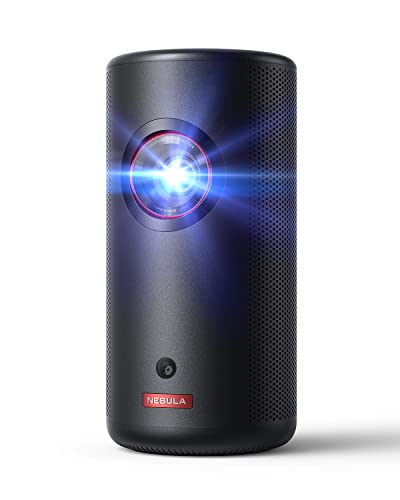
NEBULA Capsule 3 Laser by Anker
The Capsule 3 Laser is the most portable full-HD projector in this group, built into a cylinder about the size of a large drinks can. Anker lists it at just 2 pounds, and the laser light engine produces a native 1920 x 1080 picture rated at 300 ANSI lumens, with a maximum image size of 120 inches. The laser source is the point of this model: it gives the small body better brightness and contrast than the LED version of the Capsule 3, and it holds focus and color well at the modest screen sizes a projector this small is realistically asked to fill.
The built-in battery is rated for up to 2.5 hours of video playback, which covers a full film, and the unit supports USB-C PD charging, so a power bank can extend a session or top the battery up between uses. Google TV is built in with officially licensed Netflix, Google Assistant voice control, and Chromecast casting, so the projector works as a complete streaming box with nothing else attached. An 8-watt speaker with Dolby Digital support handles sound, and autofocus plus auto keystone correction run automatically when you set it down. For travelers, students in dorm rooms, and anyone who wants a projector that genuinely fits in a jacket-adjacent bag rather than a dedicated case, this is the easiest recommendation here.
XGIMI Halo+ (New)
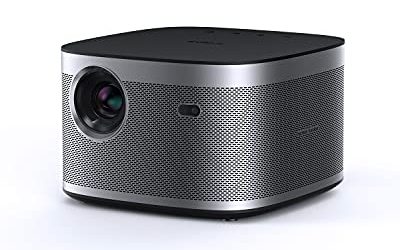
The Halo+ sits at the heavy end of this guide at about 3.5 pounds, and it spends that weight on brightness and sound. XGIMI rates the LED light engine at 700 ISO lumens with a native 1920 x 1080 picture, which is the strongest output in this group and the reason this model copes best with larger screens and rooms that are not perfectly dark. The current version runs Google TV with licensed Netflix, and XGIMI’s Intelligent Screen Adaption handles autofocus, auto keystone correction, obstacle avoidance, and screen alignment automatically when the unit is moved.
Battery life is rated at 2.5 hours of playtime from the built-in pack, and the dual 5-watt Harman Kardon speakers are the most capable audio hardware here, with enough body for a small group watching outdoors. At 3.5 pounds it is still a one-hand carry and fits in a backpack without drama, but it is the pick for people who move a projector between rooms, gardens, and campsites rather than the pick for ultralight travel. If your viewing is mostly after dark at moderate sizes, the Capsule above is smaller; if you want the picture to hold up at 100 inches or more, the Halo+ is the safer tool.
Samsung The Freestyle 2nd Gen
Samsung’s Freestyle takes a different approach to portability: instead of a battery, it is a small cylinder of about 1.8 pounds mounted in a cradle that rotates through 180 degrees, so the same unit can aim at a wall, tilt up to a ceiling, or sit anywhere in between without a tripod. The picture is native 1920 x 1080 with HDR support and an image range of 30 to 100 inches, and Samsung fits auto leveling, auto focus, and auto keystone correction so the image squares itself after each move.
The trade-off is power. There is no battery inside the Freestyle, so it runs from its USB-C power supply or from a USB-C PD power bank bought separately. In exchange, the body stays light and the platform is Samsung’s Tizen smart TV system, which includes the major streaming apps and the Samsung Gaming Hub for cloud gaming services, plus a 360-degree speaker design that spreads sound around the unit rather than firing it in one direction. Smart Calibration through a phone can tune the picture to the color of the wall in front of it. This is the pick for moving a picture around one home, ceiling projection over a bed, and anyone already comfortable with Samsung’s TV interface.
- https://www.amazon.com/dp/B0C87Q4R51
ViewSonic M1X
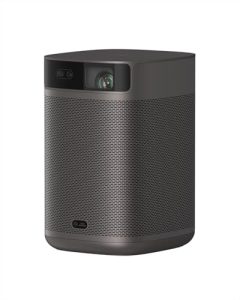
The M1X is the lightest projector in this guide at 1.7 pounds, and it makes its compromises openly: the native resolution is 854 x 480 rather than full HD. In return you get the longest battery life here, rated at up to four hours, and a patented 3-in-1 smart stand that rotates the projector through 360 degrees of projection angles while also serving as a lens cover and a carry-friendly base. ViewSonic rates the LED image at up to 100 inches, and the dual Harman Kardon speakers give it better sound than most projectors at this size, with Bluetooth on board so the unit doubles as a wireless speaker when the lens is closed.
Connectivity is generous for something this small, with HDMI, USB-C, USB-A, Wi-Fi screen mirroring, and Bluetooth audio. Horizontal and vertical keystone correction plus four-corner adjustment help when the projector sits at an angle to the wall. The resolution ceiling is real: small text softens, and fine film detail is not the point. But for camping trips, kids’ movie nights, casual backyard viewing, and presentations built around big slides rather than spreadsheets, the M1X trades pixels for the two things this category is actually about, which are weight and time away from a socket.
Side-by-side summary
The Capsule 3 Laser is the smallest route to a 1080p picture and the natural travel pick, with a real battery and a laser engine in a 2-pound can. The Halo+ is the brightness and sound leader at 3.5 pounds, better suited to bigger screens and semi-permanent spots around the home and garden. The Freestyle is the flexibility pick: the rotating cradle and ceiling projection are unique here, provided you accept a power cable or a power bank as part of the kit. The M1X is the ultralight, long-battery option whose standard-definition picture suits casual viewing rather than detail work.
Setup tips that matter more at this size
Small projectors are usually placed on whatever furniture is nearby, which means the lens rarely lines up with the screen. Lean on the automatic keystone and autofocus, but keep the angle modest: heavy digital keystone correction shrinks the usable image and softens the corners, so a small stack of books to raise the unit is still worth the effort. For ceiling projection, only the Freestyle’s cradle is designed for it out of the box; the others need a tripod mount or a shelf above the bed.
Battery models reward a little planning. Download films over Wi-Fi before a trip instead of streaming through a phone hotspot, keep the picture mode on its standard rather than brightest setting when unplugged, and remember that a USB-C power bank effectively doubles as a second battery for the Capsule 3 Laser and as the only battery for the Freestyle. Outdoors, a plain white sheet or a portable screen with some tension in it will look noticeably better than a wrinkled wall, and every model here benefits from the darkest spot you can give it.
Frequently asked questions
How bright does a lightweight projector need to be? For a dark room and a screen up to about 80 inches, 200 to 300 ANSI lumens is workable. For 100-inch images or rooms with some ambient light, look toward the 700 ISO lumen class represented by the Halo+. No model in this weight range handles direct daylight well.
Can a projector this small really fill a 100-inch screen? It can, and the Capsule 3 Laser is rated to 120 inches, but brightness per inch of screen falls as the image grows. In a properly dark room a 100-inch picture from any of the 1080p picks looks convincing; in a lit room, keep the image smaller.
Is 480p enough for the ViewSonic M1X? For animated films, casual sports, and big-text slides at a viewing distance, yes. For films you care about in detail, documents, or gaming, the 1080p models are worth the small weight increase.
Do these projectors work with phones? Yes. The Capsule 3 Laser and Halo+ include Chromecast through their Google TV and Android platforms, the Freestyle supports Samsung’s casting and SmartThings ecosystem, and the M1X offers Wi-Fi mirroring plus USB-C and HDMI inputs for a wired connection.
What about sound for a group outdoors? The Halo+ has the strongest built-in speakers here. For the other models, pairing a Bluetooth speaker or using the audio output for a wired one is the practical answer once more than a few people are watching.
The bottom line
Choose the NEBULA Capsule 3 Laser if the projector has to disappear into a bag and still show a sharp 1080p picture with its own battery and streaming built in. Choose the XGIMI Halo+ if you can carry an extra pound and a half in exchange for the brightest image and the best speakers in this class. Choose the Samsung Freestyle if the picture needs to move between wall and ceiling inside one home and you are happy powering it by cable or power bank. Choose the ViewSonic M1X if the lowest weight and the longest battery matter more than resolution. All four are honest versions of the same idea: a cinema that fits in one hand, with the differences lying in how each one spends its grams.
More from Amazon
Programs that pair well with the guide above. Offers and eligibility are set by Amazon and may change.
Free shipping on eligible items, Prime Video and more. Eligible new members can start with a free trial.
Start a Prime free trialAd-free music streaming. Eligible new subscribers can start with a free trial.
Try Music Unlimited freeA Prime membership for ages 18-24 with a trial period. Eligibility is set by Amazon.
See Prime for Young AdultsAudiobooks and podcasts to listen to on the go. Eligible new members can start with a free trial.
Try Audible freeAs an Amazon Associate we earn from qualifying purchases.